BioCentral IBBioCentral IB
IB Biology · Theme B · B4.2

Ecological niches

How each species makes its living: what it eats, how it gets energy and how it shares its habitat with others. SL and HL study the same content.
Guiding questions

What are the advantages of specialized modes of nutrition to living organisms?

How are the adaptations of a species related to its niche in an ecosystem?

Part one

Niches and oxygen

B4.2.1 – B4.2.2
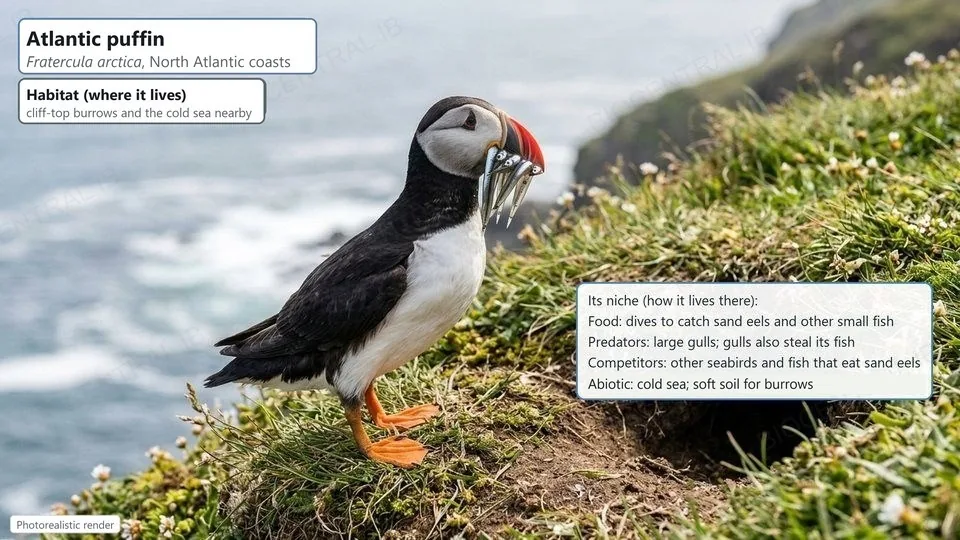
An Atlantic puffin on a cliff top beside its burrow with sand eels in its beak, labelled with its habitat (cliff-top burrows and the cold sea nearby) and its niche: food, dives to catch sand eels and small fish; predators, large gulls, which also steal its fish; competitors, other seabirds and fish that eat sand eels; abiotic, a cold sea and soft soil for burrows
B4.2.1

The niche of a species

An ecological niche is the role of a species in an ecosystem.
  • The niche includes the biotic and abiotic interactions that influence the growth, survival and reproduction of the species.
  • It includes how the species obtains food: the Atlantic puffin dives for sand eels and other small fish.
  • Biotic interactions also include its predators and competitors; abiotic ones include the cold sea and soft soil for its burrows.
CompareThe habitat is where a species lives (B4.1); the niche is how it lives there.
B4.2.2

Tolerance of oxygen

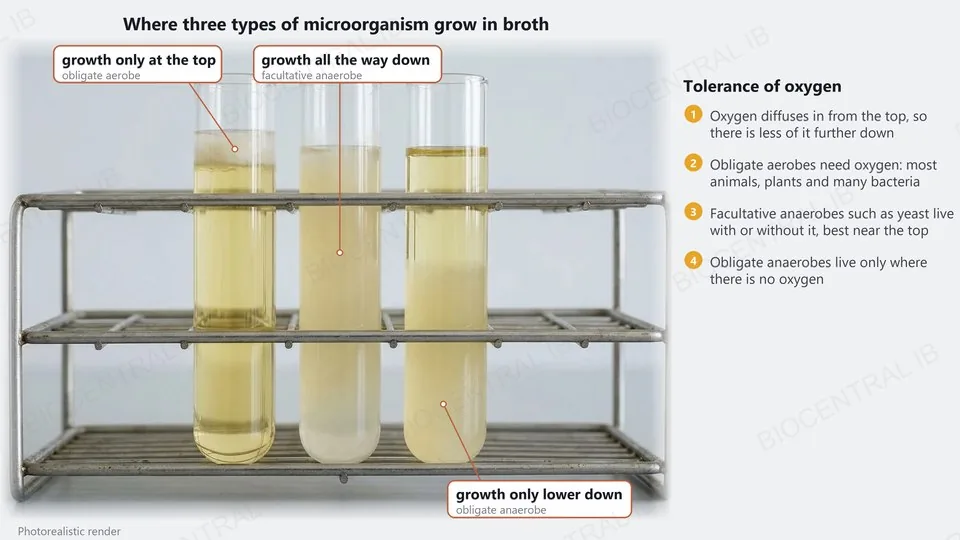
Organisms differ in whether they can live with or without oxygen gas in their environment.
  • Obligate aerobes need oxygen and cannot live without it: most animals and plants, and many bacteria.
  • Facultative anaerobes can live with or without oxygen, for example yeast: they use oxygen when it is present, because aerobic respiration yields more ATP.
  • Obligate anaerobes live only where there is no oxygen, for example in deep mud or the gut; oxygen is toxic to them.
Why it mattersOxygen is part of a niche: it decides where in a habitat each type can live.
A render of three tubes of broth in a rack. Left, growth only at the top: an obligate aerobe. Middle, growth all the way down: a facultative anaerobe. Right, growth only lower down: an obligate anaerobe. Oxygen diffuses in from the top
Part two

Modes of nutrition

B4.2.3 – B4.2.7
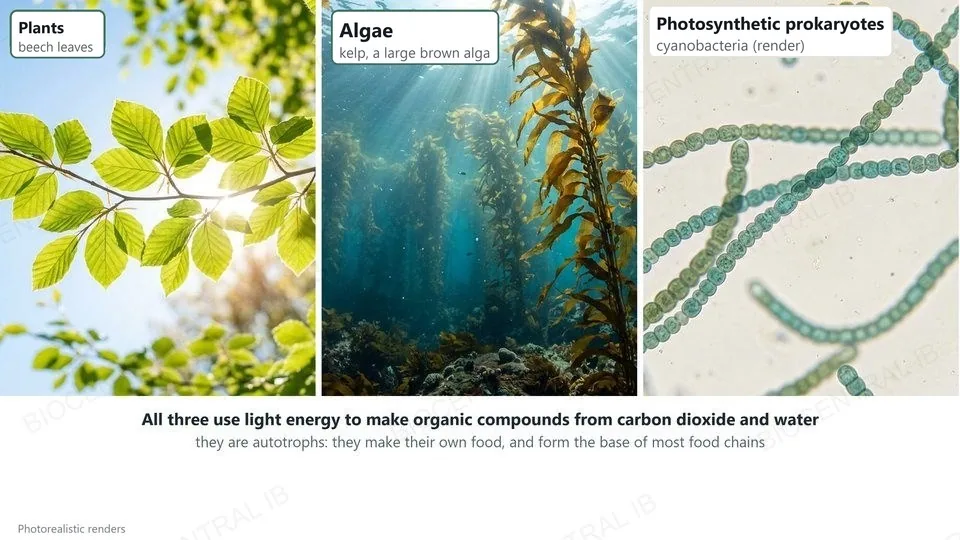
Three renders: beech leaves (plants), a kelp forest (algae) and chains of cyanobacteria (photosynthetic prokaryotes). All use light energy to make organic compounds from carbon dioxide and water
B4.2.3

Nutrition by photosynthesis

Photosynthesis is the mode of nutrition of plants, algae and several groups of photosynthetic prokaryotes.
  • These organisms are autotrophs: they use light energy to make their own organic compounds from carbon dioxide and water.
  • Photosynthetic prokaryotes include the cyanobacteria; the different types of prokaryote photosynthesis are not needed.
  • Because they make their own food, autotrophs can live wherever there is enough light, water, carbon dioxide and minerals.
Why it mattersPhotosynthesis supplies the carbon compounds and energy for almost every food chain.
B4.2.4

Holozoic nutrition in animals

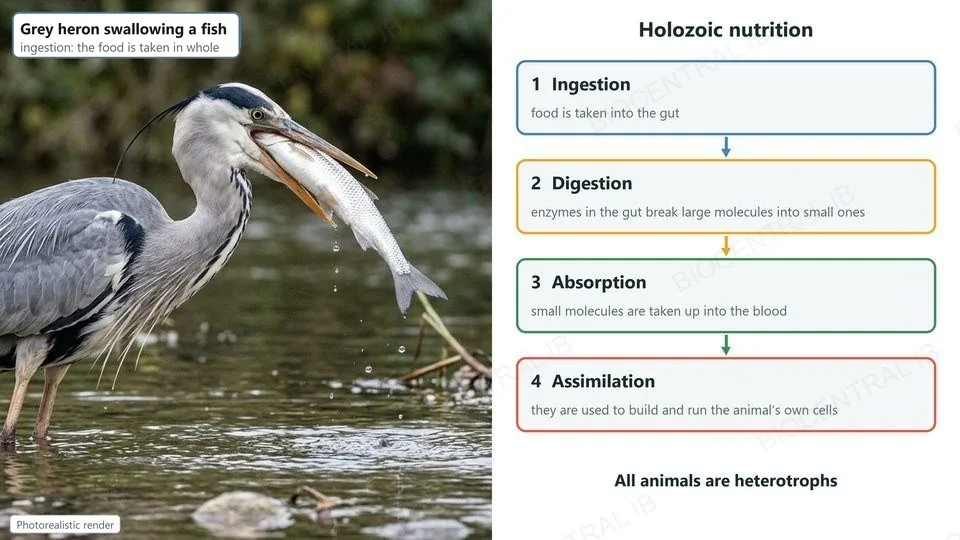
All animals are heterotrophic: they obtain carbon compounds from other organisms.
  • In holozoic nutrition food is ingested: taken into the gut, as when a heron swallows a fish.
  • It is then digested internally, by enzymes that break large molecules into small, soluble ones.
  • The small molecules are absorbed into the blood and assimilated: used to build and run the animal’s own cells.
LinkDigestion in the gut is an extracellular enzyme reaction (C1.1).
A grey heron swallowing a fish whole, beside four steps of holozoic nutrition: ingestion, food taken into the gut; digestion, enzymes break large molecules into small ones; absorption, small molecules taken up into the blood; assimilation, used to build and run the animal’s own cells
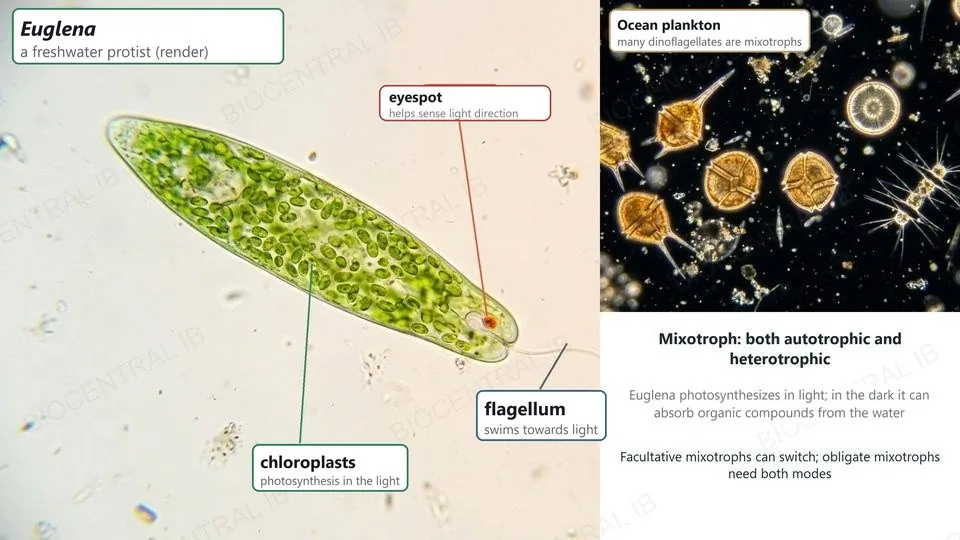
A render of a Euglena cell, labelled with its chloroplasts, red eyespot and flagellum, beside marine plankton including dinoflagellates, many of which are mixotrophs
B4.2.5

Mixotrophs: both modes

Some protists are mixotrophic: they are both autotrophic and heterotrophic.
  • Euglena, a well-known freshwater example, photosynthesizes in the light; in the dark it can absorb organic compounds from the water.
  • Many other mixotrophs are part of oceanic plankton, such as many dinoflagellates.
  • Some mixotrophs are facultative: they can live by either mode alone. Others are obligate: they need both modes to grow.
Why it mattersMixing modes helps where light or food is often in short supply.
B4.2.6

Saprotrophs: decomposers

Saprotrophic nutrition is a heterotrophic mode used by some fungi and bacteria.
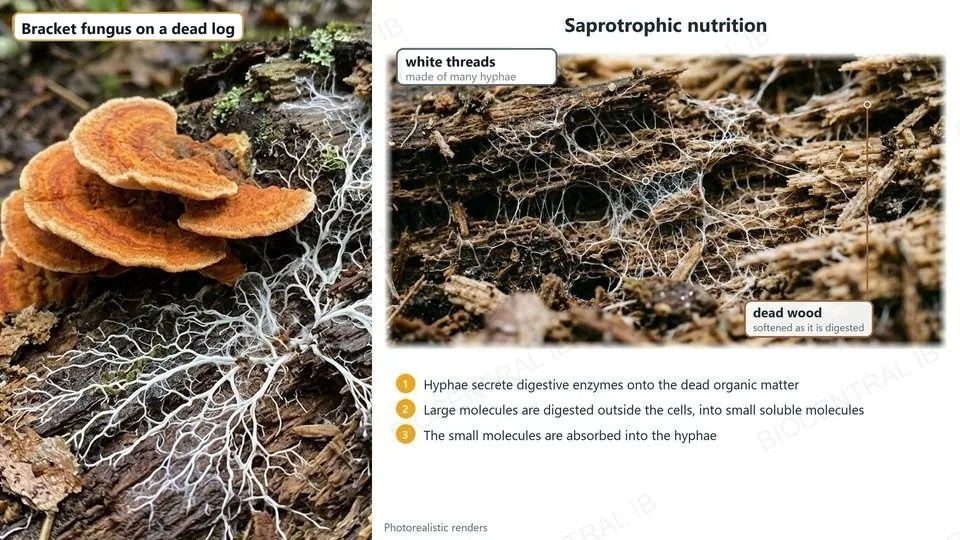
  • Saprotrophs secrete digestive enzymes onto dead organic matter, such as fallen wood, leaves and dead organisms.
  • The enzymes digest the matter outside the body (external digestion), and the small soluble products are then absorbed.
  • Fungi and bacteria that feed in this way are called decomposers.
Why it mattersDecomposers release mineral nutrients from dead matter, so other organisms can reuse them.
A bracket fungus on a dead log, beside a render of fine white threads of hyphae spreading through dead wood. Hyphae secrete digestive enzymes onto the dead matter, large molecules are digested outside the cells into small soluble molecules, and these are absorbed into the hyphae
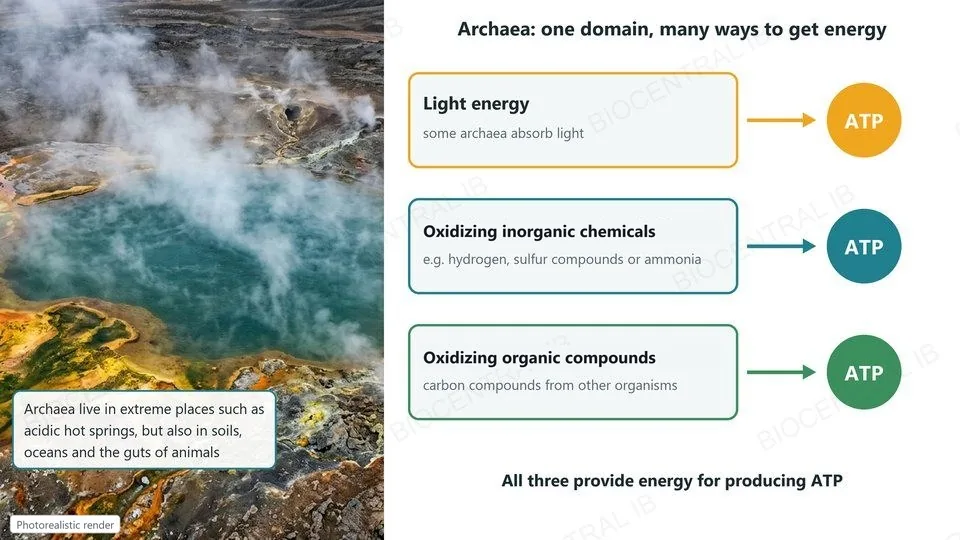
A steaming acidic hot spring with coloured microbial mats, beside three energy sources used by archaea, all leading to ATP: light energy, oxidising inorganic chemicals such as hydrogen, sulfur compounds or ammonia, and oxidising organic compounds
B4.2.7

The diversity of archaea

Archaea are one of the three domains of life, with bacteria and eukaryotes.
  • They are very varied in how they obtain energy for producing ATP.
  • Some use light energy, some oxidize inorganic chemicals and some oxidize organic compounds.
  • Many live in extreme places such as hot springs, but archaea are also common in soils, the oceans and the guts of animals.
RememberYou do not need named examples or the biochemistry: appreciate the variety.
Quick check

A protist grows in the light with no food, and in the dark if it is given prey to ingest. What is it?

an obligate mixotroph
a facultative mixotroph
an obligate autotroph
a saprotroph
Correct answer: a facultative mixotroph. It is mixotrophic because it can be autotrophic and heterotrophic, and facultative because it can grow by either mode alone. An obligate mixotroph would need both light and prey to grow.
Part three

Teeth, herbivores and predators

B4.2.8 – B4.2.10
B4.2.8 · Nature of science

Teeth and diet

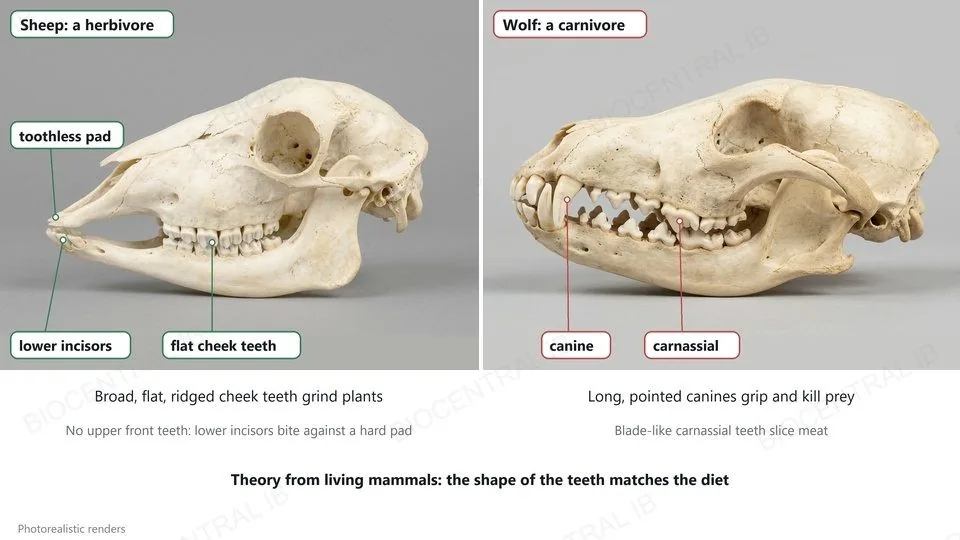
Observations of living mammals led to theories linking the shape of the teeth to the diet.
  • Herbivores such as sheep have broad, flat, ridged cheek teeth that grind tough plant material.
  • Carnivores such as wolves have long, pointed canines to grip and kill prey, and blade-like cheek teeth that slice meat.
  • Omnivores have a mixture: smaller canines and flatter cheek teeth than carnivores.
Nature of scienceDeductions can be made from theories: the theory lets us deduce the diets of extinct species.
A sheep skull with broad, flat, ridged cheek teeth and no upper front teeth, beside a wolf skull with long pointed canines and blade-like cheek teeth
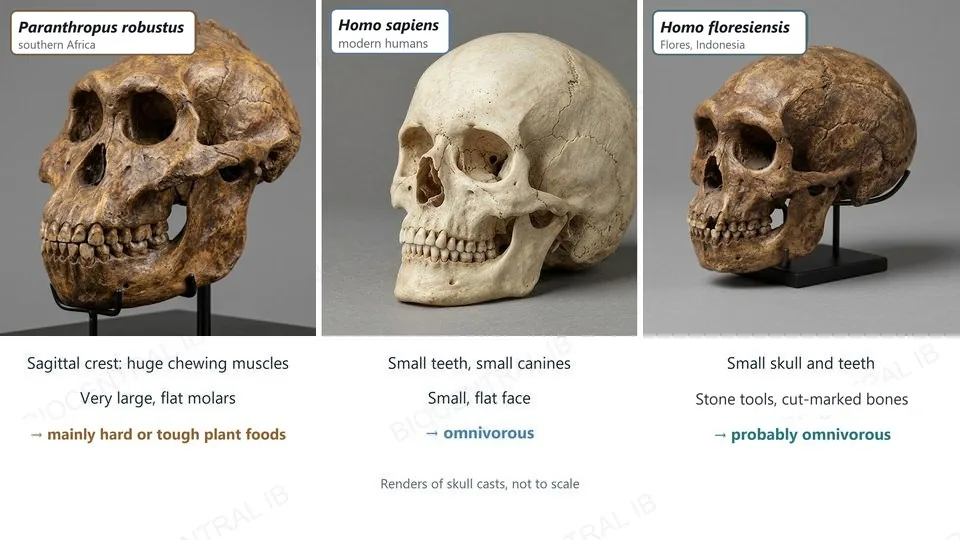
Renders of skull casts of Paranthropus robustus, with a sagittal crest and very large flat molars, Homo sapiens, with small teeth and canines, and the small skull of Homo floresiensis
B4.2.8 · Application of skills

What hominids ate

Skulls, casts and digital collections of hominids can be examined to infer diet from the teeth and jaws.
  • Paranthropus robustus had very large, flat molars and premolars, and a sagittal crest for huge chewing muscles: mainly a herbivore of hard or tough plant foods.
  • Homo sapiens has small teeth and small canines: an omnivore, with a varied diet.
  • Homo floresiensis, from the island of Flores, had a small skull and teeth; with stone tools and animal bones found nearby, it is thought to have been omnivorous.
SkillLook for tooth size and shape, and where the chewing muscles attached.
B4.2.9

Insects that eat plants

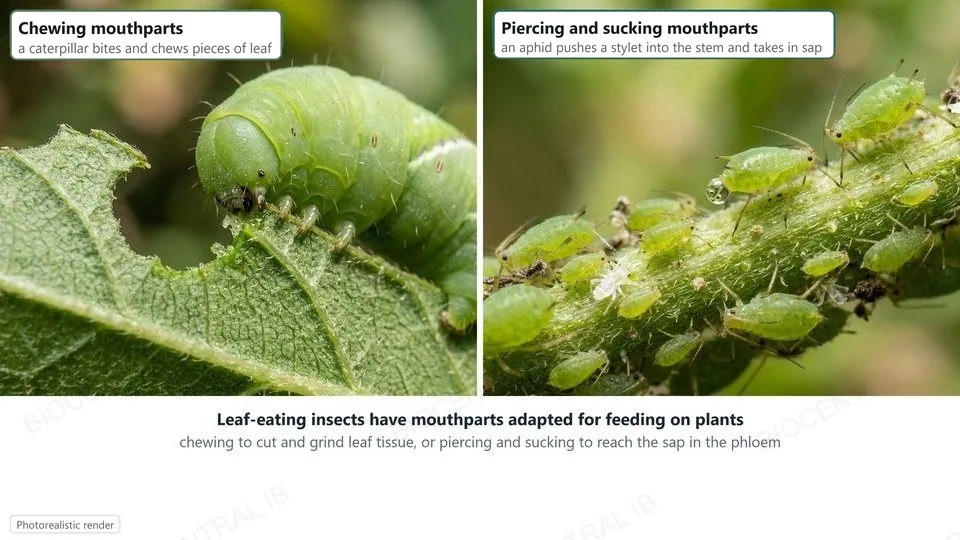
Herbivores have adaptations for feeding on plants, such as the mouthparts of leaf-eating insects.
  • Chewing mouthparts, as in caterpillars and locusts, have hard jaws that bite off and grind pieces of leaf.
  • Piercing and sucking mouthparts, as in aphids, form a fine tube (stylet) that pushes into the plant and reaches the phloem, where sap under pressure flows into it.
  • Each type lets the insect feed on a different part of the plant.
AdaptationThe mouthparts of an insect show how it obtains its food: part of its niche.
A caterpillar chewing a leaf edge, beside aphids on a stem with their piercing, sucking mouthparts in the plant
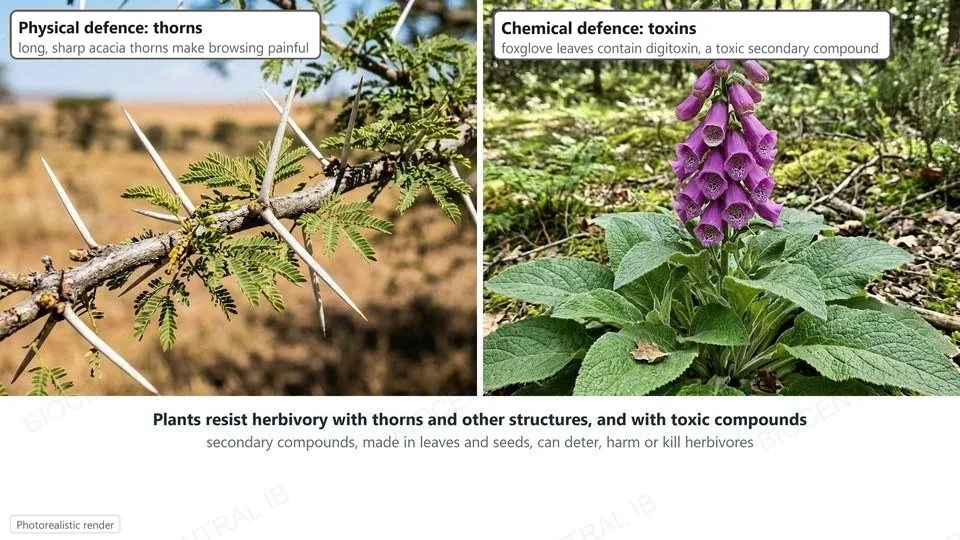
Long white acacia thorns, a physical defence, beside a foxglove, whose leaves contain the toxic secondary compound digitoxin
B4.2.9

Plants resist herbivores

Plants cannot run away, so they have adaptations that resist herbivory.
  • Physical defences include thorns, spines and stinging hairs, such as the long thorns of acacia trees.
  • Chemical defences are toxic secondary compounds made in seeds and leaves.
  • Foxglove leaves, for example, contain digitoxin, which is poisonous to the heart of animals that eat it.
Why it mattersEach defence narrows the range of animals that can feed on the plant.
B4.2.9

Herbivores that detoxify

Some animals have metabolic adaptations for detoxifying the toxins of plants.
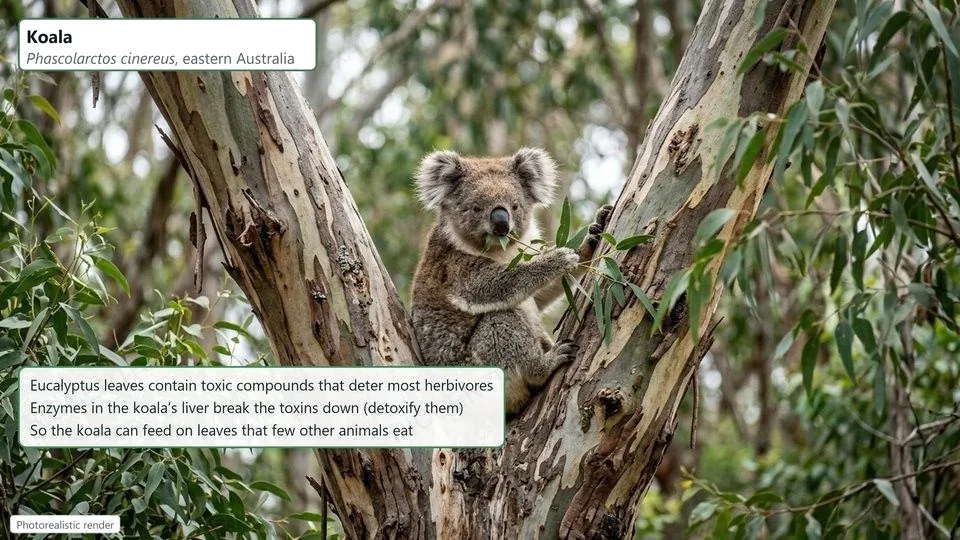
  • Eucalyptus leaves contain toxic compounds that deter most herbivores, and they give little energy.
  • Koalas feed almost entirely on them: enzymes in the liver break the toxins down to harmless products.
  • So the koala has a food supply with little competition, and a slow, energy-saving lifestyle suits the poor diet.
ComparePlant toxins and animal detoxification evolve in response to each other.
A koala in a eucalyptus tree eating the leaves, labelled: eucalyptus leaves contain toxic compounds; enzymes in the koala’s liver break the toxins down
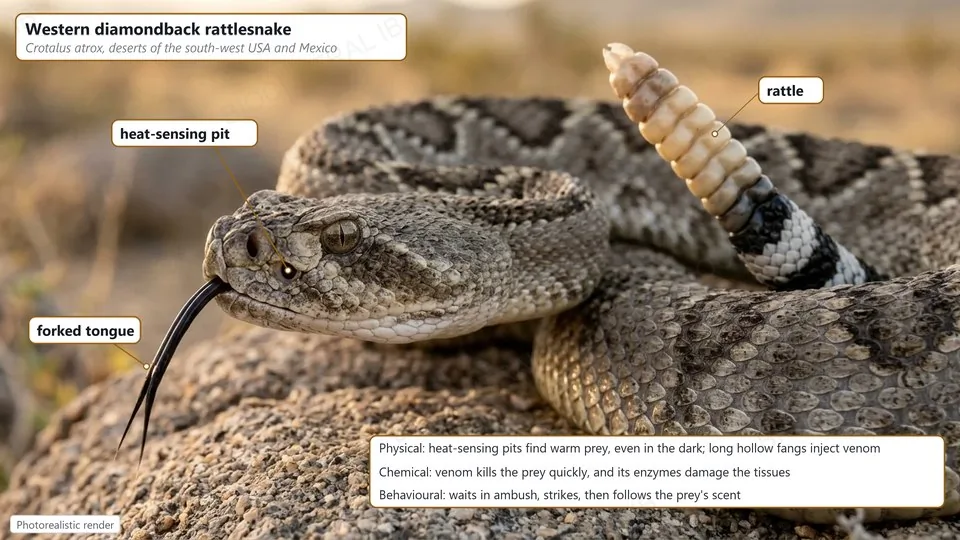
A western diamondback rattlesnake coiled on rocks, labelled with physical adaptations (heat-sensing pits, hollow fangs), a chemical adaptation (venom) and behaviour (ambush)
B4.2.10

Adaptations of predators

Predators have chemical, physical and behavioural adaptations for finding, catching and killing prey.
  • Physical: the western diamondback rattlesnake has heat-sensing pits that find warm prey, even in the dark, and long hollow fangs.
  • Chemical: its venom kills the prey quickly, and enzymes in it damage the prey's tissues.
  • Behavioural: it waits in ambush, strikes, lets the prey go and then follows its scent to where it dies.
Other examplesSpeed and claws (physical), venom (chemical), pack hunting (behavioural).
B4.2.10

How prey resist predators

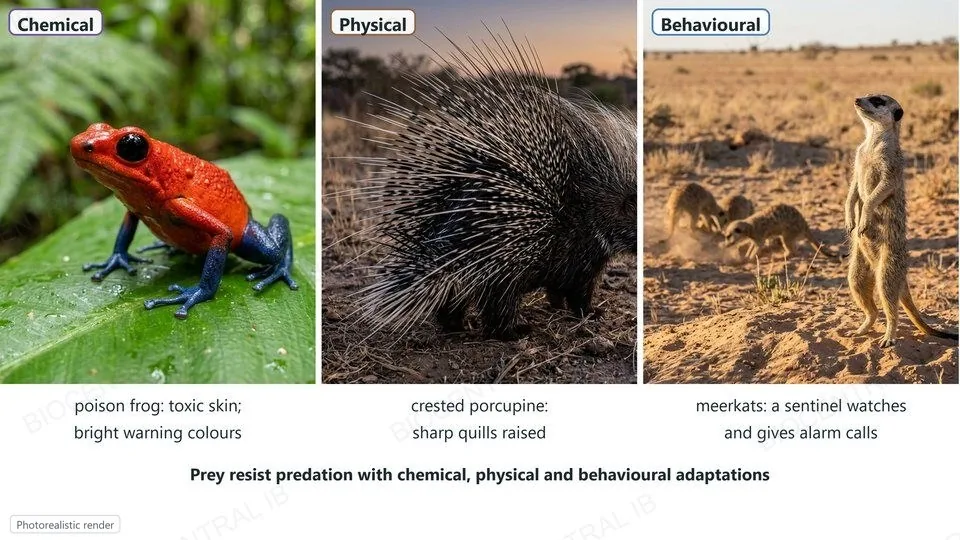
Prey animals have chemical, physical and behavioural adaptations for resisting predation.
  • Chemical: poison frogs have toxins in their skin, advertised by bright warning colours.
  • Physical: porcupines raise sharp quills; other prey have shells, spines or camouflage.
  • Behavioural: meerkats take turns as sentinels and give alarm calls; other prey flee, freeze or live in groups.
Why it mattersPredators and prey each evolve in response to the adaptations of the other.
Three prey animals: a red poison frog with toxic skin and warning colours (chemical), a crested porcupine with raised quills (physical) and a meerkat sentinel watching for predators (behavioural)
Quick check

A fossil hominid skull has a sagittal crest and very large, flat molars. What was its diet most likely to be?

mainly meat from large animals
mainly tough plant foods
sap sucked from plant stems
dead matter digested outside the body
Correct answer: mainly tough plant foods. Large, flat molars grind plant material, and the sagittal crest anchored large chewing muscles, as in Paranthropus robustus. This is a deduction from theories based on living mammals.
Part four

Light, competition and niches

B4.2.11 – B4.2.13
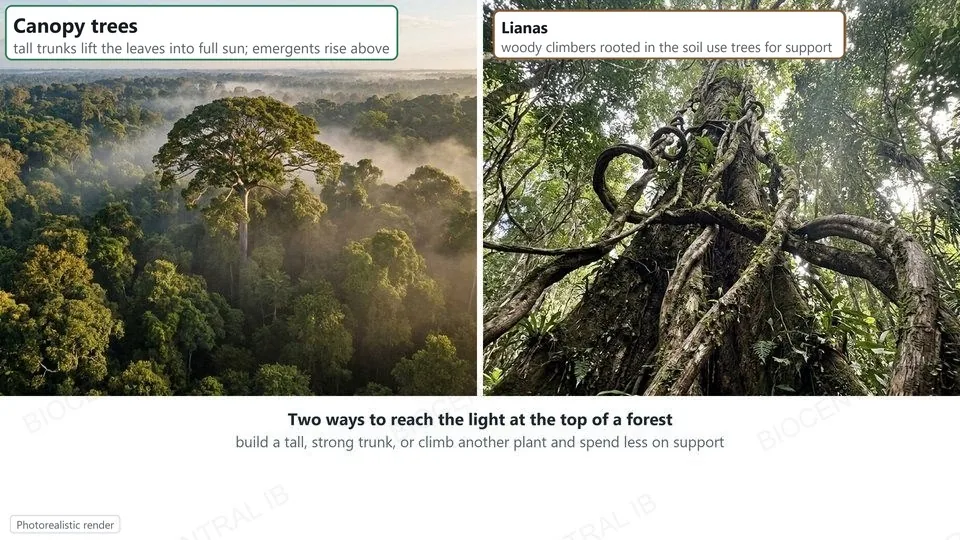
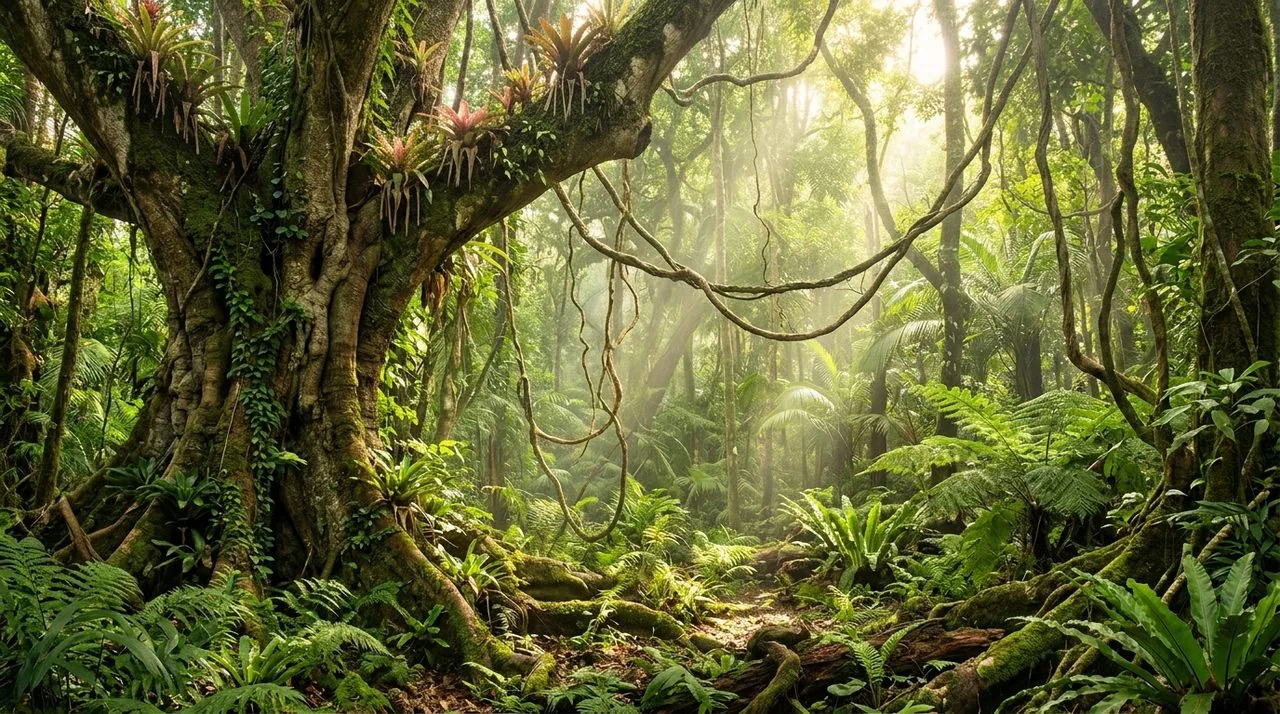
A huge emergent tree rising above a misty rainforest canopy, beside a tall trunk with thick woody lianas climbing it
B4.2.11

Reaching the canopy

In a forest, plants compete for light, and different forms reach it in different ways.
  • Trees that reach the canopy grow tall, strong trunks that lift their leaves into full sunlight; the tallest, emergents, rise above the canopy.
  • Lianas are woody climbing plants rooted in the soil.
  • Lianas climb up trees to reach the canopy, so they spend less on building a supporting trunk of their own.
CompareSame goal, light; two different ways of investing in growth.
B4.2.11

Living on other plants

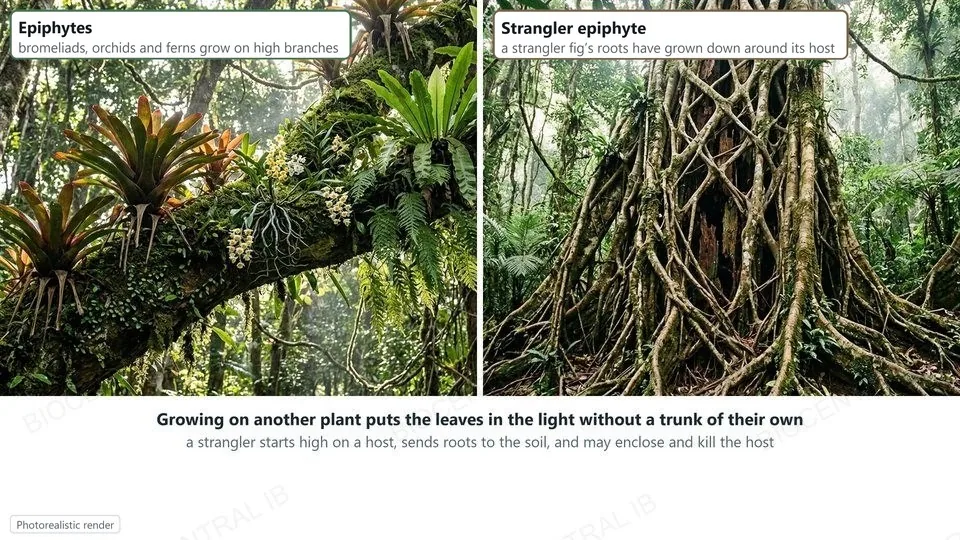
Epiphytes grow on the branches of trees, high up where there is more light.
  • Epiphytes such as bromeliads, orchids and ferns are not rooted in the soil: they get water from rain and mist, and minerals from debris.
  • Strangler epiphytes, such as strangler figs, start life as epiphytes high on a host tree.
  • They send roots down to the soil, which thicken and join around the host; the host may be enclosed and killed.
Why it mattersStarting high in the canopy avoids the long climb from the dark forest floor.
Bromeliads, orchids and ferns growing on a high mossy branch, beside a strangler fig whose roots have grown down around a host tree
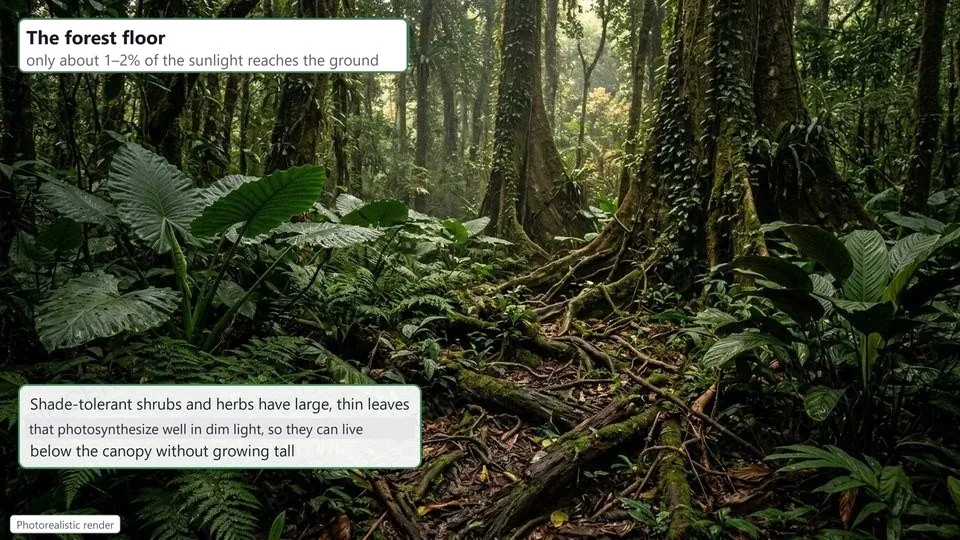
The dim floor of a tropical rainforest with large-leaved shade-tolerant plants and ferns; only about 1 to 2 percent of the sunlight reaches the ground
B4.2.11

Life in the shade

Shade-tolerant shrubs and herbs grow on the forest floor, below the canopy.
  • Only about 1–2% of the sunlight reaches the floor of a tropical rainforest.
  • Shade-tolerant plants have large, thin leaves that capture and use dim light efficiently.
  • They photosynthesize enough to grow without investing in height, so they can live where other plants would fail.
RememberCanopy trees, lianas, epiphytes, strangler epiphytes and shade plants: five strategies for one resource.
B4.2.12

Fundamental and realized niches

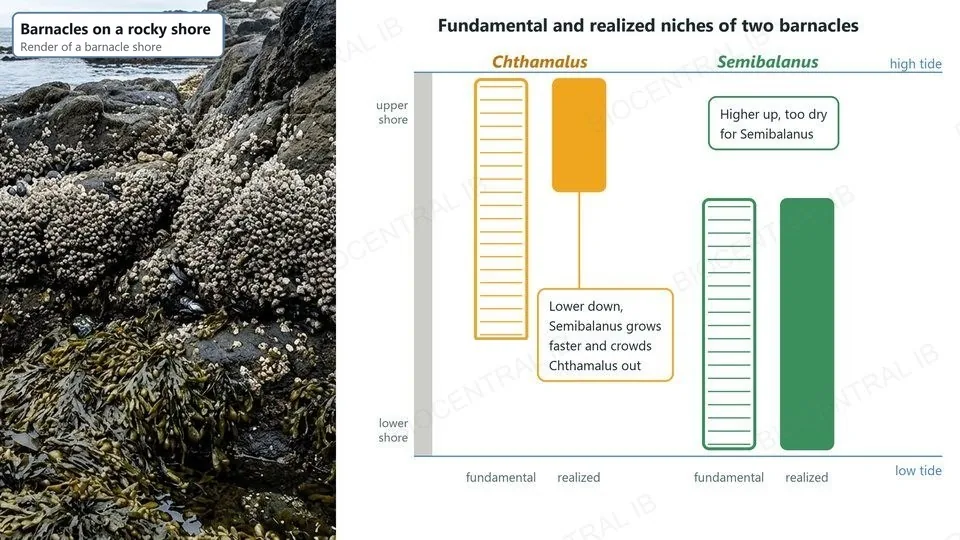
The fundamental niche is the potential niche of a species, based on its adaptations and tolerance limits.
  • The realized niche is the actual extent of the niche when the species is in competition with other species.
  • On rocky shores the barnacle Chthamalus can live lower down, but there Semibalanus grows faster and crowds it out.
  • So the realized niche of Chthamalus is only the upper shore, where it is too dry for Semibalanus.
RememberThe realized niche is the same as, or smaller than, the fundamental niche.
Barnacles on a rocky shore beside a diagram of the shore from high tide to low tide. Chthamalus has a fundamental niche reaching lower down the shore, but its realized niche is only the upper shore, because Semibalanus crowds it out lower down. Semibalanus cannot live higher up, where it is too dry
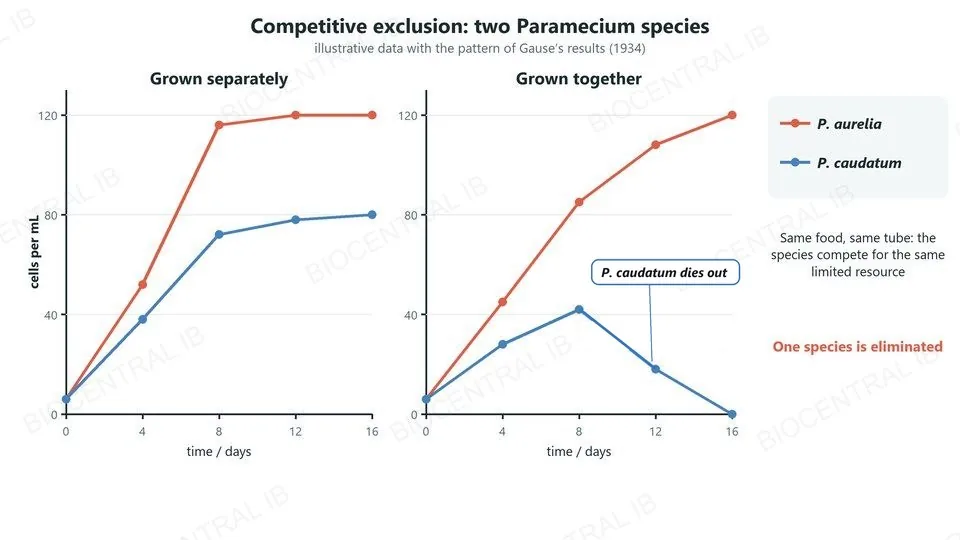
Two graphs of population density against time over 16 days. Grown separately, both Paramecium aurelia and Paramecium caudatum increase and level off. Grown together, P. aurelia increases while P. caudatum rises at first, then falls to zero by day 16
B4.2.13

Competitive exclusion

Two species with the same niche cannot coexist in one habitat for long: this is competitive exclusion.
  • G. F. Gause grew two species of Paramecium separately and together, with the same food.
  • Grown separately, each species increased and levelled off. Grown together, P. aurelia survived, but P. caudatum died out.
  • One possible outcome of competition is the elimination of one of the competing species.
Nature of scienceA controlled laboratory experiment: the only difference was the presence of the other species.
B4.2.13

Every niche is unique

The other possible outcome is that both species survive, each restricted to part of its fundamental niche.
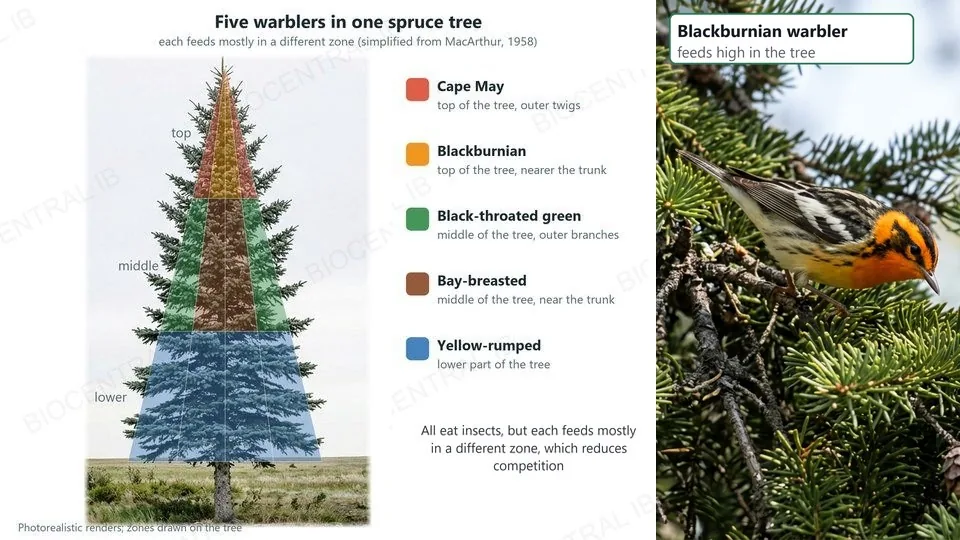
  • Five species of warbler feed on insects in the same spruce forests of North America.
  • Each feeds mostly in a different part of the tree: from the outer twigs at the top to the lower branches.
  • Because each species uses the habitat differently, competition is reduced and all five coexist.
Why it mattersCompetitive exclusion means that no two species in a community share exactly the same niche.
A render of a spruce tree with feeding zones drawn on it: Cape May warblers feed at the top on outer twigs, Blackburnian at the top nearer the trunk, black-throated green in the middle on outer branches, bay-breasted in the middle near the trunk, and yellow-rumped in the lower part of the tree. A Blackburnian warbler is shown in a spruce

Key vocabulary

Worth being able to define in a single sentence each

Ecological niche
the role of a species in an ecosystem.
Obligate anaerobe
an organism that can live only without oxygen.
Facultative anaerobe
an organism that can live with or without oxygen.
Autotroph
an organism that makes its own organic compounds.
Holozoic nutrition
ingestion, internal digestion, absorption and assimilation.
Mixotroph
an organism that is both autotrophic and heterotrophic.
Saprotroph
a decomposer that digests dead matter outside its body.
Fundamental niche
the potential niche, set by adaptations and tolerance.
Realized niche
the actual niche, when in competition with other species.
Competitive exclusion
two species cannot share the same niche for long.

Where this shows up again

C1.1 · Enzymes and metabolism
Digestion in the gut and by saprotrophs is extracellular. How does it differ from glycolysis, which happens inside cells?
C4.1 · Populations and communities
Why is removing one species and watching another a good test for interspecific competition?
B4.1 · Adaptation to environment
How do the abiotic conditions of a habitat set the limits of the fundamental niche of a species?
C4.2 · Transfer of energy and matter
Where do autotrophs, holozoic consumers and saprotrophs fit in food chains and in the carbon cycle?

B4.2 Ecological niches — one-page recap

Screenshot this slide to revise from

Niche
  • The role of a species: biotic and abiotic interactions, and how it feeds.
  • Habitat is where; niche is how.
Oxygen
  • Obligate aerobe: needs O₂. Facultative anaerobe: with or without.
  • Obligate anaerobe: only without; O₂ is toxic.
Nutrition
  • Photosynthesis (plants, algae, cyanobacteria); holozoic (all animals: ingest, digest, absorb, assimilate).
  • Mixotrophs (Euglena; obligate or facultative); saprotrophs; varied archaea.
Teeth
  • Flat molars grind plants; pointed canines kill and tear.
  • P. robustus: crest, huge molars, plants; H. sapiens and H. floresiensis: omnivores.
Feeding and defence
  • Chewing and sucking mouthparts; thorns and toxins; koala detoxifies.
  • Predators and prey: chemical, physical and behavioural adaptations.
Light and competition
  • Canopy trees, lianas, epiphytes, stranglers, shade plants.
  • Fundamental vs realized; exclusion (Gause) or sharing (warblers).
Next step

Now test yourself on B4.2

Reading the slides is half the job. The other half is answering questions the way the exam asks them.

47 quiz questions6 data questions5 exam questionsmarkschemes included

Unlock every lesson with Pro — quizzes, data questions and exam papers. Two lessons are completely free to try: A1.1 Water and B1.1 Carbohydrates and lipids.

One-page summary, key terms and sample questions for B4.2 →

No two species make their living in exactly the same way.

Know what a species eats, tolerates and competes with, and you know its niche.
B4.2 Ecological niches · BioCentral IB
Use ↓ ↑ or click to navigate
01 / 20