BioCentral IBBioCentral IB
IB Biology · Theme B · B4.1

Adaptation to environment

How the conditions of a habitat shape the organisms that live there. SL and HL study the same content.
Guiding questions

How are the adaptations and habitats of species related?

What causes the similarities between ecosystems within a terrestrial biome?

Part one

Habitats and adaptations

B4.1.1 – B4.1.2
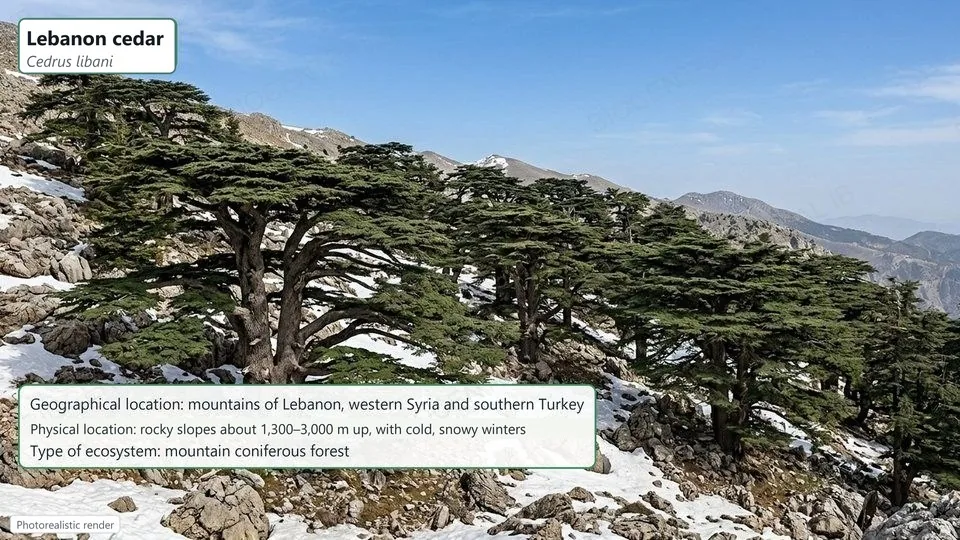
A grove of Lebanon cedars, Cedrus libani, on a rocky mountain slope with snow, labelled with its habitat: geographical location, the mountains of Lebanon, western Syria and southern Turkey; physical location, rocky slopes about 1300 to 3000 m up with cold snowy winters; type of ecosystem, mountain coniferous forest
B4.1.1

What a habitat is

A habitat is the place in which a community, species, population or organism lives.
  • A description of a habitat can include its geographical location, its physical location and the type of ecosystem.
  • The Lebanon cedar lives in the mountains of Lebanon, western Syria and southern Turkey (geographical), on rocky slopes about 1300–3000 m up (physical), in mountain coniferous forest (ecosystem).
  • A habitat can be large, such as a forest, or small, such as a rock pool or the gut of another animal.
CompareA habitat is where a species lives; its niche (B4.2) is its role there.
B4.1.2

A grass adapted to sand dunes

Adaptations are inherited features that suit an organism to the abiotic conditions of its habitat.
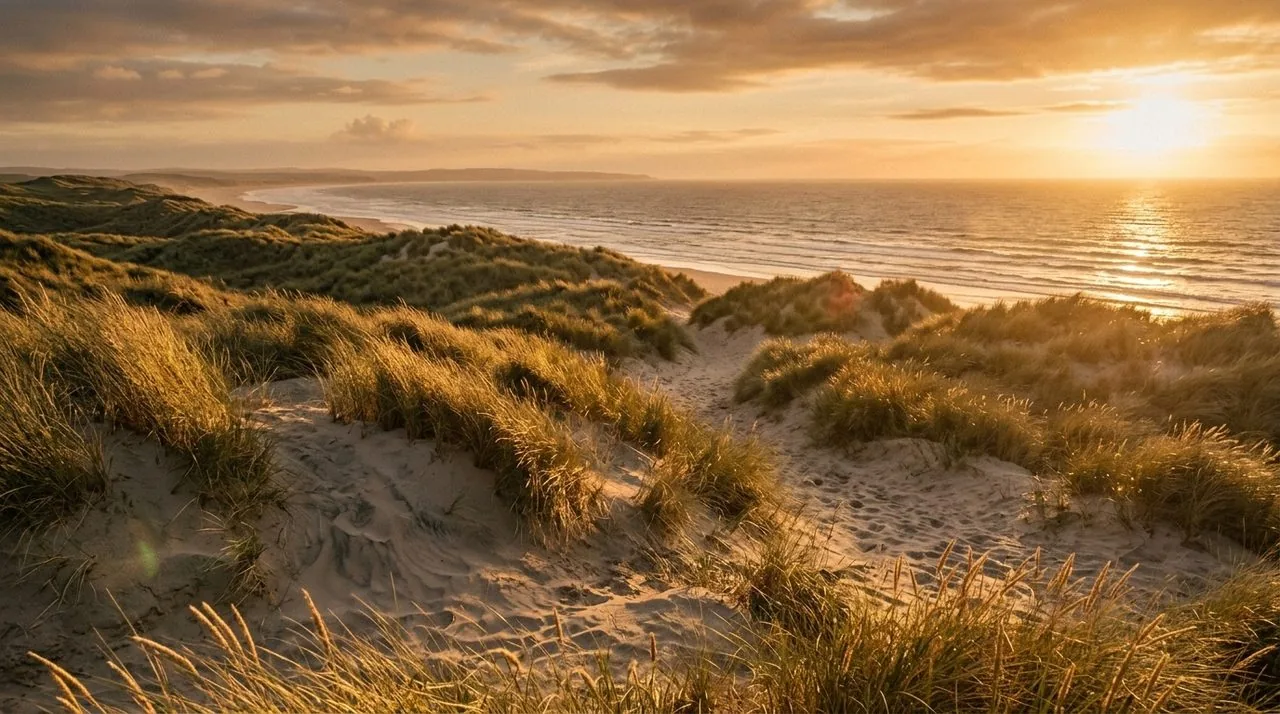
  • Marram grass (Ammophila arenaria) grows on coastal dunes: dry, salty, windy and with shifting sand.
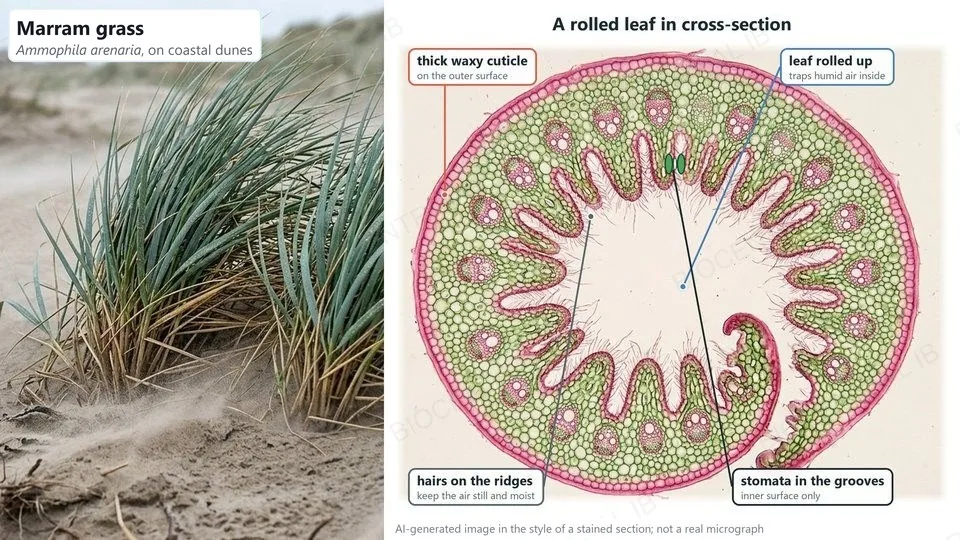
  • Its leaves roll up in dry air, trapping humid air inside; the stomata sit in grooves on the inner surface, among hairs, so less water vapour diffuses away.
  • A thick waxy cuticle covers the outer surface, and long roots and underground stems anchor the plant and reach water deep in the sand.
Why it mattersMarram grass grows up through fresh sand, so it is often the first plant to stabilise new dunes.
Marram grass, Ammophila arenaria, on a windswept dune, beside a stained cross-section of a rolled leaf: a thick waxy cuticle on the outer surface, hairs on the ridges of the inner surface, stomata in the grooves between them, and humid air trapped inside the roll
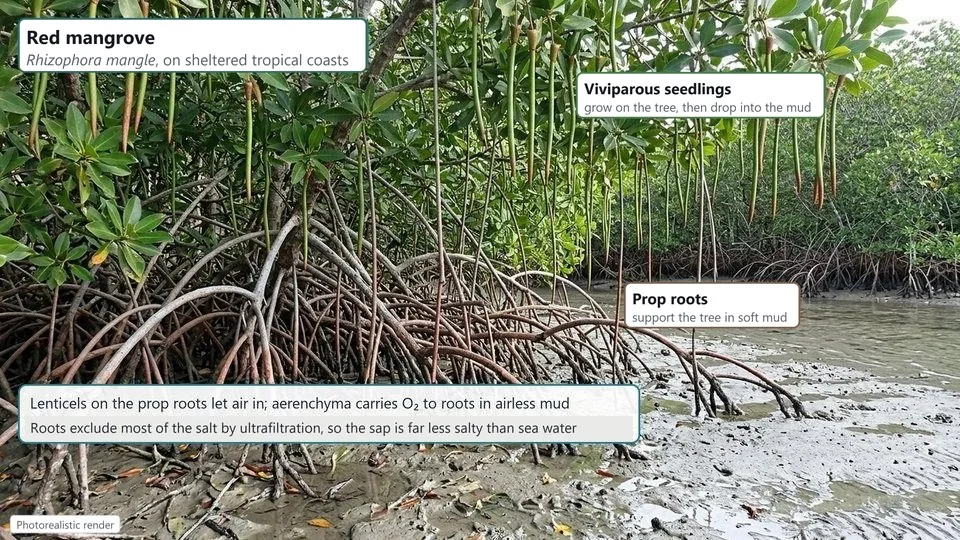
Red mangroves, Rhizophora mangle, at low tide, labelled: prop roots support the tree in soft mud; viviparous seedlings hang from the branches; lenticels let air into the roots and aerenchyma carries oxygen to roots in airless mud; root cells filter out most of the salt
B4.1.2

A tree adapted to mangrove swamps

The red mangrove (Rhizophora mangle) grows in the mud of sheltered tropical coasts, flooded by seawater at every high tide.
  • Arching prop roots support the tree in soft mud.
  • Lenticels on the roots let air in, and aerenchyma (tissue with air spaces) carries oxygen to roots in mud that has almost none.
  • The roots exclude most of the salt from sea water by ultrafiltration, and seeds germinate while still attached to the parent tree (vivipary), then drop as propagules and root quickly.
CompareMarram grass must save water; the mangrove has too much water and salt, so its adaptations are very different.
Part two

Tolerance and distribution

B4.1.3 – B4.1.4
B4.1.3

Abiotic variables and distribution

Where a species is found depends on abiotic variables such as temperature, water and light.
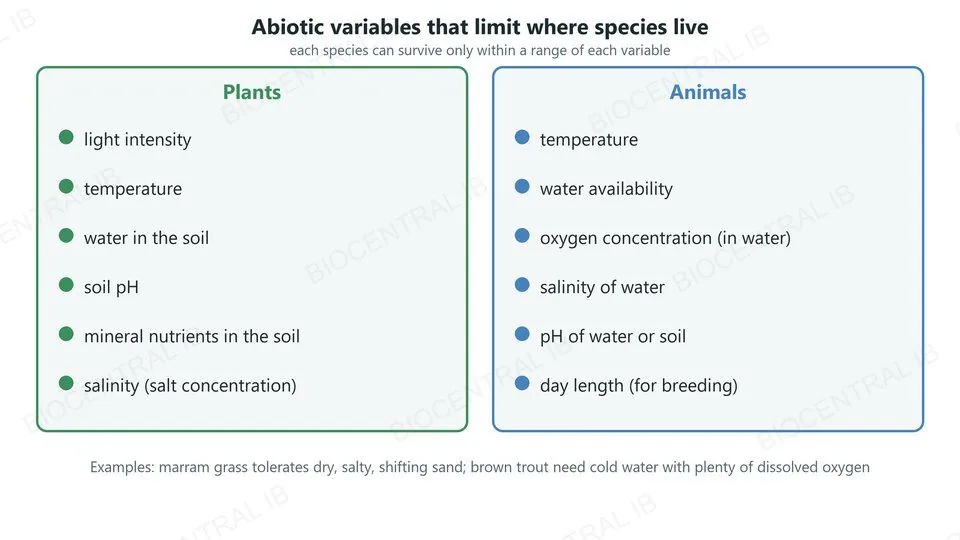
  • For plants these include light intensity, temperature, water and mineral nutrients in the soil, soil pH and salinity.
  • For animals they include temperature, water availability, the oxygen concentration of water, salinity and pH.
  • A species’ adaptations give it a range of tolerance for each variable: it is found only where every variable stays within its range.
ExampleBrown trout need cool water with plenty of dissolved oxygen.
Two lists of abiotic variables. For plants: light intensity, temperature, water in the soil, soil pH, mineral nutrients and salinity. For animals: temperature, water availability, oxygen concentration in water, salinity, pH and day length
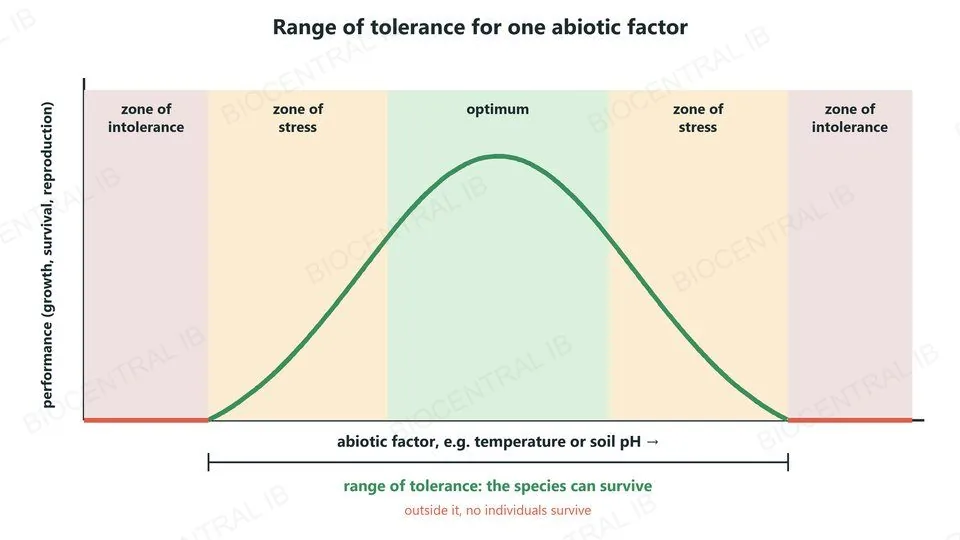
A graph of performance against an abiotic factor: a central zone of optimum, a zone of stress on each side, and a zone of intolerance beyond each limit, where no individuals survive. The range of tolerance spans from one limit to the other
B4.1.4

Range of tolerance

For each limiting factor, a species has a range of tolerance: the values over which it can survive.
  • In the middle of the range is the optimum, where the species grows and reproduces best.
  • Towards each end are zones of stress: individuals survive, but grow and reproduce less.
  • Beyond the limits is the zone of intolerance, where no individuals survive, so the species is absent.
RememberThe limits of tolerance set the edges of a species’ distribution.
B4.1.4 · Application of skills

Sampling along a transect

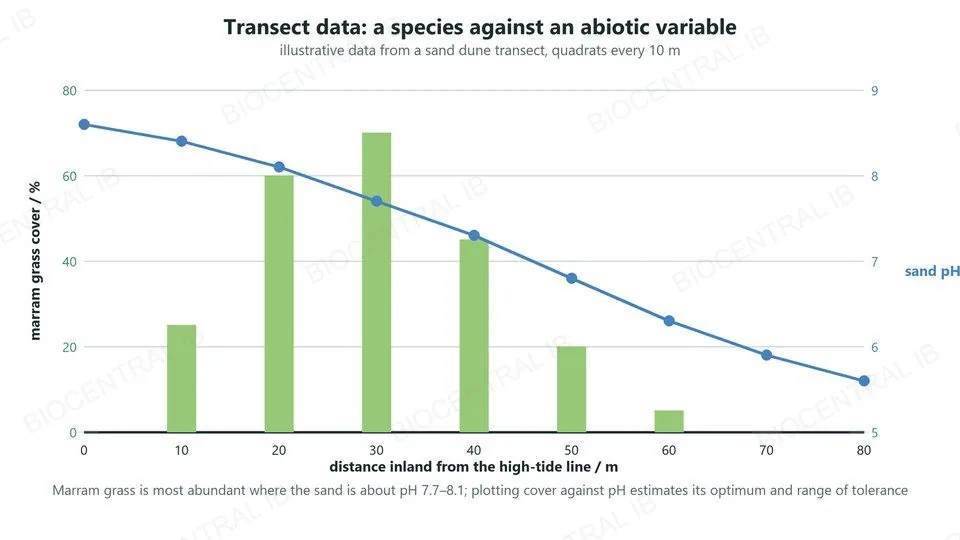
Transect data can be used to correlate the distribution of a species with an abiotic variable.
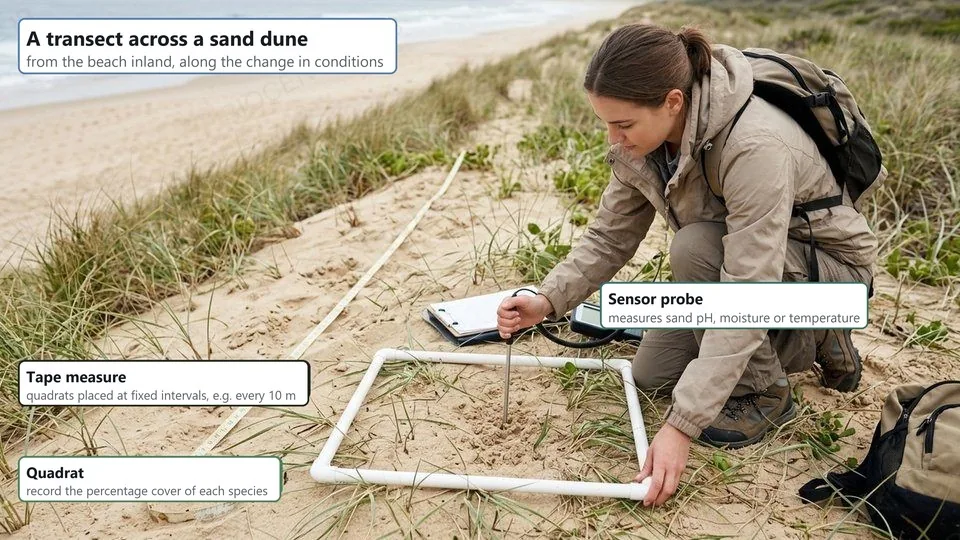
  • Lay a tape across a habitat where conditions change, such as from a beach inland across sand dunes.
  • At fixed intervals, record the abundance of the species in a quadrat and measure the abiotic variable; sensors can measure temperature, light intensity or soil pH.
  • Collect the data yourself in a natural or semi-natural habitat: one influenced by humans but dominated by wild rather than cultivated species.
SkillPlot abundance against the abiotic variable to look for a correlation.
A student on a sand dune with a measuring tape running from the beach inland, a quadrat placed at intervals along it and a sensor probe measuring sand pH, moisture or temperature
Illustrative transect data across a sand dune: marram grass cover at each 10 m interval (0, 25, 60, 70, 45, 20, 5, 0 and 0 percent) and sand pH falling from 8.6 at the high-tide line to 5.6 at 80 m inland; cover is highest at about pH 7.7 to 8.1
B4.1.4 · Application of skills

Reading transect data

Plotting abundance against an abiotic variable shows where a species does best.
  • In these illustrative data, marram grass cover is highest where the sand is about pH 7.7–8.1, towards the front of the dunes.
  • Further inland the sand becomes more acidic, and marram grass becomes rare and then disappears.
  • Other variables also change along the transect, such as sand movement and competition from other plants.
Nature of scienceA correlation does not prove that pH is the cause: an experiment would be needed to test that.
Quick check

A plant grows best at soil pH 7.0. It survives, but grows slowly, from pH 6.0 to 8.5, and is absent outside that range. Which zone is pH 8.0 in?

the zone of optimum growth
a zone of stress, within its tolerance
the zone of intolerance
outside its range of tolerance
Correct answer: a zone of stress. pH 8.0 is within the range of tolerance (6.0–8.5), so the plant survives, but it is away from the optimum, so growth is reduced. Only beyond 8.5 is the zone of intolerance.
Part three

Coral reefs and biomes

B4.1.5 – B4.1.7
B4.1.5

Conditions for coral reefs

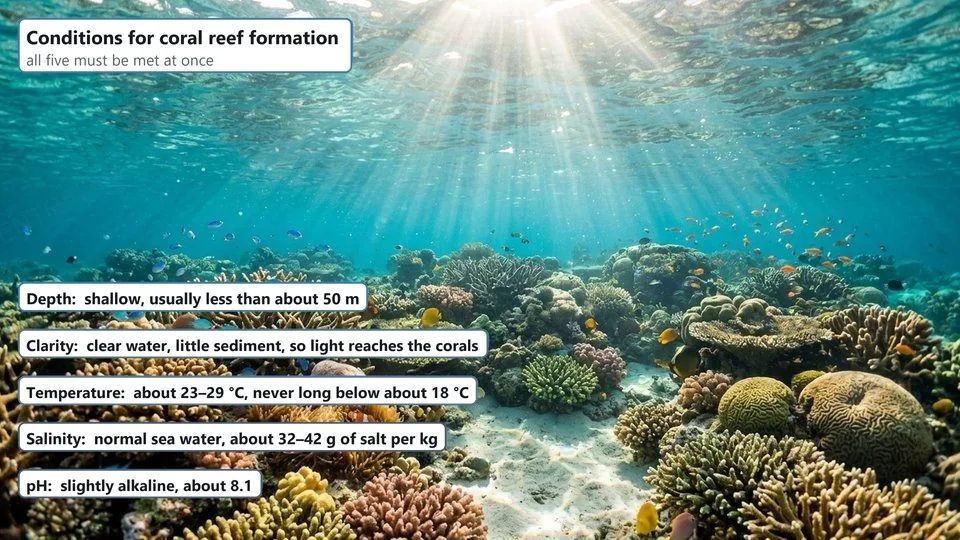
Coral reefs are an example of a marine ecosystem. Shallow tropical reefs form only where several abiotic conditions are met together.
  • Depth and clarity: shallow, clear water, usually less than about 50 m deep, so enough light reaches the corals.
  • Temperature: warm water, about 23–29 °C, so reefs are found mainly in tropical seas.
  • Salinity and pH: normal sea water (about 32–42 g of salt per kg) that is slightly alkaline, about pH 8.1, so corals can build calcium carbonate skeletons.
Why it mattersChange one condition, for example by warming or ocean acidification, and reefs stop growing.
A shallow, clear tropical reef lit by sunlight, labelled with the five conditions for reef formation: shallow water, usually less than about 50 m; clear water with little sediment; temperature about 23 to 29 °C; normal salinity, about 32 to 42 g of salt per kg; slightly alkaline, about pH 8.1
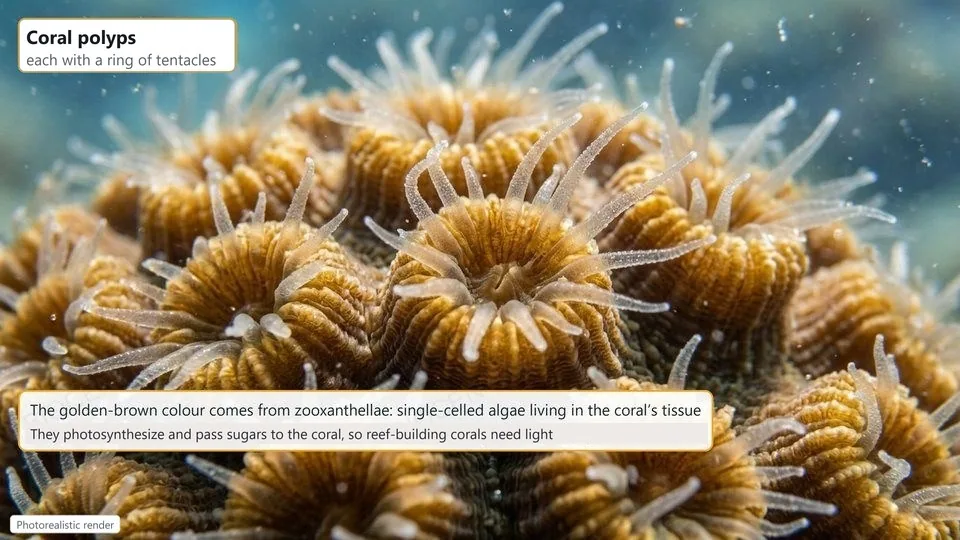
A macro render of coral polyps with tentacles; their golden-brown colour comes from zooxanthellae, single-celled algae in the coral tissue that photosynthesise and pass sugars to the coral
B4.1.5

Why corals need light

Reef-building corals are animals, but they depend on algae living in their tissues.
  • Zooxanthellae, single-celled algae inside the coral polyps, photosynthesize and pass sugars to the coral.
  • This energy lets corals grow quickly and lay down the calcium carbonate skeleton that builds the reef.
  • So corals need clear, shallow, well-lit water; if the water gets too warm, corals expel their algae and turn white (bleaching).
LinkThis partnership is a mutualism (C4.1).
B4.1.6

Climate decides the biome

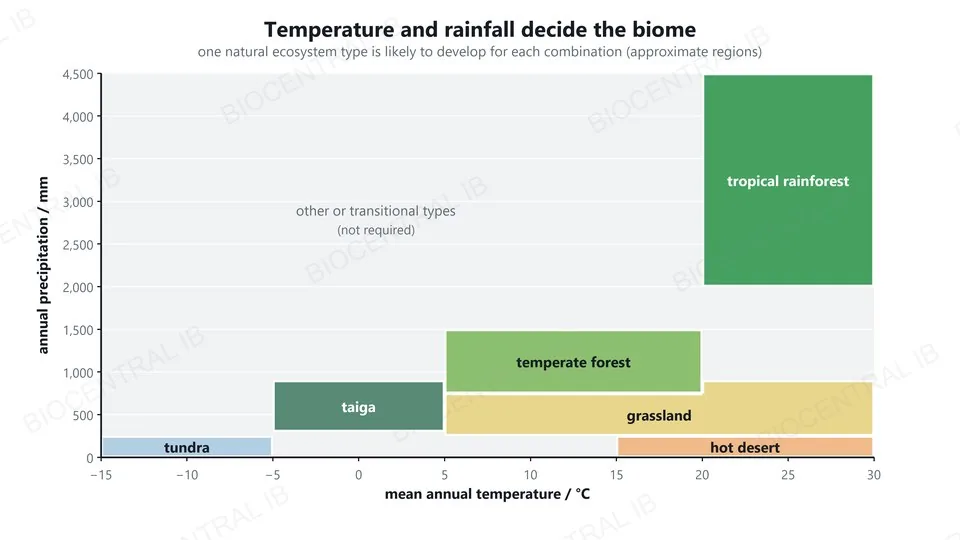
Temperature and rainfall are the main abiotic factors that determine where each terrestrial biome is found.
  • For any given temperature and rainfall pattern, one natural ecosystem type is likely to develop.
  • A graph with mean annual temperature on one axis and annual precipitation on the other shows the biomes as separate regions.
  • Hot and very wet gives tropical rainforest; hot and dry gives hot desert; very cold and dry gives tundra.
SkillUse the graph to predict a biome from a place’s climate data.
A biome graph with mean annual temperature from minus 15 to 30 °C on the horizontal axis and annual precipitation from 0 to 4500 mm on the vertical axis. Tundra is cold and dry; taiga is cold with moderate rainfall; temperate forest is mild and wet; grassland and hot desert lie at low rainfall; tropical rainforest is hot and very wet
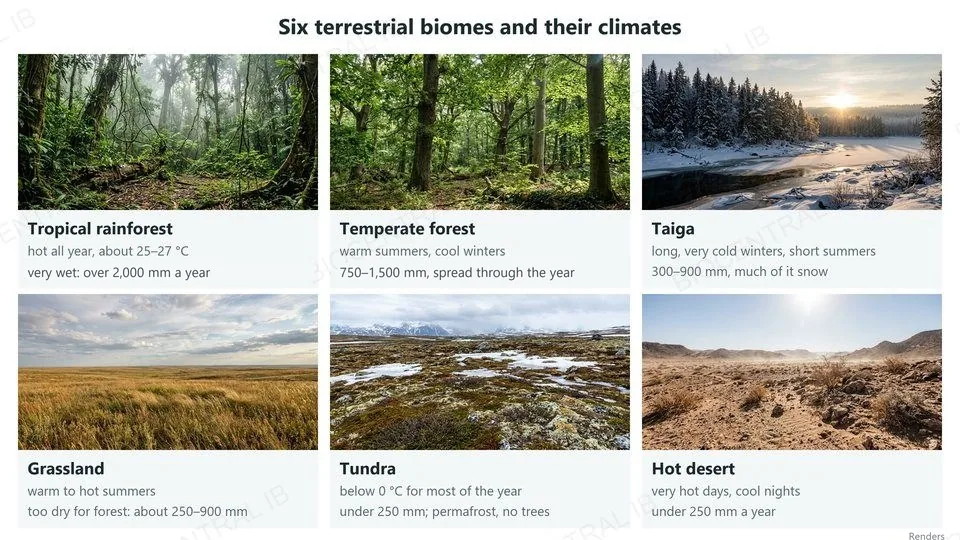
Six renders with their climates: tropical rainforest, hot all year and very wet; temperate forest, warm summers and cool winters with rain all year; taiga, long very cold winters; grassland, too dry for forest; tundra, below 0 °C for most of the year with permafrost; hot desert, very hot days and under 250 mm of rain a year
B4.1.7

Six biomes

A biome is a group of ecosystems with similar communities, because they have similar abiotic conditions.
  • Tropical forest: hot and wet all year. Temperate forest: warm summers, cool winters, rain all year.
  • Taiga: long, very cold winters and short summers. Grassland: too dry for forest, often with a dry season.
  • Tundra: very cold and dry, with permafrost and no trees. Hot desert: very dry, with hot days and cool nights.
RememberThe same biome appears on different continents wherever the climate is similar.
B4.1.7

Convergent evolution

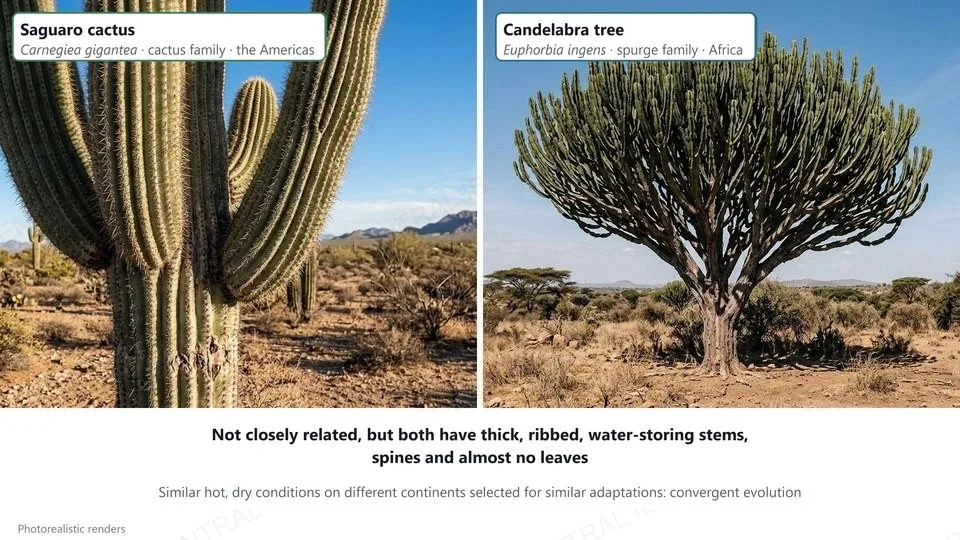
Ecosystems in the same biome look alike partly because of convergent evolution.
  • Convergent evolution is the evolution of similar features in unrelated organisms that face similar conditions.
  • The saguaro cactus of the Americas and the candelabra euphorbia of Africa belong to different plant families.
  • Yet both have thick, ribbed, water-storing stems, spines, almost no leaves and CAM photosynthesis, selected by similar hot, dry conditions.
Why it mattersSimilar climates select similar forms, so the communities of a biome resemble each other worldwide.
A saguaro cactus from the Americas beside a candelabra euphorbia from Africa: both have thick ribbed water-storing stems, spines, almost no leaves and CAM photosynthesis, although they are not closely related
Quick check

Cacti and euphorbias are only distantly related, yet both have succulent stems, spines and almost no leaves. What best explains this?

they share a recent desert-living ancestor
cacti were carried to Africa and changed
similar desert conditions selected similar traits
the traits arose by chance in both groups
Correct answer: convergent evolution. The two groups evolved separately on different continents, but similar dry, hot conditions selected similar water-saving features in both.
Part four

Hot deserts and tropical rainforests

B4.1.8
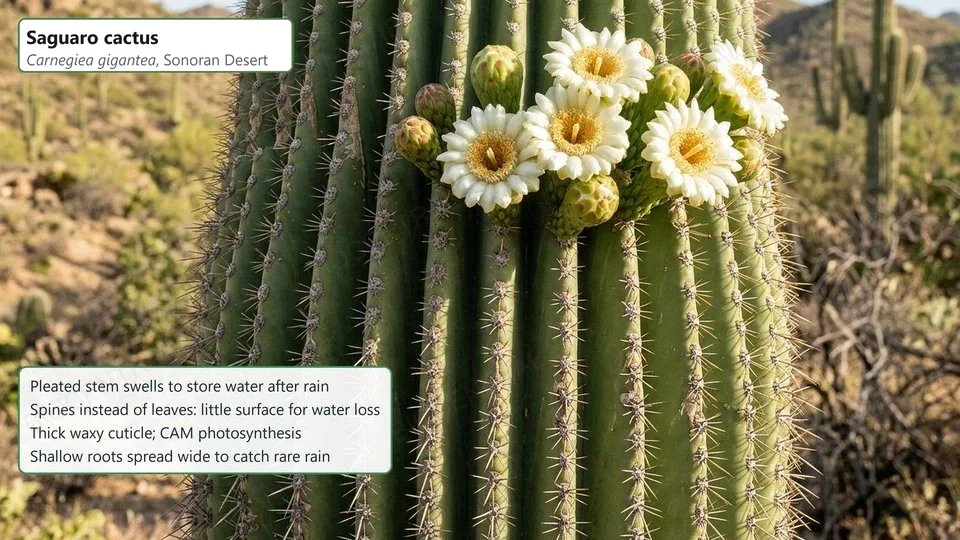
The pleated stem of a saguaro cactus, labelled: the pleated stem swells to store water after rain; spines instead of leaves; thick waxy cuticle and CAM photosynthesis; shallow roots spread wide to catch rare rain
B4.1.8

A desert plant: the saguaro

In hot deserts the main problems are very little water and very high daytime temperatures.
  • The saguaro cactus (Carnegiea gigantea) stores water in a pleated stem that swells after rain.
  • Its leaves are reduced to spines, and its stem has a thick waxy cuticle, so little water is lost.
  • Shallow roots spread widely to absorb rain quickly, and it uses CAM photosynthesis (next slide).
AdaptationStore water when it rains; lose as little as possible in between.
B4.1.8

CAM photosynthesis

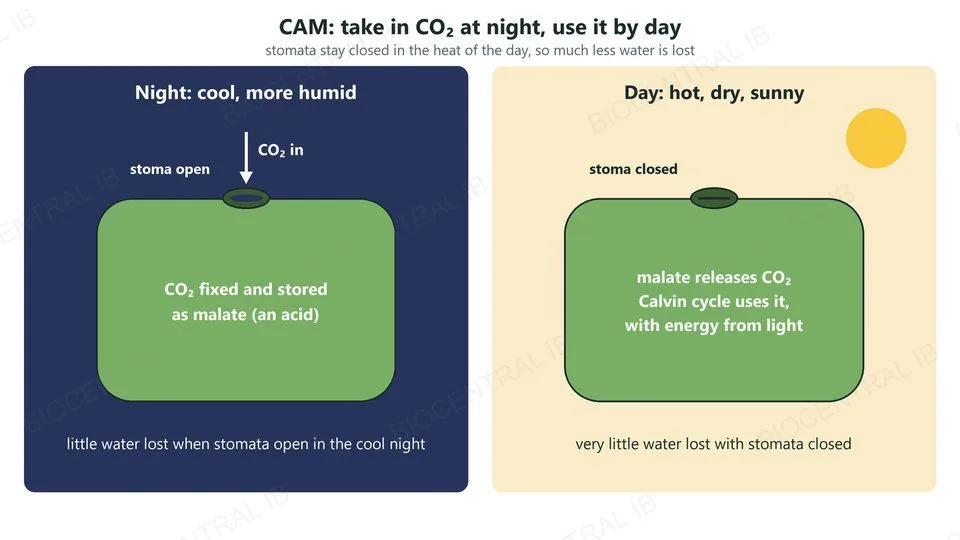
CAM plants open their stomata at night and keep them closed in the heat of the day.
  • At night, when it is cooler and more humid, CO₂ diffuses in and is fixed and stored as malate.
  • By day, with the stomata closed, the malate releases CO₂, which the Calvin cycle uses with energy from light.
  • Because the stomata open only when it is cool, far less water is lost by transpiration.
LinkC1.3 covers the light-dependent reactions and the Calvin cycle.
Two panels of a CAM plant stem. At night, when it is cool and more humid, the stoma is open, CO2 enters and is fixed and stored as malate. In the hot day the stoma is closed; malate releases CO2 for the Calvin cycle, using energy from light
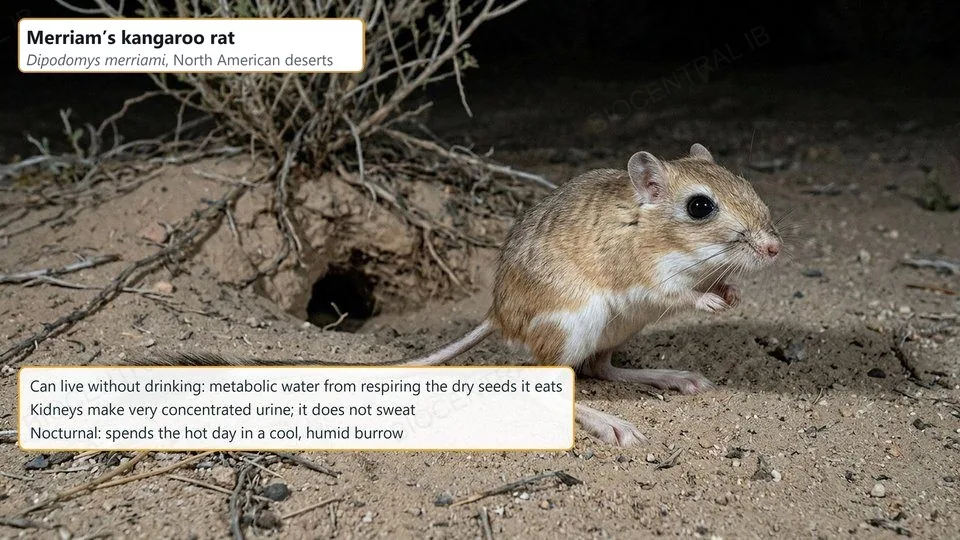
Merriam’s kangaroo rat beside its burrow at night, labelled: it can live without drinking, using metabolic water from respiring dry seeds; its kidneys make very concentrated urine and it does not sweat; it is nocturnal and spends the hot day in a cool, humid burrow
B4.1.8

A desert animal: the kangaroo rat

Merriam’s kangaroo rat (Dipodomys merriami) lives in the deserts of North America.
  • It can survive without drinking, using metabolic water released when it respires the dry seeds it eats.
  • Its kidneys produce very concentrated urine, and it does not sweat, so it loses very little water.
  • It is nocturnal: by day it stays in a cool, humid burrow, out of the heat.
AdaptationBehaviour and physiology together keep water loss to a minimum.
B4.1.8

Rainforest plants: kapok and cacao

In tropical rainforest the problems are thin, poor soil, strong competition for light and almost constant wetness.
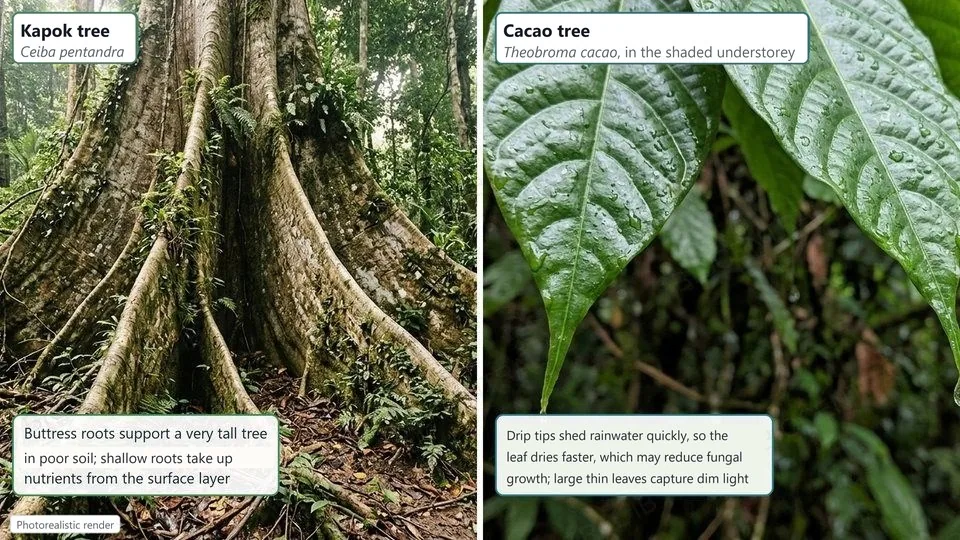
  • The kapok tree (Ceiba pentandra) grows above the canopy; buttress roots support its great height in shallow soil.
  • Its shallow roots take up nutrients from the thin surface layer, where dead leaves decompose quickly.
  • The cacao tree (Theobroma cacao) grows in the shaded understorey: its large leaves capture dim light, and drip tips shed rainwater so the leaves dry faster, which may reduce fungal growth.
AdaptationIn the rainforest plants compete for light and must shed water, not save it.
The buttress roots of a kapok tree, Ceiba pentandra, which support a very tall tree in thin soil, beside the drip-tipped leaves of a cacao tree, Theobroma cacao, which shed rainwater quickly
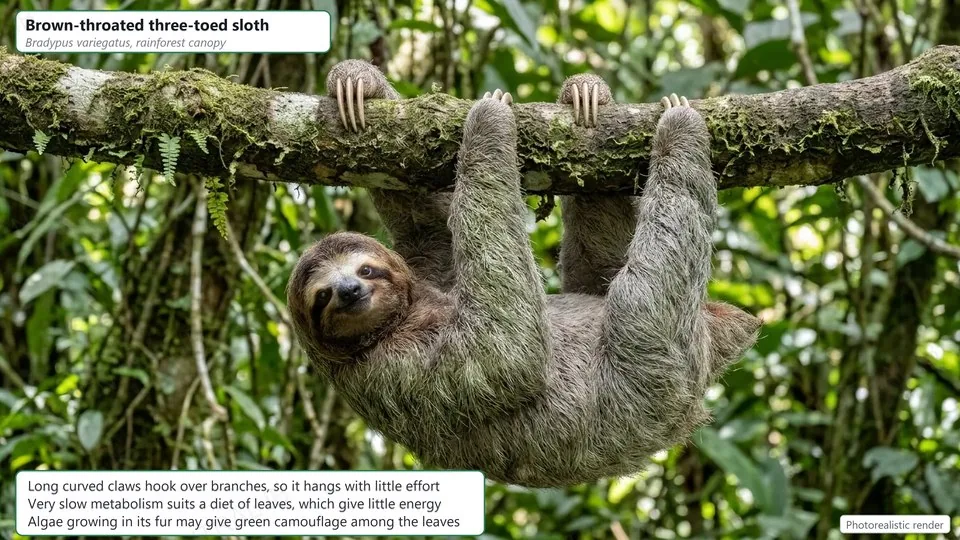
A brown-throated three-toed sloth hanging from a branch by its long curved claws, with a green tint of algae in its fur
B4.1.8

A rainforest animal: the sloth

The brown-throated three-toed sloth (Bradypus variegatus) lives in the canopy of Central and South American rainforests.
  • Long curved claws hook over branches, so it can hang with little effort.
  • It eats leaves, which give little energy; its very slow metabolism and slow movement suit this diet.
  • Algae grow in its fur, giving it a green tint that may help hide it from predators such as harpy eagles.
AdaptationLife in the canopy: grip, camouflage and an energy-saving lifestyle.

Key vocabulary

Worth being able to define in a single sentence each

Habitat
the place in which a community, species, population or organism lives.
Adaptation
an inherited feature that suits an organism to its habitat.
Abiotic variable
a non-living factor, such as temperature, light or pH.
Range of tolerance
the values of a factor over which a species can survive.
Limiting factor
a factor whose value restricts where a species can live.
Transect
a line along which samples are taken at intervals.
Biome
ecosystems with similar communities due to similar abiotic conditions.
Convergent evolution
similar features evolving in unrelated organisms.
Zooxanthellae
single-celled algae living in coral tissue.
CAM
taking in CO₂ at night and using it by day, saving water.

Where this shows up again

B4.2 · Ecological niches
A habitat is where a species lives; a niche is its role. How can two species share a habitat but have different niches?
C4.1 · Populations and communities
How does the mutualism between corals and zooxanthellae show a relationship between species in a community?
B2.1 · Membranes
How might the exclusion of salt by mangrove roots depend on the selective permeability of cell membranes?
C1.3 · Photosynthesis
How does CAM photosynthesis separate the uptake of CO₂ from its use in the Calvin cycle?

B4.1 Adaptation to environment — one-page recap

Screenshot this slide to revise from

Habitat
  • Where it lives: geographical, physical location, ecosystem type.
  • Example: Lebanon cedar, rocky slopes 1300–3000 m.
Adaptations
  • Marram grass: rolled leaves, sunken stomata, hairs, cuticle.
  • Red mangrove: prop roots, lenticels, aerenchyma, salt filtering, vivipary.
Tolerance
  • Optimum → stress → intolerance, for each factor.
  • Transect: quadrats and sensors at intervals; correlation, not cause.
Coral reefs
  • Shallow, clear, 23–29 °C, normal salinity, pH about 8.1.
  • Zooxanthellae need light; they feed the coral.
Biomes
  • Temperature + rainfall predict the biome.
  • Six biomes; convergent evolution makes them alike worldwide.
Deserts and rainforests
  • Saguaro (CAM, stored water); kangaroo rat (metabolic water).
  • Kapok buttresses, cacao drip tips; sloth claws and algae.
Next step

Now test yourself on B4.1

Reading the slides is half the job. The other half is answering questions the way the exam asks them.

40 quiz questions6 data questions5 exam questionsmarkschemes included

Unlock every lesson with Pro — quizzes, data questions and exam papers. Two lessons are completely free to try: A1.1 Water and B1.1 Carbohydrates and lipids.

One-page summary, key terms and sample questions for B4.1 →

Every adaptation answers a question its habitat asks.

Know the conditions, and you can predict the life that fits them.
B4.1 Adaptation to environment · BioCentral IB
Use ↓ ↑ or click to navigate
01 / 20