BioCentral IBBioCentral IB
IB Biology · Theme B · B2.2 · SL and HL

Organelles and compartmentalization

Why a cell is divided into separate working parts. Part one is for SL and HL; part two is HL only.
Guiding questions

How are organelles in cells adapted to their functions?

What are the advantages of compartmentalization in cells?

Part one

Organelles and compartments

B2.2.1 – B2.2.3
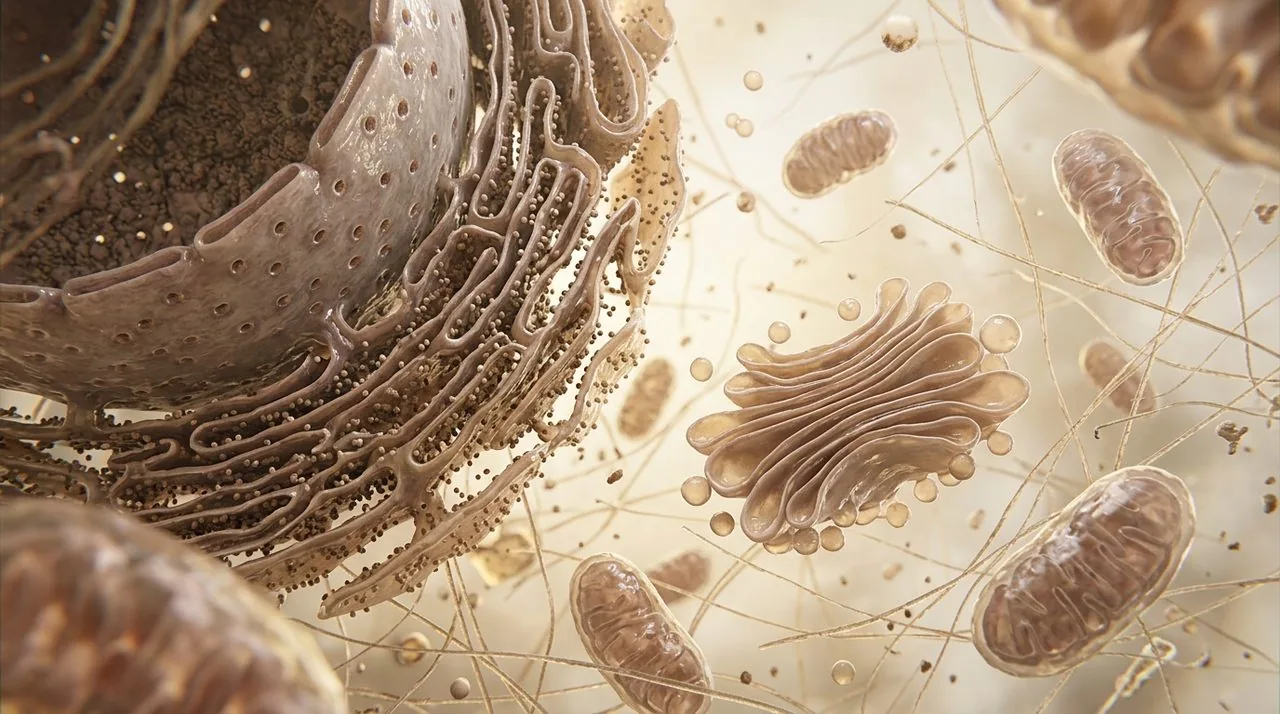
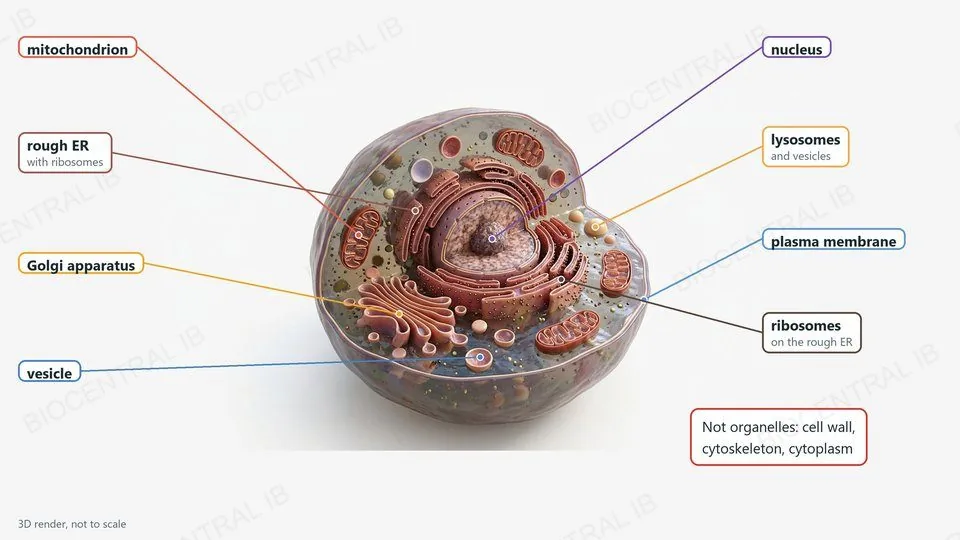
A 3D cutaway render of an animal cell, labelled: nucleus, rough endoplasmic reticulum with ribosomes, Golgi apparatus, mitochondria, lysosomes, vesicles and plasma membrane. The cytoplasm and cytoskeleton are not organelles
B2.2.1

What is an organelle?

Organelles are discrete subunits of cells, each adapted to perform specific functions.
  • Nuclei, mitochondria, the rough ER, the Golgi apparatus, lysosomes, vesicles, ribosomes and the plasma membrane are organelles.
  • An organelle does not have to be surrounded by a membrane: ribosomes are organelles.
  • The cell wall, the cytoskeleton and the cytoplasm are not considered organelles.
RememberEach organelle has a structure that suits its function.
B2.2.1 · Nature of science

Separating organelles: cell fractionation

Progress in science often follows the development of new techniques.
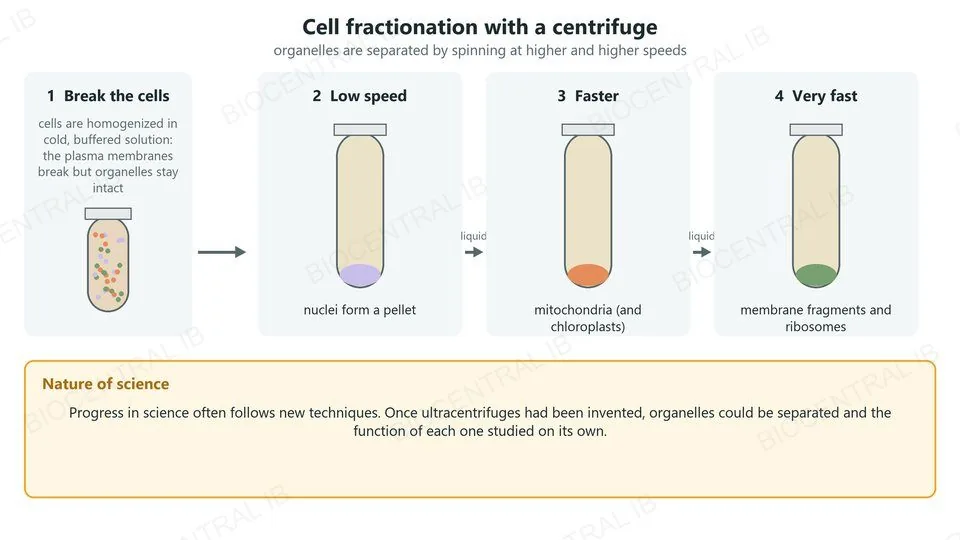
  • Cells are broken open, and the mixture is spun in a centrifuge at increasing speeds.
  • Larger, denser organelles such as nuclei form a pellet first; mitochondria need higher speeds, and ribosomes and membrane fragments very high speeds.
  • Only once ultracentrifuges had been invented, and methods of cell fractionation developed, could the function of each organelle be studied on its own.
Nature of scienceNew instruments open up new questions.
Cell fractionation: cells are broken open, then the homogenate is spun at increasing speeds; nuclei form a pellet at low speed, mitochondria and chloroplasts at higher speed, and membrane fragments and ribosomes at very high speed
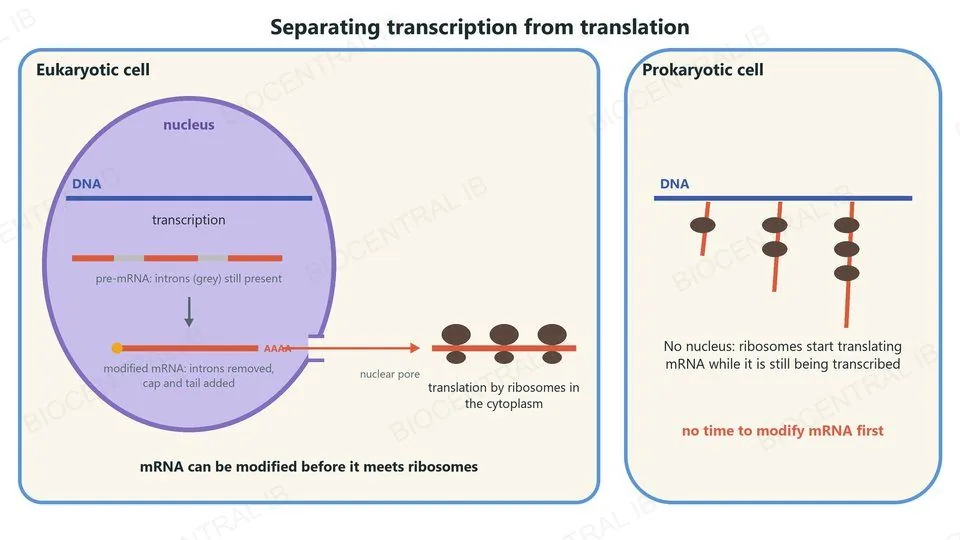
In a eukaryotic cell, DNA is transcribed in the nucleus, the pre-mRNA is modified, and the mRNA leaves through a nuclear pore to ribosomes in the cytoplasm. In a prokaryotic cell, ribosomes attach to mRNA while it is still being transcribed
B2.2.2

Why separate the nucleus?

In eukaryotic cells, the nucleus is a separate compartment from the cytoplasm.
  • Transcription happens in the nucleus; translation happens on ribosomes in the cytoplasm.
  • So mRNA can be modified after transcription (post-transcriptional modification), for example by removing introns, before it meets ribosomes.
  • Prokaryotes have no nucleus, so this is not possible: mRNA may meet ribosomes immediately, even while it is still being transcribed.
LinkPost-transcriptional modification is in D1.2.
B2.2.3

Compartments in the cytoplasm

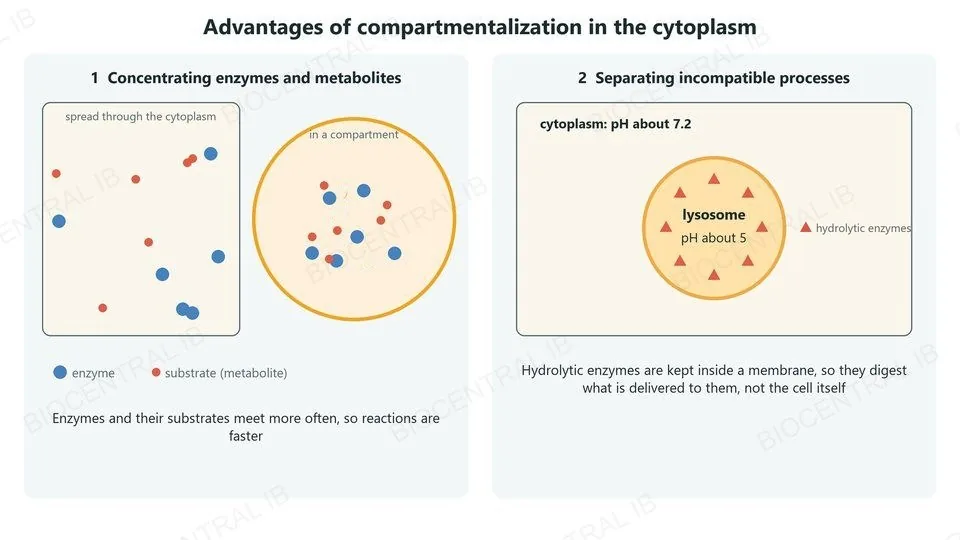
Membrane-bound compartments in the cytoplasm give two advantages.
  • Concentration: enzymes and their substrates (metabolites) can be kept together at high concentrations, so reactions are faster.
  • Separation: incompatible biochemical processes are kept apart, each in the conditions it needs.
  • Lysosomes contain hydrolytic enzymes that work best at about pH 5; inside the lysosome they are kept away from the rest of the cell, where the pH is about 7.2.
Why it mattersMany different reactions can happen in one cell at the same time.
Two advantages of compartments: enzymes and substrates concentrated together inside a compartment, and a lysosome at pH 5 kept separate from the cytoplasm at pH 7.2
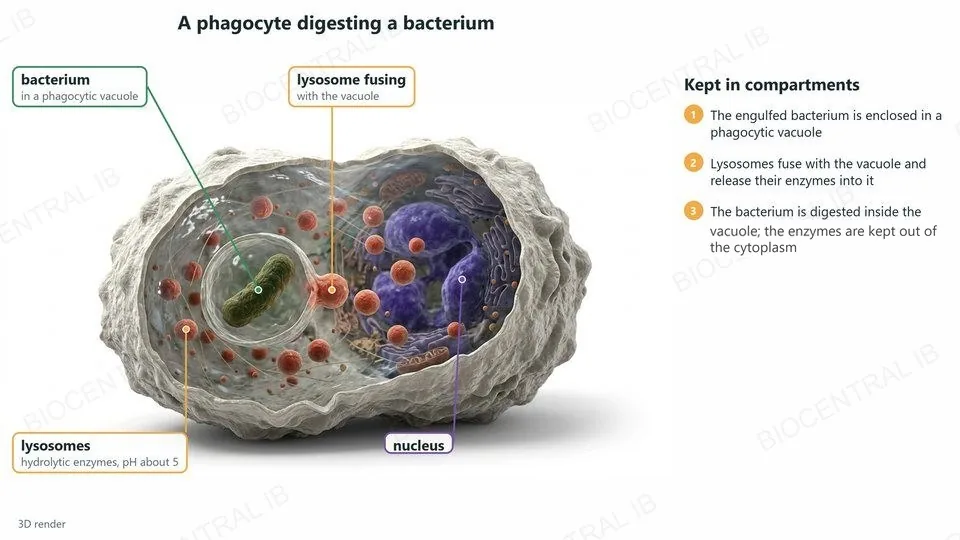
A 3D render of a phagocyte cut open, labelled: a bacterium inside a phagocytic vacuole, a lysosome fusing with the vacuole, other lysosomes containing hydrolytic enzymes at about pH 5, and the nucleus
B2.2.3

Lysosomes and phagocytic vacuoles

Phagocytic white blood cells engulf bacteria and digest them in compartments.
  • The engulfed bacterium is enclosed in a phagocytic vacuole, separate from the cytoplasm.
  • Lysosomes fuse with the vacuole and release their hydrolytic enzymes into it.
  • The enzymes digest the bacterium inside the vacuole, and the useful products are absorbed into the cytoplasm; the enzymes are kept out of the rest of the cell.
ExampleCompartmentalization lets a cell digest an invader without digesting itself.
Quick check

Which of these is NOT considered an organelle?

a ribosome
the plasma membrane
the cytoskeleton
a vesicle
Correct answer: the cytoskeleton. The cell wall, cytoskeleton and cytoplasm are not considered organelles. Ribosomes are organelles even though they have no membrane, and so are the plasma membrane and vesicles.
Part two · HL

Organelles adapted to their functions

B2.2.4 – B2.2.9 · HL only
B2.2.4 · HL

The mitochondrion

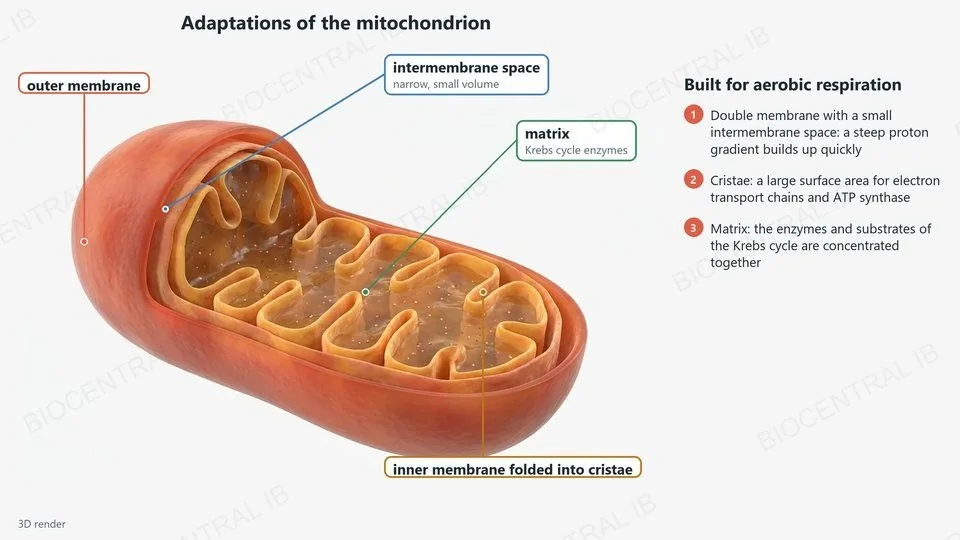
Mitochondria are adapted to produce ATP by aerobic cell respiration.
  • A double membrane with a small intermembrane space: protons pumped into it quickly build up a steep gradient for ATP synthase.
  • The inner membrane is folded into cristae, giving a large surface area for the electron transport chain and ATP synthase.
  • The matrix holds the enzymes and substrates of the Krebs cycle, compartmentalized together.
LinkCell respiration is in C1.2.
A 3D cutaway render of a mitochondrion, labelled: outer membrane, inner membrane folded into cristae, small intermembrane space, and matrix containing the enzymes and substrates of the Krebs cycle
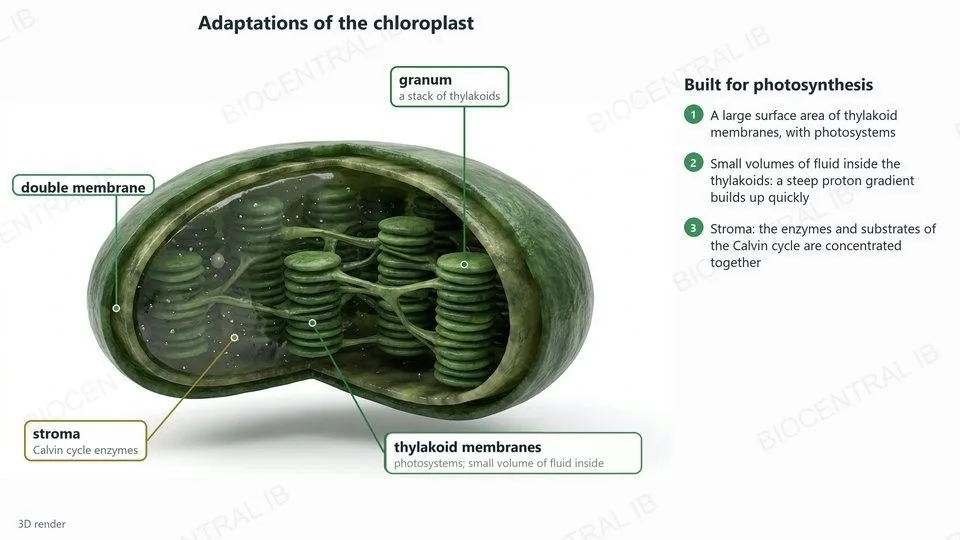
A 3D cutaway render of a chloroplast, labelled: double membrane, thylakoids stacked into grana with photosystems, small volume of fluid inside the thylakoids, and stroma containing the enzymes and substrates of the Calvin cycle
B2.2.5 · HL

The chloroplast

Chloroplasts are adapted for photosynthesis.
  • Thylakoid membranes, stacked into grana, give a large surface area for the photosystems.
  • The fluid inside the thylakoids has a small volume, so a steep proton gradient builds up quickly.
  • The stroma holds the enzymes and substrates of the Calvin cycle, compartmentalized together.
CompareMitochondria and chloroplasts both use large membrane areas and small spaces.
B2.2.6 · HL

The nuclear envelope

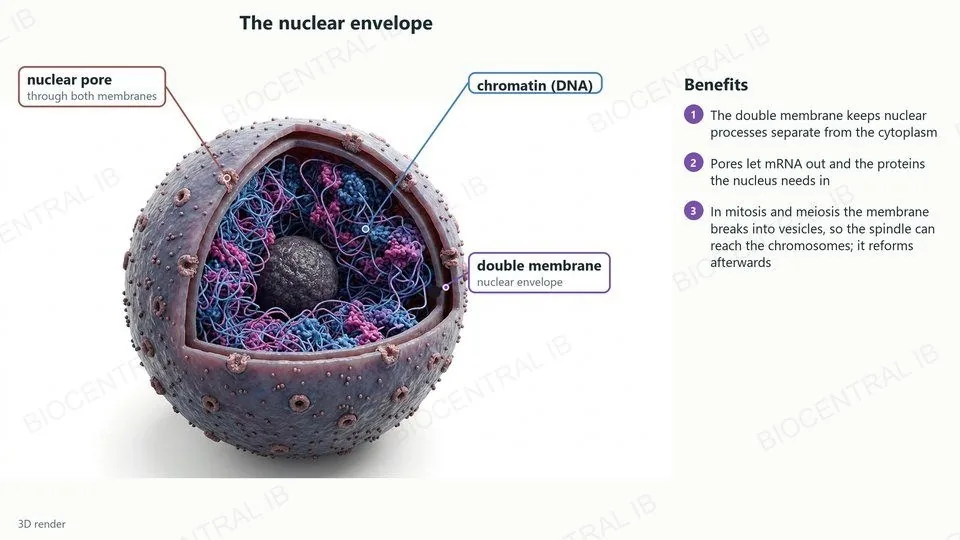
The nucleus is surrounded by a double membrane: the nuclear envelope.
  • The envelope keeps the processes of the nucleus separate from the cytoplasm.
  • It needs pores, which pass through both membranes: mRNA leaves the nucleus through them, and proteins needed in the nucleus enter.
  • During mitosis and meiosis the envelope breaks into vesicles, so the spindle can reach the chromosomes; it reforms around each new nucleus.
LinkMitosis and meiosis are in D2.1.
A 3D cutaway render of a nucleus with a double membrane and nuclear pores, labelled with the benefits of the double membrane and pores
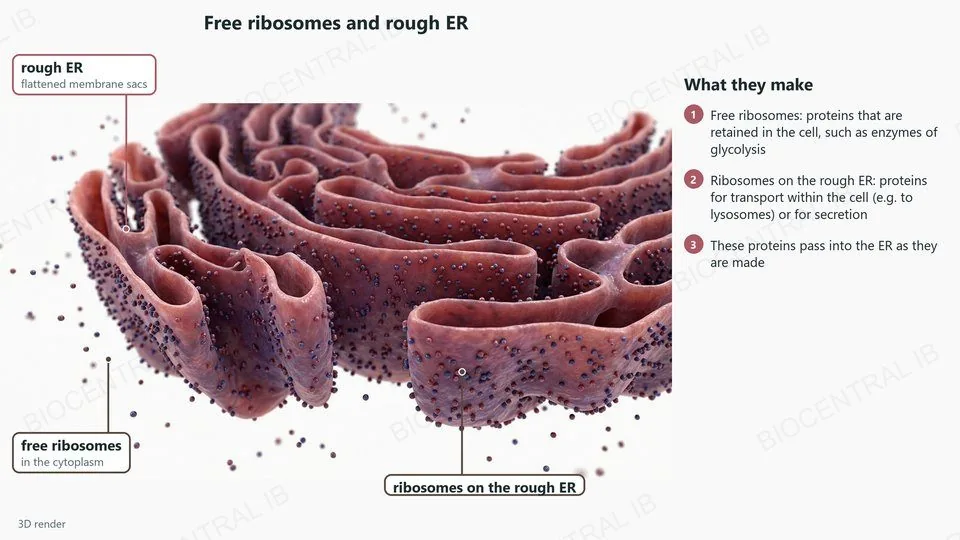
A 3D render of rough endoplasmic reticulum with ribosomes on its surface and free ribosomes in the cytoplasm nearby, labelled with what each kind of ribosome makes
B2.2.7 · HL

Free ribosomes and rough ER

Ribosomes are either free in the cytoplasm or attached to the rough endoplasmic reticulum (rough ER).
  • Free ribosomes make proteins that are retained in the cell, for example enzymes of glycolysis.
  • The rough ER is a network of flattened membrane sacs with ribosomes attached to its outer surface.
  • Its ribosomes make proteins for transport within the cell, for example to lysosomes, and for secretion; the proteins enter the ER as they are made.
ExamplePancreatic cells that secrete digestive enzymes are packed with rough ER.
B2.2.8 · HL

The Golgi apparatus

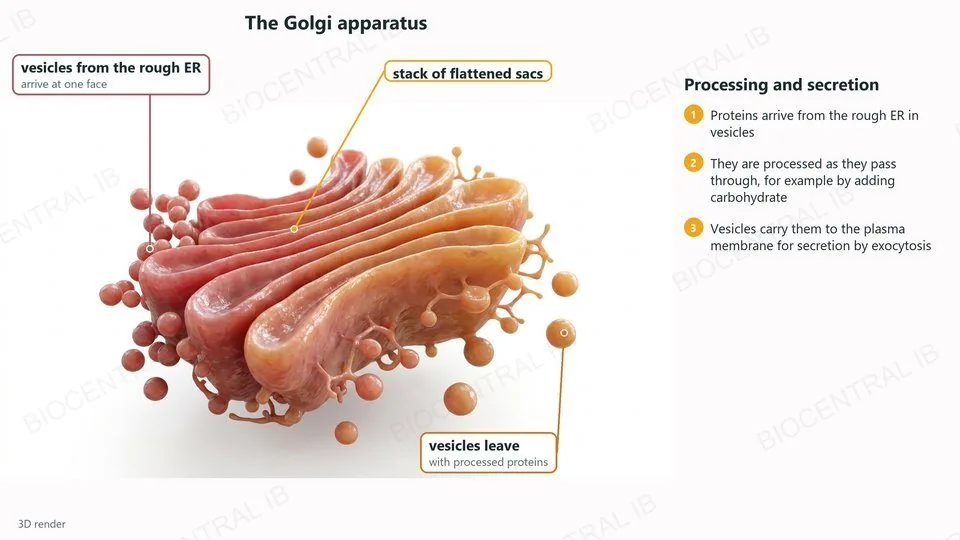
The Golgi apparatus processes proteins and prepares them for secretion.
  • It is a stack of flattened membrane sacs, curved like a pile of plates.
  • Vesicles from the rough ER bring proteins to one face; the proteins are processed as they pass through, for example by adding carbohydrate.
  • Vesicles carrying the processed proteins bud off the other face and move to the plasma membrane, where the proteins are secreted.
RememberRibosomes make proteins; the Golgi apparatus processes them.
A 3D render of a Golgi apparatus: a stack of flattened sacs, with vesicles from the rough ER arriving at one face and vesicles carrying processed proteins leaving the other face
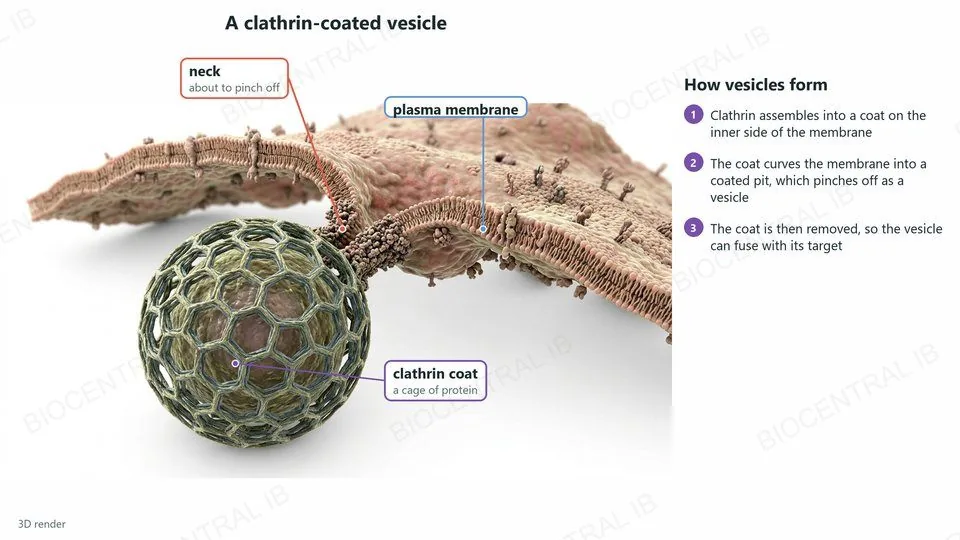
A 3D render of a clathrin-coated vesicle, covered in a cage of clathrin protein, still joined by a narrow neck to the plasma membrane
B2.2.9 · HL

Vesicles and clathrin

Vesicles are small sacs of membrane that carry materials between compartments and to the plasma membrane.
  • Vesicles bud off one membrane and fuse with another, so their contents never mix with the cytoplasm.
  • Clathrin is a protein that assembles into a coat on the inner side of a membrane, curving it into a coated pit that pinches off as a vesicle.
  • Example: cells take in LDL by clathrin-coated vesicles (endocytosis); the coat is then removed.
LinkEndocytosis and exocytosis are in B2.1.
B2.2.7 – B2.2.9 · HL

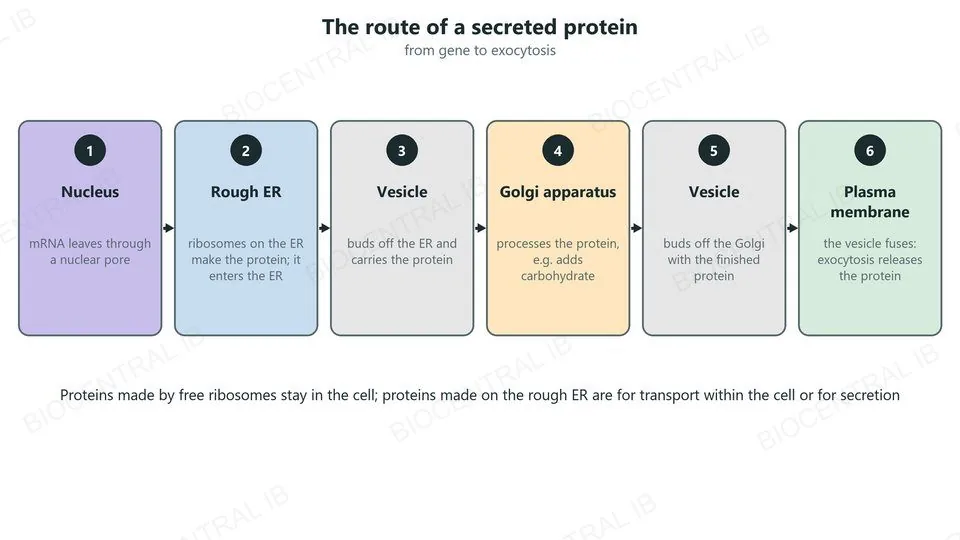
The route of a secreted protein

Organelles work together to make and secrete proteins.
  • mRNA leaves the nucleus through a pore and is translated by ribosomes on the rough ER.
  • The protein enters the ER and is carried in a vesicle to the Golgi apparatus, which processes it.
  • A vesicle carries the finished protein to the plasma membrane, where exocytosis releases it from the cell.
ExampleDigestive enzymes and peptide hormones such as insulin follow this route.
Six steps in the route of a secreted protein: mRNA leaves the nucleus; ribosomes on the rough ER make the protein, which enters the ER; a vesicle carries it to the Golgi apparatus; the Golgi processes it; a vesicle carries it to the plasma membrane; exocytosis releases it
Quick check · HL

A protein is made by ribosomes on the rough ER. Where is it most likely to go?

it stays dissolved in the cytoplasm
it is secreted from the cell
it enters the nucleus
it enters a mitochondrion
Correct answer: it is secreted from the cell. Ribosomes on the rough ER make proteins for transport within the cell or for secretion. Free ribosomes make proteins that stay in the cell.

Key vocabulary

Worth being able to define in a single sentence each

Organelle
a discrete subunit of a cell adapted to a specific function.
Compartmentalization
division of a cell into separate membrane-bound spaces.
Cell fractionation
separating the organelles of broken cells by centrifugation.
Post-transcriptional modification
changes made to mRNA after transcription.
Lysosome
a vesicle of hydrolytic enzymes that works at about pH 5.
Phagocytic vacuole
a vacuole enclosing engulfed material, such as a bacterium.

Key vocabulary · HL

Additional higher level terms

Cristae
folds of the inner mitochondrial membrane.
Matrix
the inside of a mitochondrion, where the Krebs cycle happens.
Thylakoid
a flattened membrane sac in a chloroplast, with photosystems.
Stroma
the fluid of a chloroplast, where the Calvin cycle happens.
Nuclear pore
a channel through both membranes of the nuclear envelope.
Rough ER
ER with ribosomes that make proteins for transport or secretion.
Golgi apparatus
a stack of sacs that processes proteins for secretion.
Clathrin
a protein whose coat helps vesicles form.

Where this shows up again

D1.2 · Protein synthesis
What happens to mRNA in the nucleus before it is translated?
C1.2 · Cell respiration
How do the cristae and the matrix of the mitochondrion support the stages of aerobic respiration?
C1.3 · Photosynthesis
Which stages of photosynthesis happen on the thylakoids and which in the stroma?
B2.1 · Membranes and membrane transport
How does membrane fluidity allow vesicles to form and fuse?

B2.2 Organelles and compartmentalization — one-page recap

Screenshot this slide to revise from

Organelles
  • Discrete subunits: nucleus, ribosomes, vesicles, plasma membrane…
  • Not organelles: cell wall, cytoskeleton, cytoplasm. NOS: ultracentrifuges.
Nucleus and cytoplasm
  • Transcription and translation separated.
  • mRNA is modified before it meets ribosomes; not possible in prokaryotes.
Compartments
  • Concentrate enzymes and metabolites; separate incompatible processes.
  • Lysosomes (pH 5) and phagocytic vacuoles.
HL · Mitochondria and chloroplasts
  • Mitochondrion: small intermembrane space, cristae, Krebs enzymes in matrix.
  • Chloroplast: large thylakoid area, small thylakoid volume, Calvin enzymes in stroma.
HL · Nucleus and ribosomes
  • Double envelope with pores; breaks into vesicles in mitosis and meiosis.
  • Free ribosomes: proteins kept in the cell; rough ER: transport and secretion.
HL · Golgi and vesicles
  • Golgi processes proteins for secretion.
  • Vesicles move materials; clathrin coats help them form.
Next step

Now test yourself on B2.2

Reading the slides is half the job. The other half is answering questions the way the exam asks them.

28 quiz questions5 data questions5 exam questionsmarkschemes included

Unlock every lesson with Pro — quizzes, data questions and exam papers. Two lessons are completely free to try: A1.1 Water and B1.1 Carbohydrates and lipids.

One-page summary, key terms and sample questions for B2.2 →

One cell, many rooms.

Each compartment keeps its own conditions, so the cell can do many jobs at once.
B2.2 Organelles and compartmentalization · BioCentral IB
Use ↓ ↑ or click to navigate
01 / 20