
BioCentral IBBioCentral IB
IB Biology · Theme B · B1.1

Carbohydrates and lipids

How a few kinds of atom build energy stores, plant cell walls and membranes. SL and HL study the same content.
Guiding questions

In what ways do variations in form allow diversity of function in carbohydrates and lipids?

How do carbohydrates and lipids compare as energy storage compounds?

Part one

Carbon and macromolecules

B1.1.1 – B1.1.3
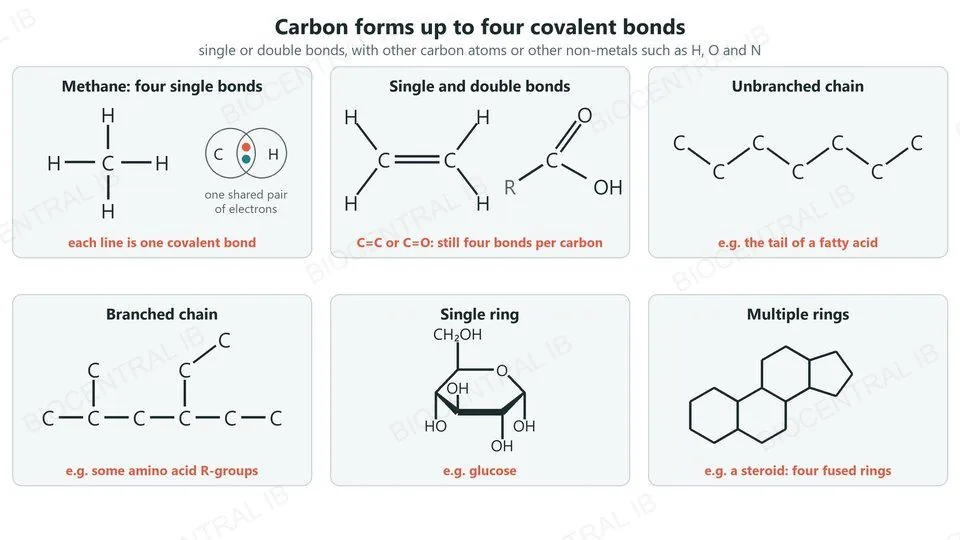
Six panels on carbon bonding: methane with four single bonds and a close-up of one bond as a shared pair of electrons; ethene with a C=C double bond and a carboxyl group with a C=O double bond; an unbranched chain of carbon atoms; a branched chain; a single ring (glucose); and multiple fused rings (a steroid)
B1.1.1

Carbon builds diverse compounds

A covalent bond is a pair of electrons shared between two atoms. A carbon atom can form up to four covalent bonds.
  • Carbon can form four single bonds, or a mix of single and double bonds, with other carbon atoms or with atoms of other non-metals such as hydrogen, oxygen and nitrogen.
  • Carbon atoms join into unbranched or branched chains, and into single or multiple rings.
  • Groups such as –OH, –COOH and –NH₂ attached to these carbon skeletons give each molecule its own properties.
Why it mattersThis versatility is why carbon compounds are the basis of all life, from sugars and fats to proteins and DNA.
B1.1.1 · Nature of science

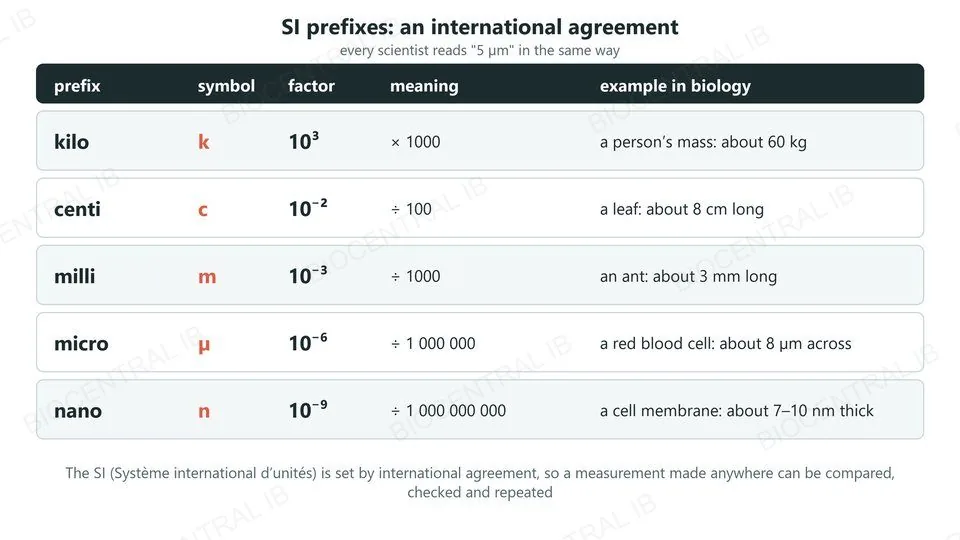
SI prefixes: an international agreement

Scientific conventions are based on international agreement, so scientists everywhere use the same units.
  • kilo (k) = 10³, centi (c) = 10⁻², milli (m) = 10⁻³, micro (µ) = 10⁻⁶ and nano (n) = 10⁻⁹.
  • Biology uses the small prefixes most: cells are measured in micrometres, and membranes and molecules in nanometres.
  • Because the prefixes are agreed internationally through the SI, a result such as “5 µm” means the same in every laboratory.
Nature of scienceShared conventions let scientists compare, check and repeat each other’s measurements.
A table of SI prefixes: kilo, k, 10 to the 3 (a person of about 60 kg); centi, c, 10 to the minus 2 (a leaf about 8 cm long); milli, m, 10 to the minus 3 (an ant about 3 mm long); micro, µ, 10 to the minus 6 (a red blood cell about 8 µm across); nano, n, 10 to the minus 9 (a cell membrane about 7 to 10 nm thick)
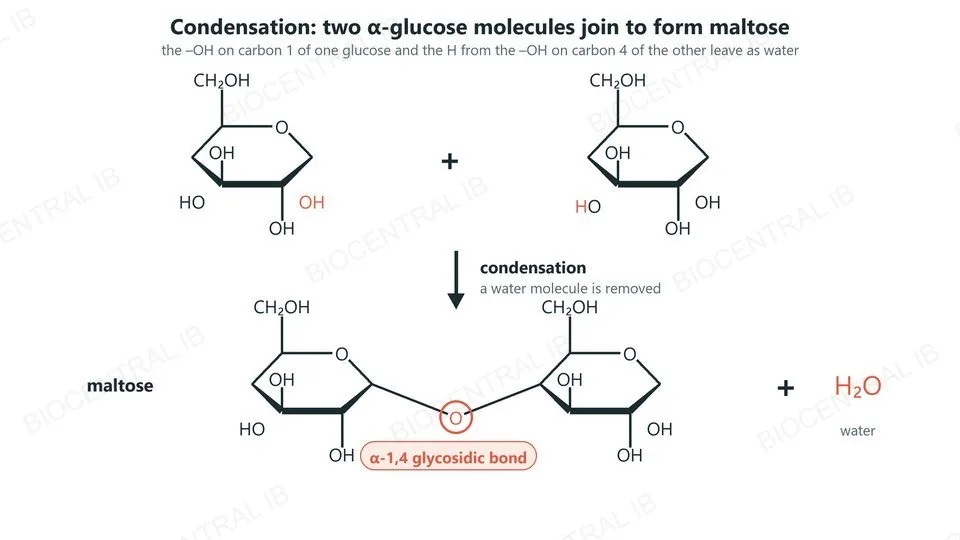
Two alpha-glucose molecules join by condensation. The OH on carbon 1 of the first and the H of the OH on carbon 4 of the second are highlighted; they leave as water, forming maltose with an alpha-1,4 glycosidic bond
B1.1.2

Condensation builds polymers

A condensation reaction links two monomers with a covalent bond and releases a molecule of water.
  • When two α-glucose molecules join, the –OH on carbon 1 of one and an –H from the –OH on carbon 4 of the other form water, leaving a glycosidic bond.
  • Repeating the reaction adds monomers one at a time, building a long polymer.
  • Condensation builds polysaccharides from monosaccharides, polypeptides from amino acids and nucleic acids from nucleotides.
RememberEvery bond made by condensation releases one water molecule.
B1.1.3

Digestion by hydrolysis

Digestion is the breakdown of large, insoluble polymers into small, soluble monomers that can be absorbed.
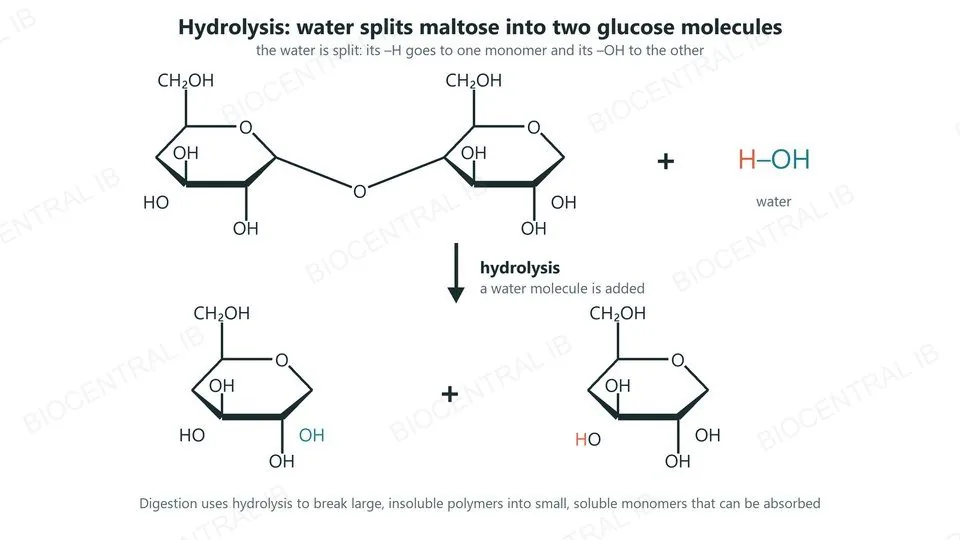
  • Digestion works by hydrolysis: water is added and the bond between two monomers breaks.
  • The water molecule is split: its –H joins one monomer and its –OH joins the other, which is where the name comes from (“splitting by water”).
  • Polysaccharides are hydrolysed to monosaccharides, polypeptides to amino acids and nucleic acids to nucleotides.
Why it mattersHydrolysis is condensation in reverse: the same bond is made by removing water and broken by adding it.
Maltose and water react by hydrolysis. The water splits: its H goes to the oxygen on carbon 4 of one glucose and its OH to carbon 1 of the other, giving two alpha-glucose molecules
Part two

Carbohydrates

B1.1.4 – B1.1.7
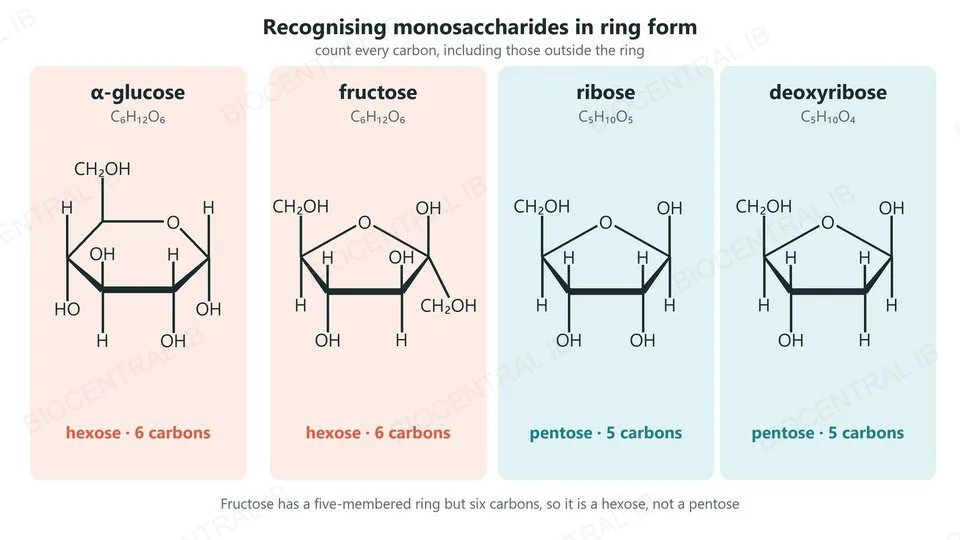
Ring diagrams of four monosaccharides: alpha-glucose and fructose are hexoses with six carbons, ribose and deoxyribose are pentoses with five carbons. Fructose has a five-membered ring but six carbons
B1.1.4

Monosaccharides: pentoses and hexoses

A monosaccharide is a single sugar unit. In cells, most monosaccharides exist as rings.
  • Pentoses have five carbon atoms, such as ribose and deoxyribose; hexoses have six, such as glucose and fructose.
  • To recognise one, count every carbon atom, including those outside the ring: fructose has a five-membered ring but six carbons, so it is a hexose.
  • α-glucose and β-glucose differ only in the –OH on carbon 1: below the ring in α-glucose, above it in β-glucose.
SkillYou need to recognise these ring diagrams; you do not need to draw them.
B1.1.4

Glucose: properties and use

Glucose is the main fuel of cells, and its properties suit that job.
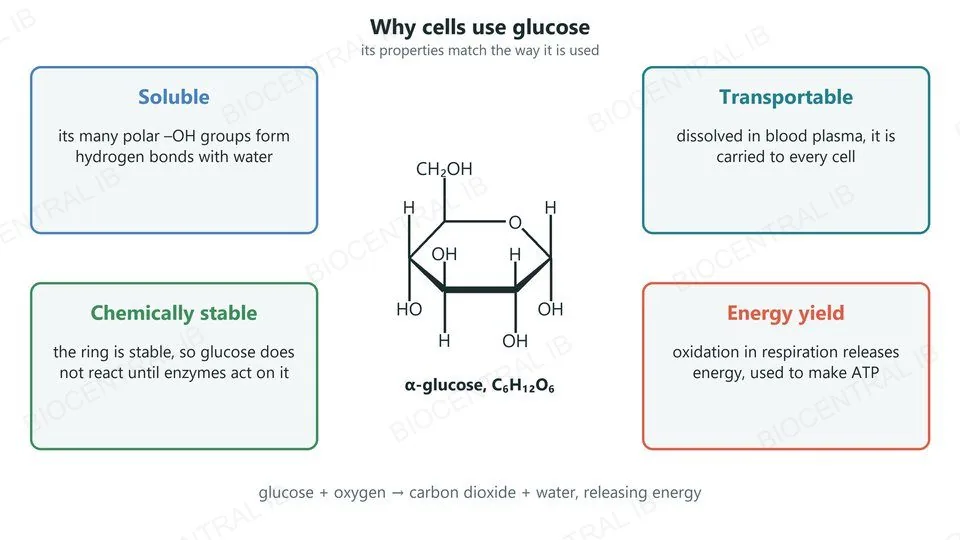
  • Solubility: its polar –OH groups form hydrogen bonds with water, so it dissolves.
  • Transportability: dissolved in blood plasma, it is carried to every cell in the body.
  • Chemical stability: its ring is stable, so it does not react until an enzyme acts on it.
  • Energy yield: oxidising it in respiration releases energy, used to make ATP.
LinkBecause glucose dissolves, cells store it as large insoluble polymers instead (next slides).
An alpha-glucose ring surrounded by four properties: soluble, transportable, chemically stable and a high energy yield when oxidised
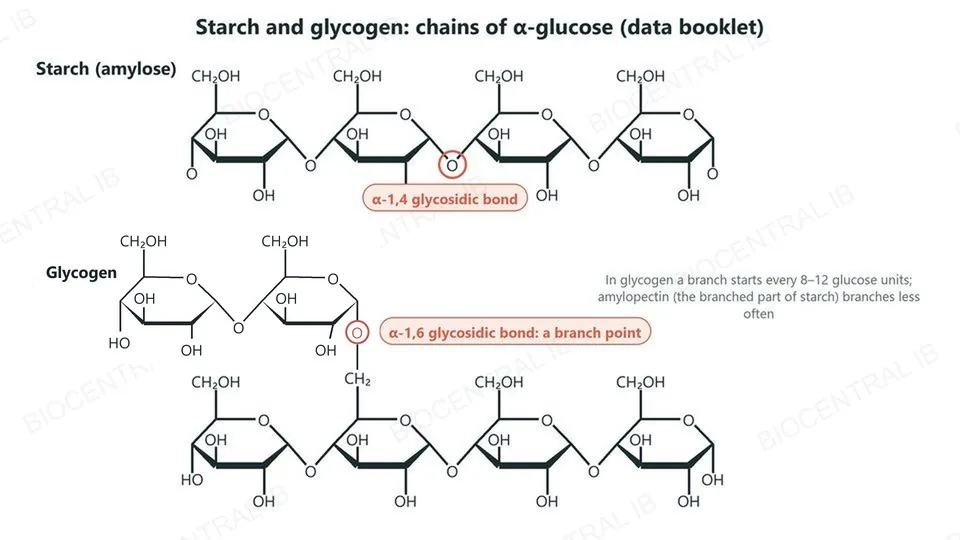
Data-booklet structures: amylose as a chain of alpha-glucose joined by alpha-1,4 glycosidic bonds, and glycogen with a branch joined by an alpha-1,6 glycosidic bond at a CH2 group
B1.1.5

Starch and glycogen: energy stores

Starch in plants and glycogen in animals are polymers of α-glucose that store energy.
  • Amylose, one form of starch, is an unbranched chain of α-glucose joined by 1,4 glycosidic bonds; the chain coils into a helix.
  • Amylopectin, the other form of starch, and glycogen are branched: a 1,6 glycosidic bond starts each branch, and glycogen branches more often.
  • The structures of starch and glycogen are given in the data booklet.
Data bookletFind the α-1,4 and α-1,6 glycosidic bonds in the booklet diagrams.
B1.1.5

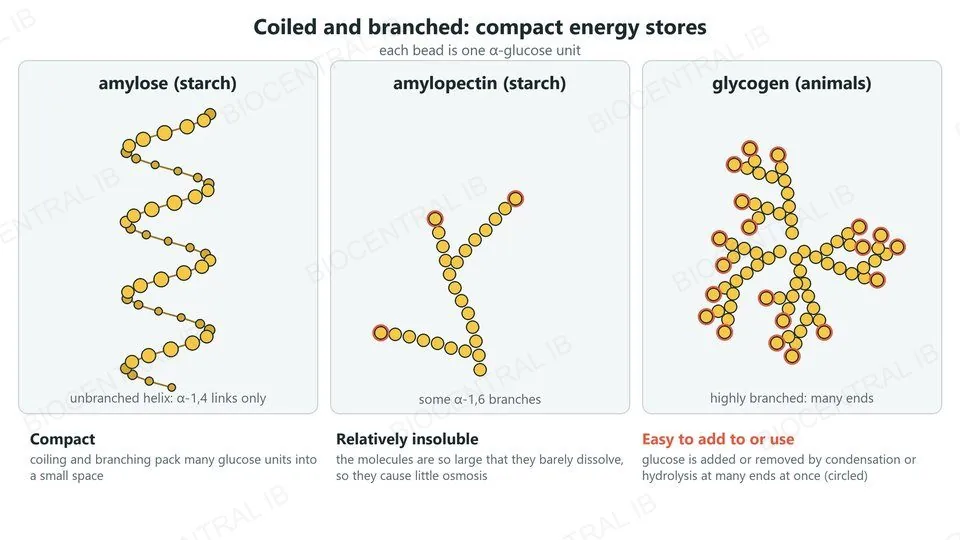
Why coils and branches suit storage

Coiling and branching during polymerization make starch and glycogen good energy stores.
  • Compact: coiling and branching pack many glucose units into a small space.
  • Relatively insoluble: the molecules are so large that they barely dissolve, so they draw little water into the cell by osmosis.
  • Easy to build up or mobilise: α-glucose is added by condensation or removed by hydrolysis at the chain ends, and branching gives many ends.
CompareGlycogen is the most branched, so animals can release glucose from it quickly.
Bead models of amylose coiled into an unbranched helix, amylopectin with a few branches, and glycogen highly branched with many free ends circled
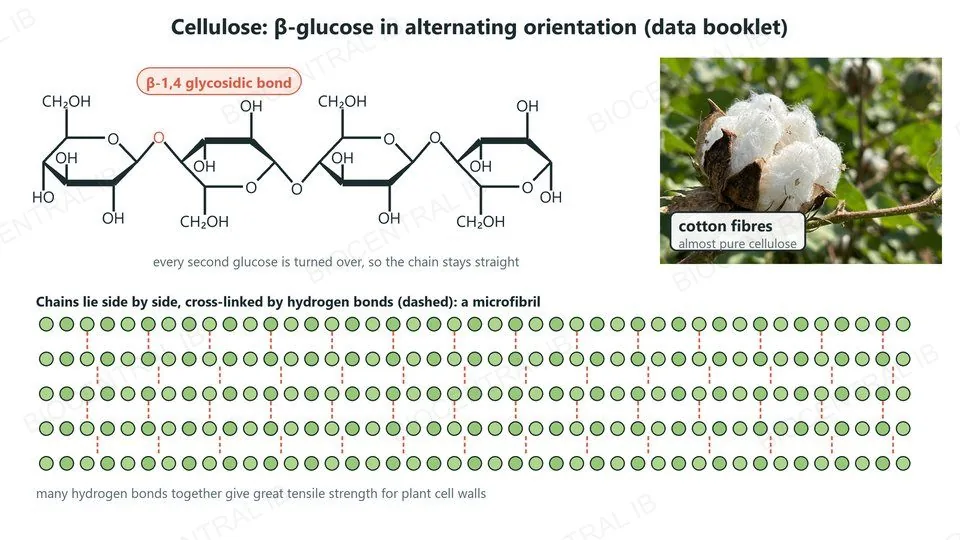
Data-booklet structure of cellulose: beta-glucose units joined by beta-1,4 glycosidic bonds, every second unit turned over. Below, parallel chains cross-linked by hydrogen bonds form a microfibril, and a photo of cotton fibres, which are almost pure cellulose
B1.1.6

Cellulose: a structural polysaccharide

Cellulose is a polymer of β-glucose and the main material of plant cell walls.
  • β-glucose monomers are joined by 1,4 glycosidic bonds, with every second monomer turned over, so their orientation alternates.
  • This gives straight, unbranched chains, which lie side by side in bundles called microfibrils.
  • Hydrogen bonds cross-link neighbouring chains; there are so many that cellulose has great tensile strength.
Why it mattersStrong cell walls resist the pressure of the water inside plant cells, so plants stay firm.
B1.1.7

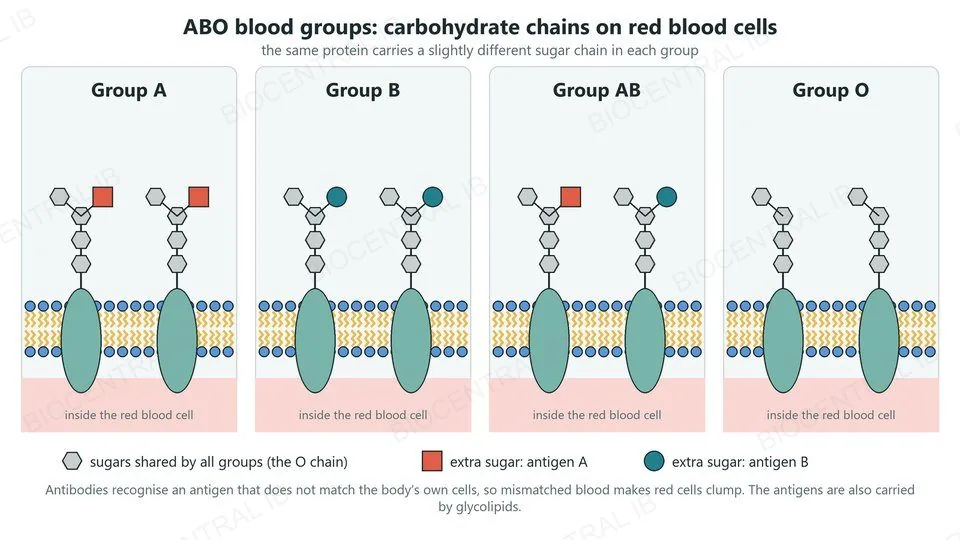
Glycoproteins and cell recognition

A glycoprotein is a protein with carbohydrate chains attached, usually facing out from the cell surface.
  • The carbohydrate chains act as markers that other cells, such as white blood cells, recognise.
  • The ABO blood groups are an example: red blood cells carry antigen A, antigen B, both or neither, depending on one extra sugar at the end of the chain.
  • People make antibodies against the A or B antigen if their own cells lack it, so transfused cells of a mismatched group clump.
ExampleGroup O red cells carry neither antigen, so they can usually be given to people of any ABO group.
Red blood cell membranes of groups A, B, AB and O, each with glycoproteins carrying a chain of shared sugars. Group A adds one extra sugar (antigen A), group B a different extra sugar (antigen B), group AB both and group O neither
Quick check

Starch and cellulose are both polymers of glucose. Why do amylose chains coil while cellulose chains are straight?

α-glucose in amylose; alternating β-glucose in cellulose
cellulose chains contain many more glucose units
amylose monomers are joined by hydrogen bonds
cellulose monomers are joined by peptide bonds
Correct answer: the type of glucose. Amylose is made of α-glucose, which gives a coiling chain. Cellulose is made of β-glucose with every second unit turned over, which keeps the chain straight. Both are joined by glycosidic bonds.
Part three

Lipids

B1.1.8 – B1.1.13
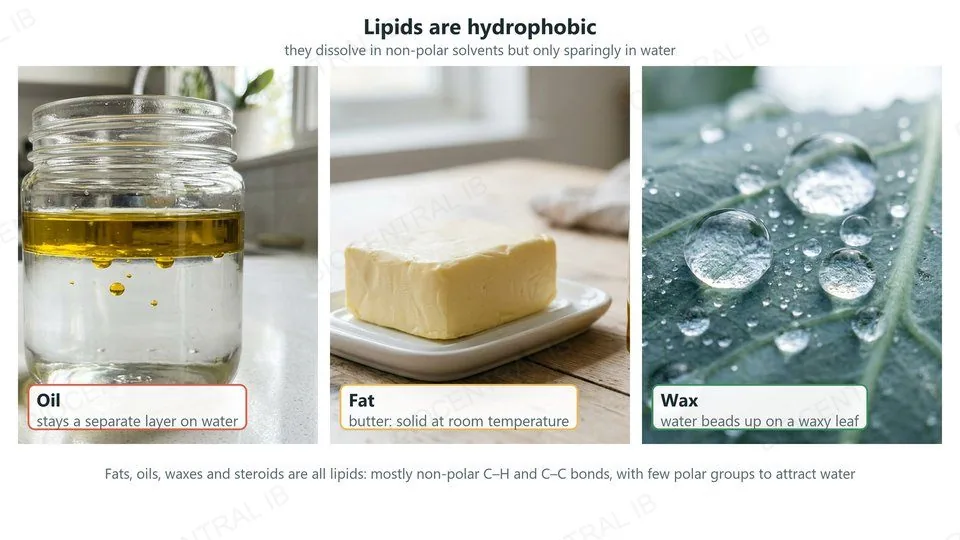
Three photos: a layer of oil floating on water in a jar, a block of butter, and water drops beading on a waxy cabbage leaf
B1.1.8

Lipids are hydrophobic

Lipids are substances in living organisms that dissolve in non-polar solvents but are only sparingly soluble in water.
  • Lipids include fats, oils, waxes and steroids.
  • They are made mostly of non-polar C–H and C–C bonds, with few polar groups to attract water molecules.
  • So oil forms a separate layer on water, and rain beads up on a waxy leaf instead of wetting it.
Why it mattersBeing hydrophobic lets lipids store energy without water, waterproof surfaces and form the core of membranes.
B1.1.9

Triglycerides and phospholipids

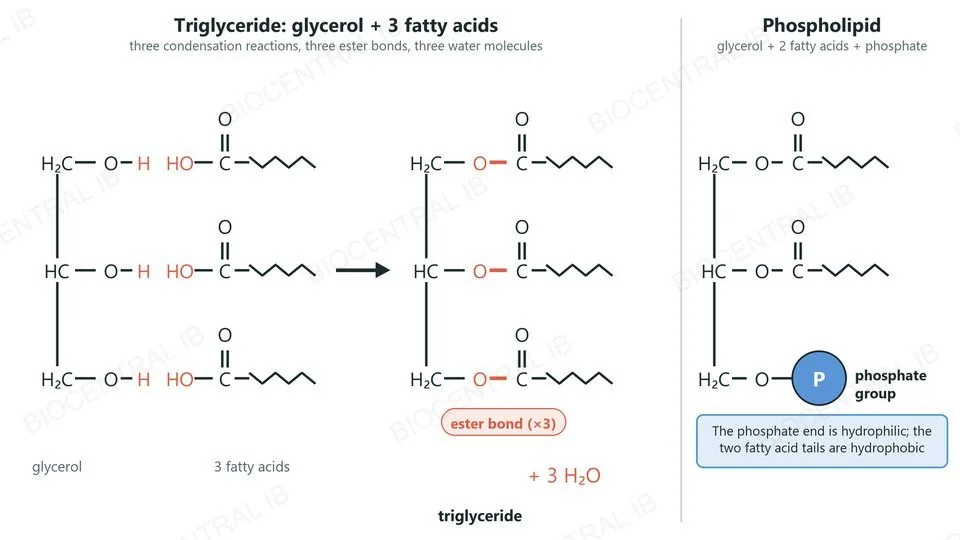
Both are made by condensation reactions between glycerol and other molecules.
  • One glycerol molecule can link to three fatty acids, forming a triglyceride and three molecules of water.
  • Each link is an ester bond, formed between an –OH of glycerol and the –COOH of a fatty acid.
  • In a phospholipid, glycerol is linked to two fatty acids and one phosphate group.
CompareA triglyceride is hydrophobic all over; the phosphate group makes one end of a phospholipid hydrophilic.
Glycerol and three fatty acids react by condensation: the H of each glycerol OH and the OH of each fatty acid carboxyl group leave as three water molecules, forming three ester bonds in a triglyceride. Beside it, a phospholipid: glycerol with two fatty acids and a phosphate group
Data-booklet structures of three 18-carbon fatty acids: stearic acid, saturated, with no C=C double bonds; oleic acid, monounsaturated, with one cis C=C double bond; linoleic acid, polyunsaturated, with two cis C=C double bonds. At each double bond both hydrogen atoms are on the same side of the chain.
B1.1.10

Saturated and unsaturated fatty acids

Fatty acids differ in the number of C=C double bonds in their hydrocarbon chain.
  • Saturated fatty acids have no C=C double bonds, for example stearic acid.
  • Monounsaturated fatty acids have one C=C double bond, for example oleic acid.
  • Polyunsaturated fatty acids have two or more C=C double bonds, for example linoleic acid.
  • All three examples are drawn in the data booklet; each double bond is cis, with both hydrogen atoms on the same side of the chain.
Data bookletCount the C=C bonds in a chain to decide which type a fatty acid is.
B1.1.10

Double bonds lower the melting point

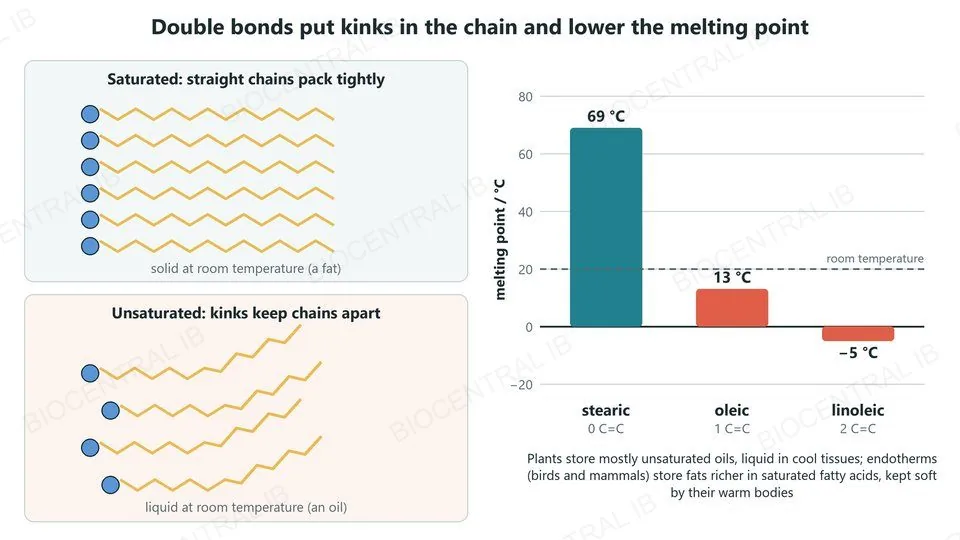
Straight saturated chains pack closely; C=C double bonds usually put kinks in the chain.
  • Kinked chains cannot pack tightly, so unsaturated fatty acids melt at lower temperatures: stearic acid at about 69 °C, oleic acid at about 13 °C.
  • Plants store energy mostly as unsaturated oils, which stay liquid in plant tissues even when they are cool.
  • Endotherms (birds and mammals) store fats with more saturated fatty acids; their warm bodies keep these fats soft.
ExampleOlive oil, from a plant, is liquid at room temperature; butter, from a mammal’s milk, is solid.
Straight saturated chains packed tightly beside kinked unsaturated chains packed loosely, and a bar chart of melting points: stearic acid about 69 °C, oleic acid about 13 °C and linoleic acid about minus 5 °C, with room temperature marked at 20 °C
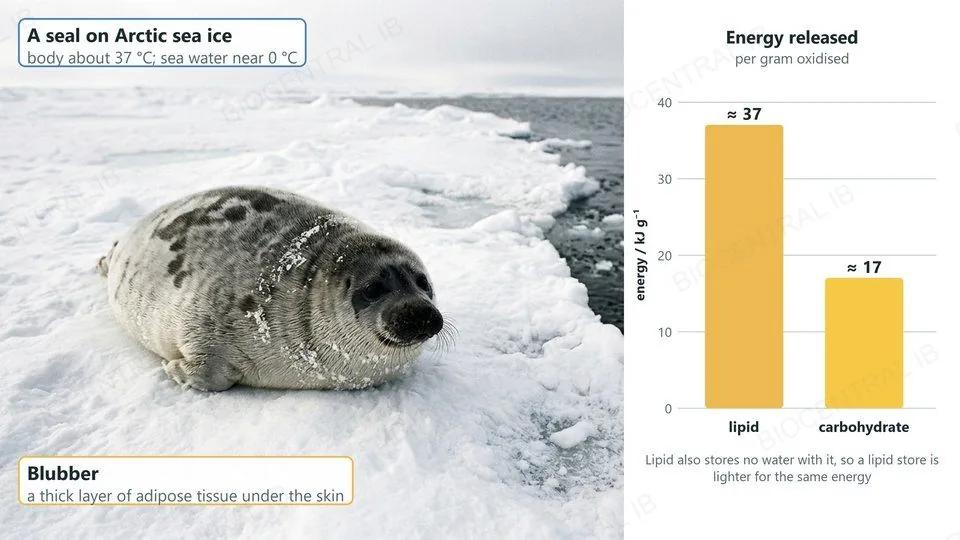
A seal on Arctic sea ice, labelled with its blubber, a thick layer of adipose tissue, and its body temperature of about 37 °C in water near 0 °C; beside it a bar chart: lipid releases about 37 kJ per gram, carbohydrate about 17 kJ per gram
B1.1.11

Adipose tissue: store and insulator

Triglycerides in adipose tissue are used for long-term energy storage and for thermal insulation.
  • Oxidising triglycerides releases about twice as much energy per gram as carbohydrate, and they are stored without water, so the store is light.
  • They are insoluble, so even large stores have no osmotic effect on cells.
  • Fat conducts heat poorly: a seal’s thick blubber keeps its body at about 37 °C in sea water near 0 °C.
HabitatEndotherms that live in cold places, such as seals and whales, tend to have thick insulating layers of fat.
B1.1.12

Phospholipid bilayers

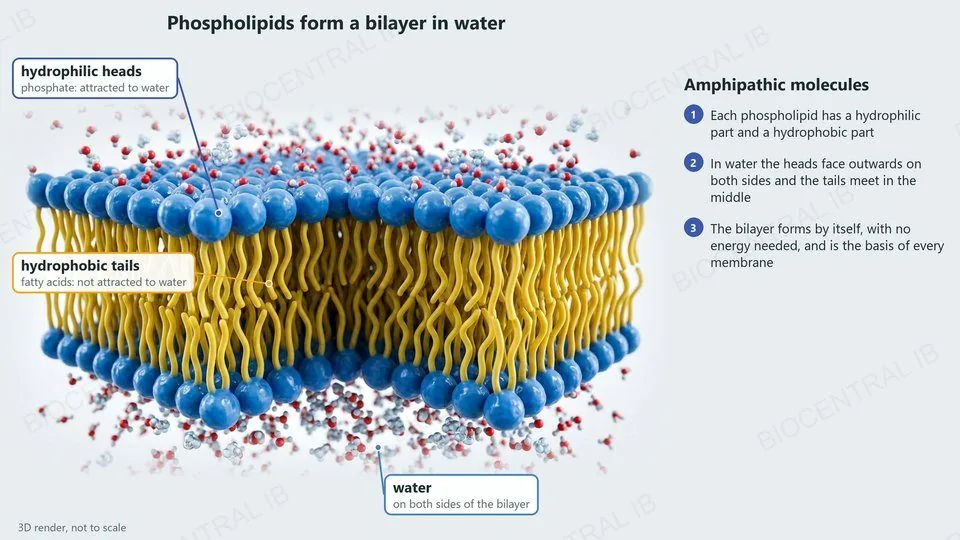
Phospholipids are amphipathic: each molecule has a hydrophilic part and a hydrophobic part.
  • The phosphate head is attracted to water; the two fatty acid tails are not.
  • In water, phospholipids arrange themselves into a double layer: heads face the water on both sides and tails face each other in the middle.
  • This bilayer forms by itself, with no energy needed, and it is the basis of every cell membrane.
LinkB2.1 builds on this: the hydrophobic core makes the membrane a barrier.
A 3D render of a phospholipid bilayer in water. Blue hydrophilic phosphate heads face the water on both sides; yellow hydrophobic fatty acid tails meet in the middle. The bilayer forms by itself, with no energy needed, and is the basis of every membrane
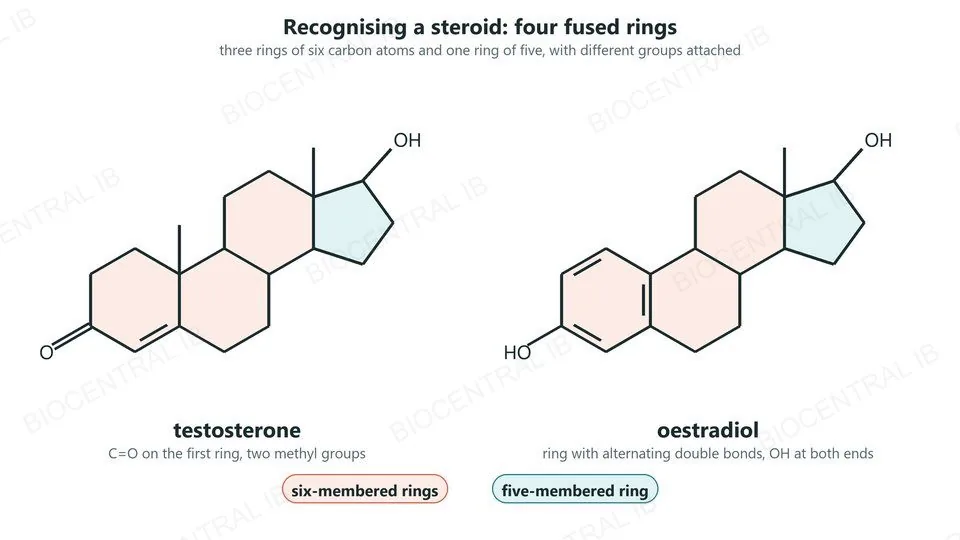
Skeletal formulas of testosterone and oestradiol, each with four fused rings: three six-membered rings and one five-membered ring
B1.1.13

Recognising steroids

Steroids are lipids built on four fused rings of carbon atoms: three six-membered rings and one five-membered ring.
  • Oestradiol and testosterone are steroid hormones; cholesterol is another steroid.
  • Different groups attached to the same four-ring skeleton give each steroid its own properties.
  • To identify a steroid in a molecular diagram, look for the four fused rings.
SkillYou should be able to identify a compound as a steroid from its molecular diagram.
B1.1.13

Steroids cross membranes

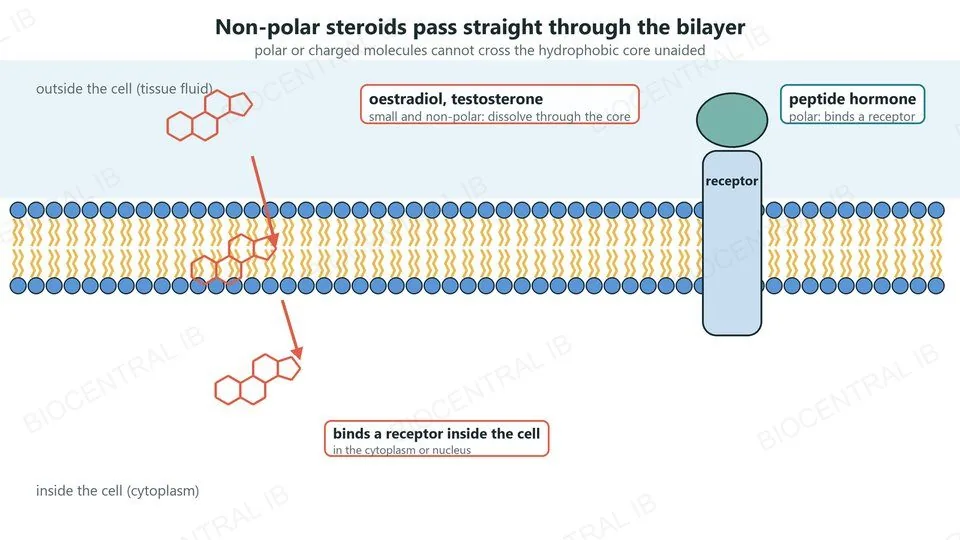
Steroids are non-polar, so they can pass through the phospholipid bilayer.
  • Oestradiol and testosterone dissolve into the hydrophobic core of the membrane and diffuse straight through it, with no channel or carrier protein.
  • Inside a target cell they bind receptors in the cytoplasm or nucleus.
  • Polar or charged molecules, such as peptide hormones, cannot cross the hydrophobic core, so they bind receptors on the cell surface.
Why it mattersWhether a hormone can cross the membrane decides where its receptor has to be.
A steroid molecule diffusing from outside the cell through the hydrophobic core of the bilayer to a receptor inside the cell, while a peptide hormone binds a receptor in the membrane surface
Quick check

Oestradiol can enter its target cells without the help of a membrane protein, but a peptide hormone cannot. Why?

oestradiol is a far larger molecule
peptide hormones break down in blood
oestradiol is non-polar, so it dissolves through the bilayer
oestradiol is pumped in by active transport
Correct answer: oestradiol is non-polar. As a steroid it dissolves into the hydrophobic core of the bilayer and diffuses through. Peptide hormones are polar, so they cannot cross and bind receptors on the cell surface instead.

Key vocabulary

Worth being able to define in a single sentence each

Condensation
joins two monomers with a covalent bond, releasing water.
Hydrolysis
splits a bond between monomers by adding water.
Digestion
breakdown of large insoluble polymers into small soluble monomers.
Monosaccharide
a single sugar unit, such as glucose or ribose.
Polysaccharide
a polymer of monosaccharides, such as starch or cellulose.
Glycoprotein
a protein with carbohydrate chains attached.
Lipid
dissolves in non-polar solvents, only sparingly in water.
Triglyceride
glycerol linked to three fatty acids by ester bonds.
Amphipathic
having both a hydrophilic part and a hydrophobic part.
Steroid
a lipid with four fused carbon rings.

Where this shows up again

A1.1 · Water
The solvent properties of water are essential for the transport of glucose in blood plasma. How does the polarity of glucose enable it to dissolve and be transported?
B2.1 · Membranes
How does the structure of phospholipids underpin the formation and selective permeability of cell membranes?
B1.2 / B2.1 · Proteins and membranes
How do the properties of amino acid R-groups decide whether part of a protein sits in the hydrophobic core of a membrane or faces water?
C1.2 · Respiration
During long periods without food the body shifts from using carbohydrate to using lipid. How does this relate to the roles of glycogen and adipose tissue?

B1.1 Carbohydrates and lipids — one-page recap

Screenshot this slide to revise from

Carbon and polymers
  • Carbon: up to 4 covalent bonds; chains, branches, rings.
  • Condensation builds polymers (water out); hydrolysis breaks them (water in).
Monosaccharides
  • Pentoses 5 C, hexoses 6 C: count every carbon.
  • Glucose: soluble, transportable, stable, high energy yield.
Polysaccharides
  • Starch and glycogen: coiled and branched α-glucose; compact, insoluble stores.
  • Cellulose: alternating β-glucose; H-bonded microfibrils, strong.
Glycoproteins and lipids
  • Carbohydrate markers on cells, e.g. ABO antigens.
  • Lipids: fats, oils, waxes, steroids; hydrophobic.
Fats
  • Triglyceride = glycerol + 3 fatty acids (ester bonds); phospholipid has a phosphate.
  • More C=C, lower melting point; plants store oils, endotherms fats.
Membranes and steroids
  • Amphipathic phospholipids form bilayers in water.
  • Steroids (four fused rings) are non-polar and cross the bilayer.
Next step

Now test yourself on B1.1

Reading the slides is half the job. The other half is answering questions the way the exam asks them.

40 quiz questions6 data questions5 exam questionsmarkschemes included

This whole lesson is free — notes, quiz, data questions and exam papers. No payment needed.

One-page summary, key terms and sample questions for B1.1 →

Same few atoms, very different jobs.

Change the shape of a molecule and you change what it can do.
B1.1 Carbohydrates and lipids · BioCentral IB
Use ↓ ↑ or click to navigate
01 / 20