BioCentral IBBioCentral IB
IB Biology · Theme A · A4.2

Conservation of biodiversity

Why species are disappearing now, and what conservation does about it. SL and HL study the same content.
Guiding questions

What factors are causing the sixth mass extinction of species?

How can conservationists minimize the loss of biodiversity?

Part one

What biodiversity is, and how much there is

A4.2.1 · A4.2.2
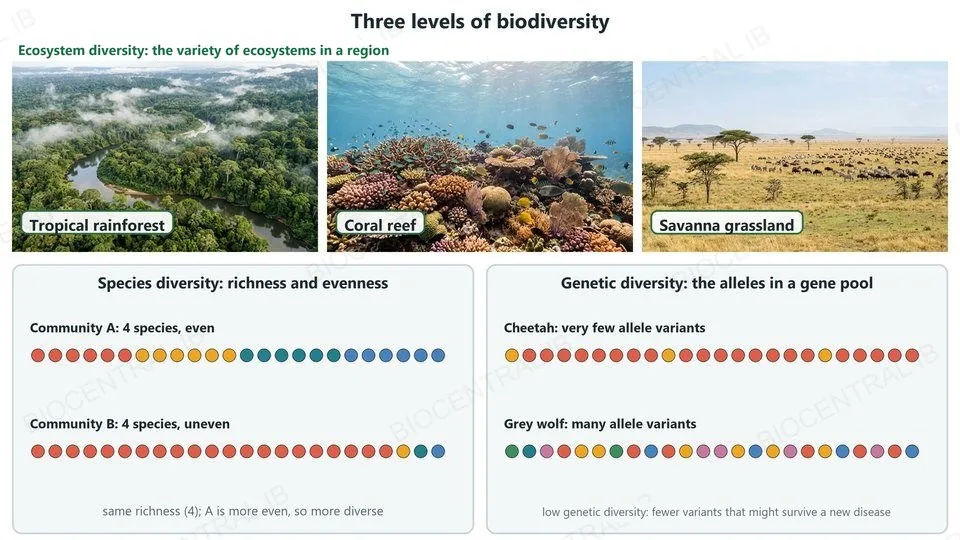
Three levels of biodiversity. Ecosystem diversity: photographs of a tropical rainforest, a coral reef and a savanna grassland. Species diversity: two communities with the same four species, one with individuals spread evenly and one dominated by a single species. Genetic diversity: a cheetah gene pool with very few allele variants and a grey wolf gene pool with many
A4.2.1

Biodiversity: three levels

Biodiversity is the variety of life in all its forms, levels and combinations.
  • Ecosystem diversity is the variety of habitats in a region, such as rainforest, coral reef and grassland.
  • Species diversity has two parts: richness (how many species) and evenness (how evenly individuals are shared between them).
  • Genetic diversity is the range of alleles in a species’ gene pool. Cheetahs have very little, so they have fewer variants to survive a new disease.
Why it mattersAll three levels can be lost separately: an ecosystem can degrade while its species survive, and a species can survive with most of its genetic diversity gone.
A4.2.2

More species than ever before

Millions of species have been discovered, named and described, but many more remain to be discovered.
  • About 2.2 million species have been described; estimates of the total run to about 8.7 million eukaryotes, and far more if microbes are counted.
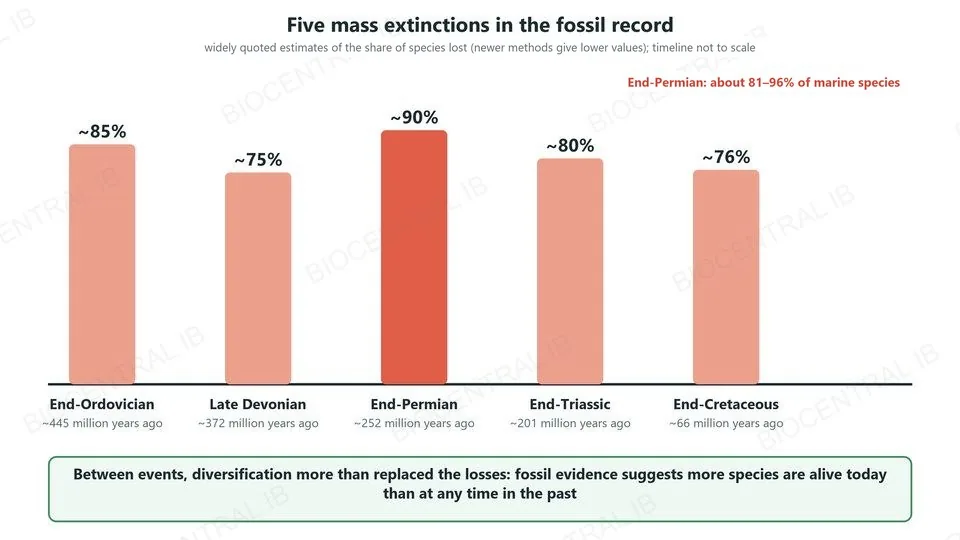
  • The fossil record shows five mass extinctions. The worst, at the end of the Permian about 252 million years ago, removed an estimated 81% to 96% of marine species.
  • Diversification after each one more than replaced the losses: fossil evidence suggests more species are alive today than at any time in the past.
ButMany biologists think a sixth mass extinction has begun, with extinction rates estimated at tens to hundreds of times (IPBES) to about 1000 times the natural background rate.
A bar chart of the five mass extinctions with the approximate share of species lost: end-Ordovician about 445 million years ago, about 85%; Late Devonian about 372 million years ago, about 75%; end-Permian about 252 million years ago, about 90% (an estimated 81% to 96% of marine species); end-Triassic about 201 million years ago, about 80%; end-Cretaceous 66 million years ago, about 76%. A note says fossil evidence suggests more species are alive today than at any time in the past
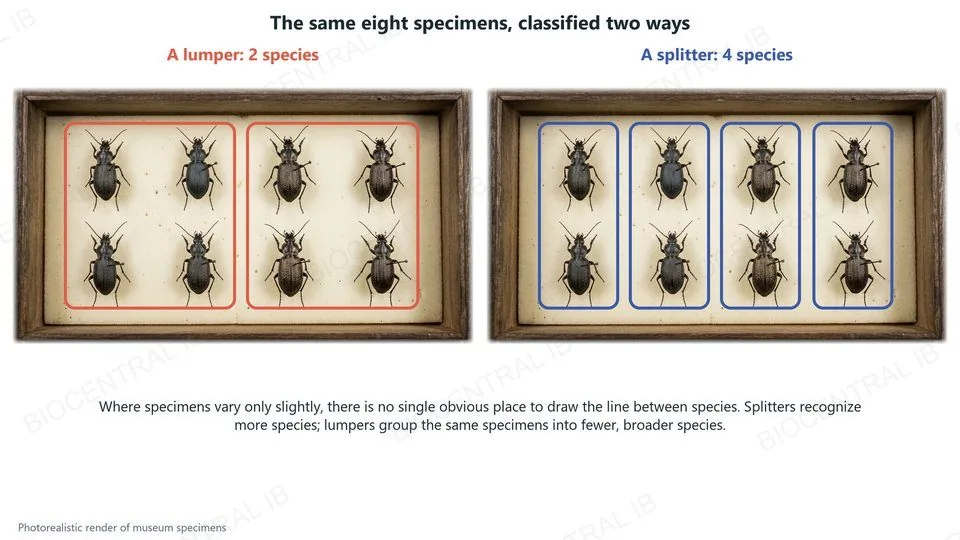
A photograph of the same museum drawer of eight similar ground beetles shown twice. A lumper groups them into 2 species, four in each; a splitter groups them into 4 species, two in each
A4.2.2 · Nature of science

Lumpers and splitters

Classification is an example of pattern recognition, but the same observations can be classified in different ways.
  • “Splitters” recognize more species in a taxonomic group; “lumpers” group the same specimens into fewer, broader species.
  • Where populations vary continuously, there is no single obvious place to draw the line between one species and two.
  • So the number of described species depends partly on the convention a taxonomist follows, not on nature alone.
Nature of scienceDisagreement here is not an error by either side: it shows that classification involves judgement as well as data.
Part two

Lost species and lost ecosystems

A4.2.3 · A4.2.4
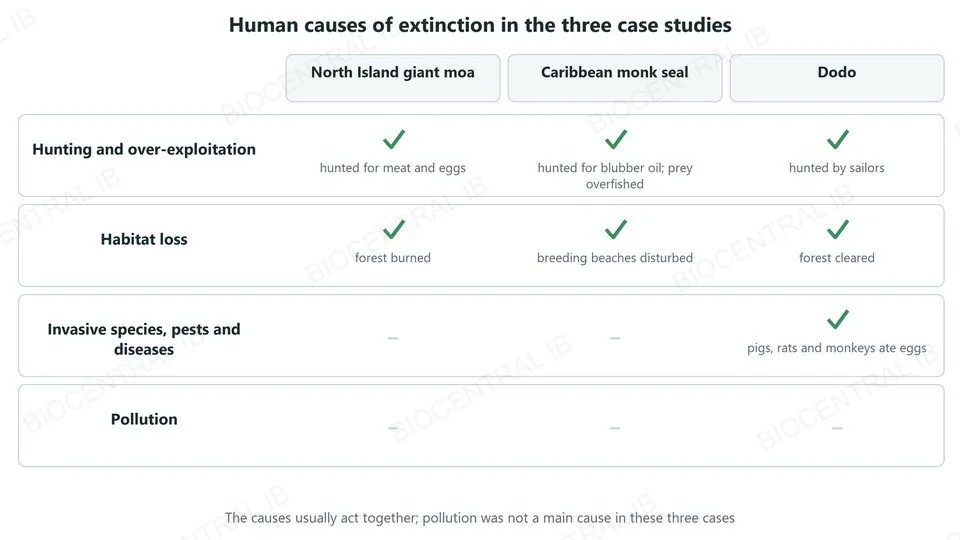
A table of human causes against the three case studies. Hunting and over-exploitation: the moa (hunted for meat and eggs), the Caribbean monk seal (hunted for blubber oil, prey overfished) and the dodo (hunted by sailors). Habitat loss: moa forest burned, seal breeding beaches disturbed, dodo forest cleared. Invasive species: only the dodo (pigs, rats and monkeys ate eggs). Pollution: none of the three
A4.2.3

How humans drive extinction

Anthropogenic extinction is extinction caused by human activity. The current sixth mass extinction is anthropogenic, unlike the earlier five.
  • Hunting and over-exploitation: taking animals or plants faster than their populations can replace them.
  • Habitat loss: deforestation, clearance of land for farming and urbanization leave species with nowhere to live.
  • Invasive species, pests and diseases moved by people, and pollution, harm species that have no defences against them.
Case studiesThe causes usually act together. The next slides show which ones drove the moa, the Caribbean monk seal and the dodo extinct.
A4.2.3

Lost megafauna: the giant moa

The giant moa shows how quickly hunting can wipe out large land animals that evolved without humans.
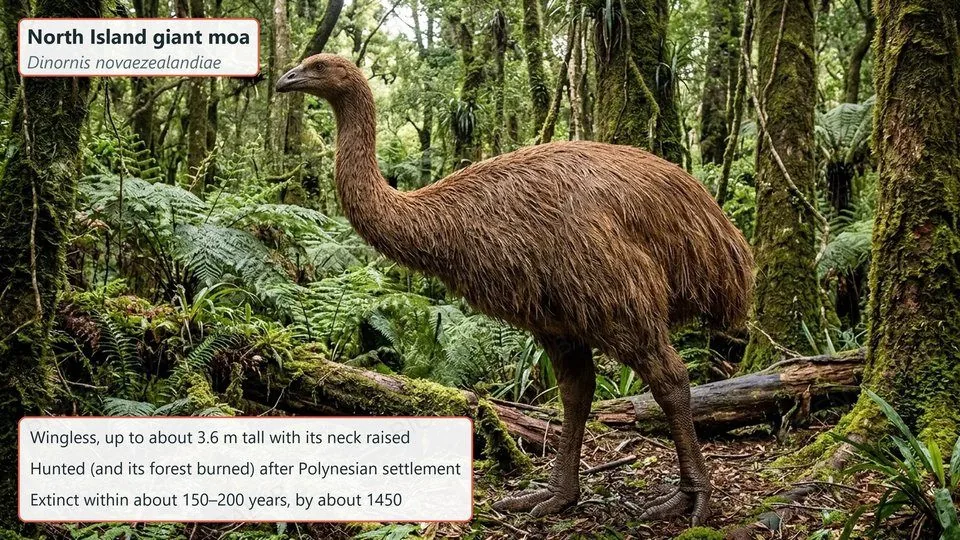
  • The North Island giant moa, Dinornis novaezealandiae, was a wingless bird up to about 3.6 m tall with its neck raised, found only in New Zealand.
  • It had evolved with no mammal predators and bred slowly, so it could not withstand hunting.
  • Polynesian settlers arrived around 1280–1300; hunting, and burning of its forest, wiped out all moa species within about 150–200 years.
The guide’s exampleThe loss of terrestrial megafauna: large land animals driven extinct by people.
A reconstruction of a North Island giant moa, Dinornis novaezealandiae, a wingless bird in a New Zealand forest. Labels: up to about 3.6 m tall with its neck raised; hunted, and its forest burned, after Polynesian settlement; extinct within about 150 to 200 years, by about 1450
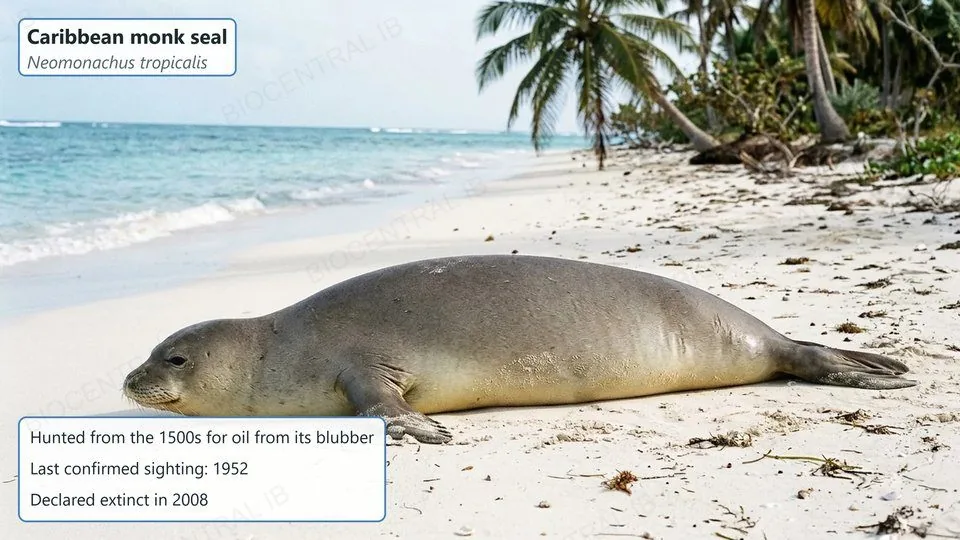
A Caribbean monk seal, Neomonachus tropicalis, on a Caribbean beach. Labels: hunted from the 1500s for oil from its blubber; last confirmed sighting 1952; declared extinct in 2008
A4.2.3

A lost marine species: the Caribbean monk seal

The Caribbean monk seal, Neomonachus tropicalis, is the guide’s example of the loss of a marine species.
  • It lived on beaches and reefs across the Caribbean and the Gulf of Mexico.
  • From the 1500s it was hunted for the oil from its blubber, and for meat and skins; seals resting in colonies on beaches were easy to kill.
  • Overfishing of its prey and disturbance of its beaches added to the decline. The last confirmed sighting was in 1952, and it was declared extinct in 2008.
Why it mattersIt is the only true seal known to have been driven extinct by humans: the oceans are no refuge from over-exploitation.
A4.2.3

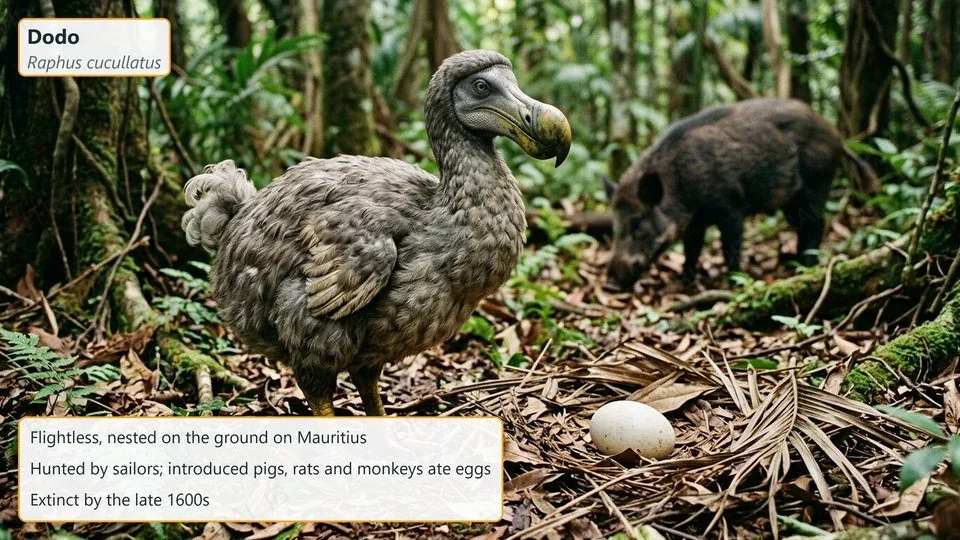
A familiar case: the dodo

The guide also asks for an extinction from an area familiar to students; the dodo is one of the best-known cases.
  • The dodo, Raphus cucullatus, was a flightless bird found only on the island of Mauritius, where it nested on the ground.
  • Sailors arriving from the late 1500s hunted it, and the pigs, rats and monkeys they brought ate its eggs and chicks.
  • With forest clearance as well, these pressures drove it extinct by the late 1600s, within a century of contact.
Your areaFind a species that has gone extinct from the area where you live, and work out which human causes were involved.
A reconstruction of a dodo, Raphus cucullatus, beside its ground nest and egg on Mauritius, with an introduced pig behind it. Labels: flightless and ground-nesting; hunted by sailors while introduced pigs, rats and monkeys ate eggs; extinct by the late 1600s
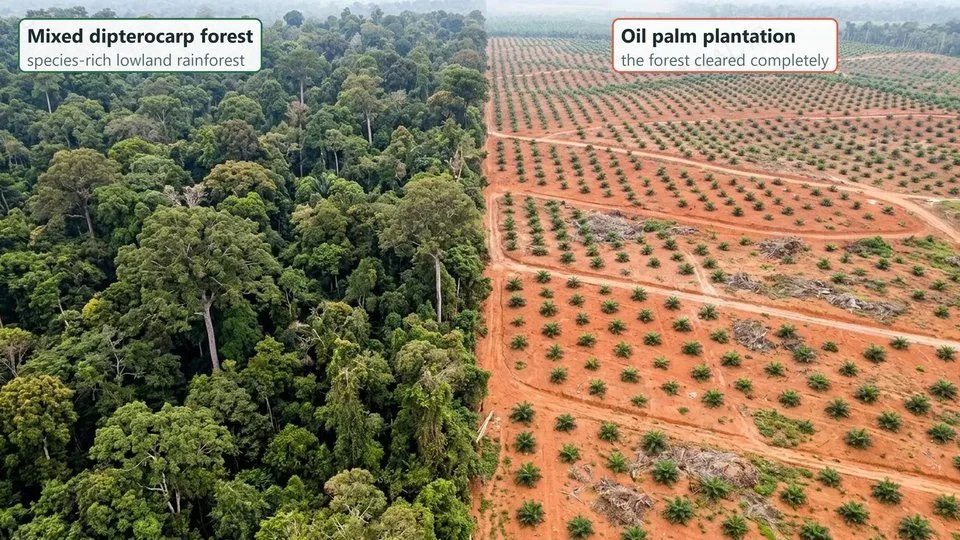
An aerial view of a sharp boundary between mixed dipterocarp rainforest on the left and an oil palm plantation on cleared red soil on the right
A4.2.4

Ecosystem loss: dipterocarp forest

An ecosystem can be lost even when its species survive elsewhere. The causes to study are directly or indirectly anthropogenic.
  • Mixed dipterocarp forest is a species-rich lowland rainforest of Southeast Asia, dominated by trees of the family Dipterocarpaceae.
  • Large areas of Borneo and Sumatra have been logged for timber and then cleared completely for oil palm plantations.
  • Dipterocarps reproduce in rare, synchronised mass-flowering events, so small isolated fragments often fail to regenerate.
Why it mattersA plantation holds a tiny fraction of the forest’s species and none of its structure.
A4.2.4

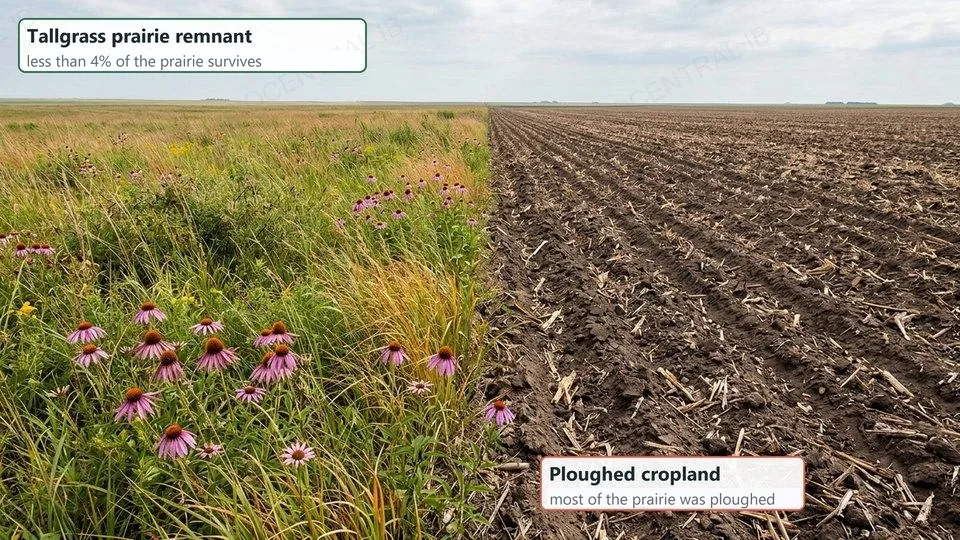
A second case: the tallgrass prairie

North America’s tallgrass prairie is one of the most complete losses of any ecosystem.
  • It once covered about 68 million hectares of the central United States and Canada, with deep-rooted grasses kept open by fire and grazing bison.
  • From the 1800s its deep, fertile soils were ploughed for wheat and maize; less than 4% survives.
  • Other ecosystems are lost to the drainage of wetlands, the damming of rivers and the fragmentation of habitat into small patches.
Your areaThe guide asks for a lost ecosystem from an area familiar to you, if possible: look for one near where you live.
Tallgrass prairie with grasses and purple coneflowers meeting a ploughed field; less than 4% of the prairie survives
Quick check

Less than 4% of the tallgrass prairie survives, yet most of its plant species still exist in small remnants. What has been lost?

Most of its plant species, which are now extinct
The ecosystem: the connected grassland and its interactions
Nothing, because the species still survive somewhere
Only its soil, which was moved to the cropland
Correct answer: the ecosystem. Ecosystem loss removes the interactions between species and their environment, such as grazing and fire, even if the species survive elsewhere.
Part three

The evidence and the causes

A4.2.5 · A4.2.6
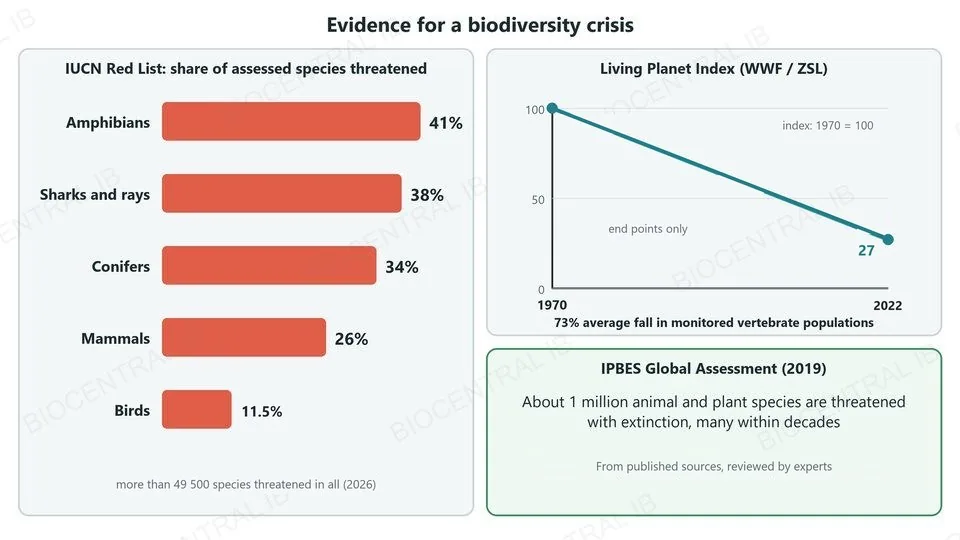
Evidence for a biodiversity crisis: IUCN Red List shares of assessed species threatened, amphibians 41%, sharks and rays 38%, conifers 34%, mammals 26%, birds 11.5%, more than 49 500 species in all; the Living Planet Index fell from 100 in 1970 to 27 in 2022, a 73% average fall; IPBES 2019 estimated about 1 million species threatened with extinction
A4.2.5

Evidence for a crisis

The evidence comes from reliable surveys of biodiversity in a wide range of habitats around the world.
  • IPBES (the Intergovernmental Science-Policy Platform on Biodiversity and Ecosystem Services) brings together the findings of thousands of studies worldwide in global assessment reports. Its 2019 report estimated that about 1 million animal and plant species are threatened with extinction.
  • The IUCN Red List lists more than 49 500 threatened species, including 41% of assessed amphibians and 26% of mammals.
  • The Living Planet Index shows a 73% average fall in monitored vertebrate populations between 1970 and 2022.
Nature of scienceTo be verifiable, evidence usually has to come from a published, peer-reviewed source that allows its methods to be checked.
A4.2.5

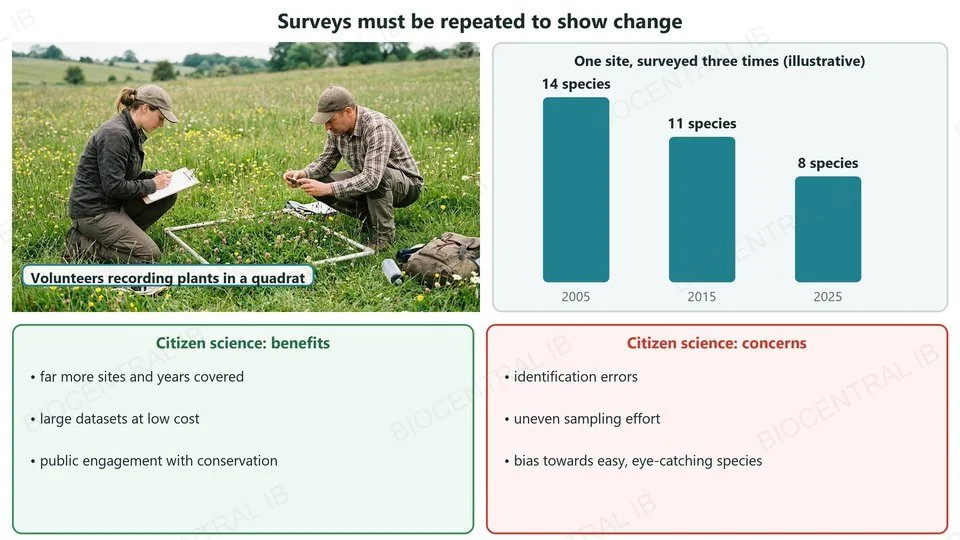
Repeated surveys and citizen science

Surveys need to be repeated to provide evidence of change in species richness and evenness.
  • One survey is a snapshot: only repeats at the same sites, using the same methods, can show a trend. Simpson's reciprocal index (data booklet) turns richness and evenness into one number to compare.
  • Both expert scientists and citizen scientists contribute: volunteers record birds, insects and plants in far more places and years than professionals could.
  • Citizen data bring their own concerns: identification errors, uneven effort, and bias towards easy or eye-catching species.
Nature of scienceData recorded by citizens bring benefits but also unique methodological concerns.
Volunteers recording plants in a quadrat, and a bar chart of one site surveyed three times: 14 species in 2005, 11 in 2015 and 8 in 2025 (illustrative). Benefits of citizen science: more sites and years, large datasets, public engagement. Concerns: identification errors, uneven effort, bias towards eye-catching species
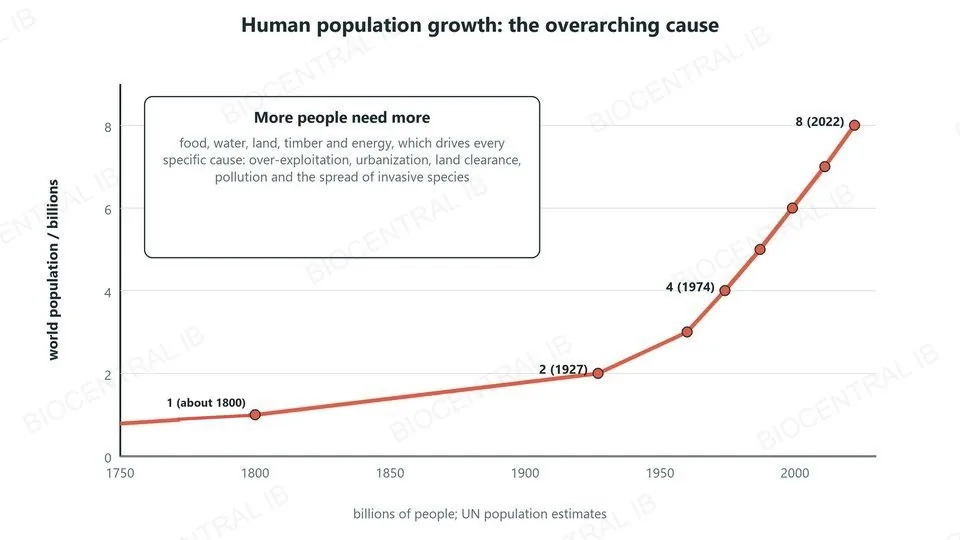
A graph of world population: 1 billion in about 1800, 2 billion in 1927, 4 billion in 1974 and 8 billion in 2022. More people need more food, water, land, timber and energy, which drives every specific cause
A4.2.6

The overarching cause: population growth

Human population growth is the overarching cause of the current biodiversity crisis.
  • The world population passed 1 billion around 1800, 2 billion in 1927, 4 billion in 1974 and 8 billion in 2022.
  • More people need more food, water, land, timber and energy, and consumption per person has risen too.
  • This demand drives each of the specific causes on the next slide.
Why it mattersProtecting a reserve cannot succeed on its own while the demand for land keeps growing around it.
A4.2.6

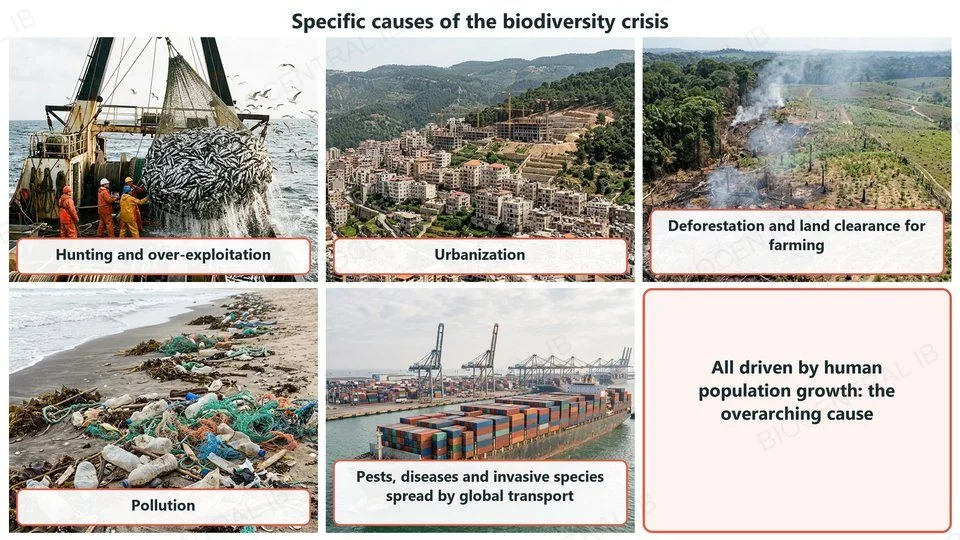
The specific causes

Alongside population growth, the guide lists these specific causes.
  • Hunting and other forms of over-exploitation, such as overfishing.
  • Urbanization, and deforestation and clearance of land for agriculture, with the loss of natural habitat that follows.
  • Pollution, and the spread of pests, diseases and invasive alien species by global transport. Chytrid fungus, carried by the trade in amphibians, has been linked to the decline of hundreds of amphibian species.
RememberThe causes act together: a population already reduced by habitat loss is far more easily finished off by hunting or disease.
Five photographs of the specific causes: a trawler hauling a full net (hunting and over-exploitation), a city spreading up wooded hills (urbanization), freshly burned forest turned to fields (deforestation and land clearance for farming), plastic waste on a beach (pollution), and a container ship (pests, diseases and invasive species spread by global transport). A panel says all are driven by human population growth
Part four

Conservation

A4.2.7 · A4.2.8
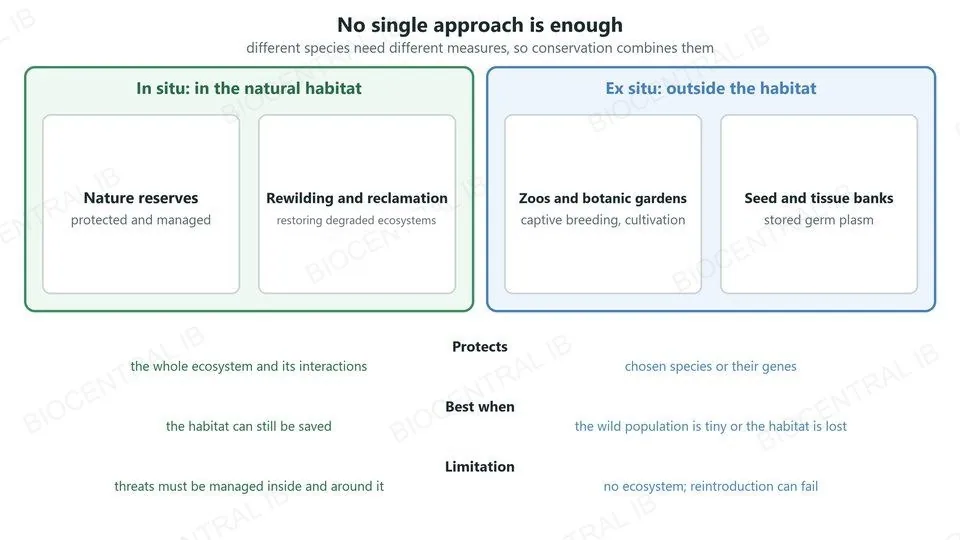
In situ approaches, nature reserves and rewilding or reclamation, and ex situ approaches, zoos and botanic gardens and seed and tissue banks. In situ protects the whole ecosystem while the habitat can be saved; ex situ protects chosen species or genes when the wild population is tiny or the habitat is lost
A4.2.7

Several approaches are needed

No single approach is sufficient by itself, and different species require different measures.
  • In situ conservation protects species in their natural habitats, along with the interactions and evolution of the whole community.
  • Ex situ conservation, in zoos, botanic gardens and seed or tissue banks, protects species or their genes away from the wild.
  • Many programmes combine them: captive-bred animals are released into protected, restored habitat.
Why it mattersA species whose habitat has gone needs ex situ help; a species in an intact habitat needs that habitat defended.
A4.2.7

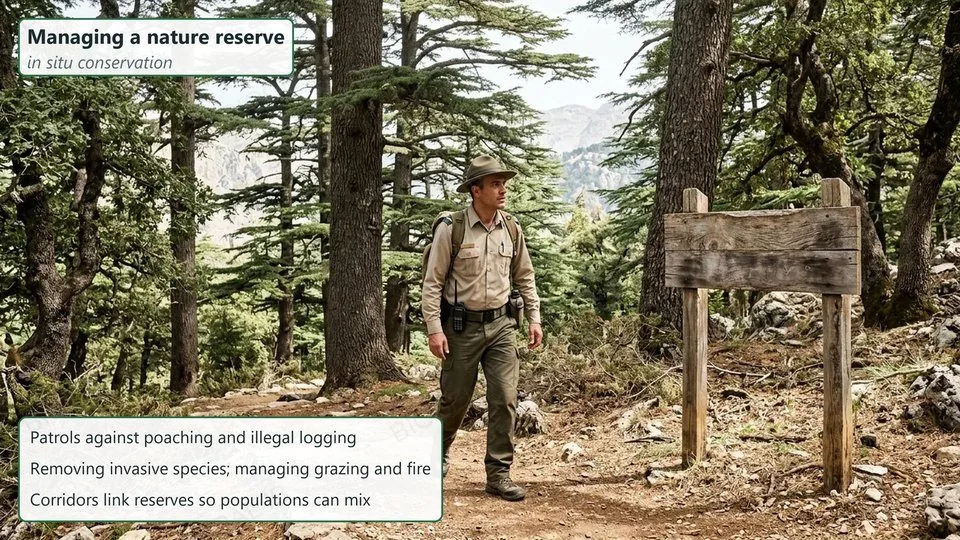
In situ: managing nature reserves

A nature reserve protects biodiversity only if it is actively managed.
  • Rangers patrol against poaching and illegal logging.
  • Invasive species are removed, and grazing, fire and visitors are managed to keep habitats in good condition.
  • Corridors of habitat link reserves, so populations are not isolated and can still interbreed.
Watch outProtection on paper is not protection in practice: a reserve can still lose species to threats inside and around it.
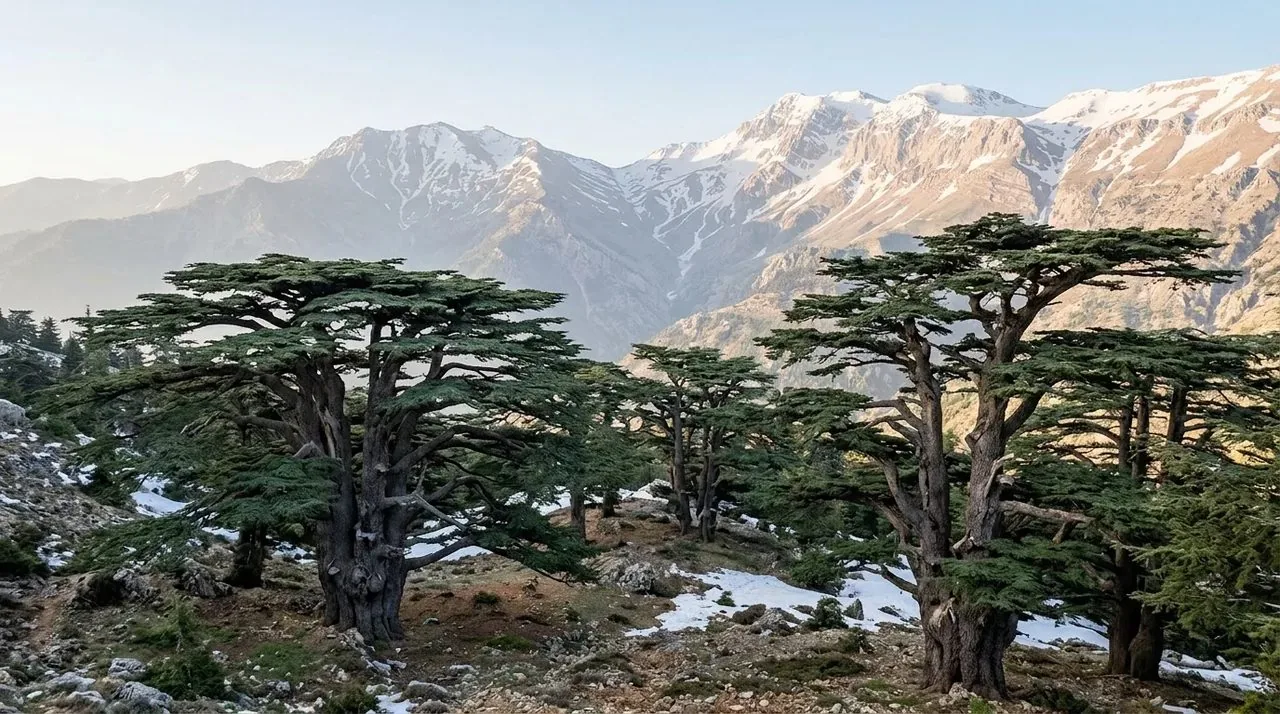
A ranger walking through a protected cedar and oak forest. Labels: patrols against poaching and illegal logging; removing invasive species and managing grazing and fire; corridors link reserves
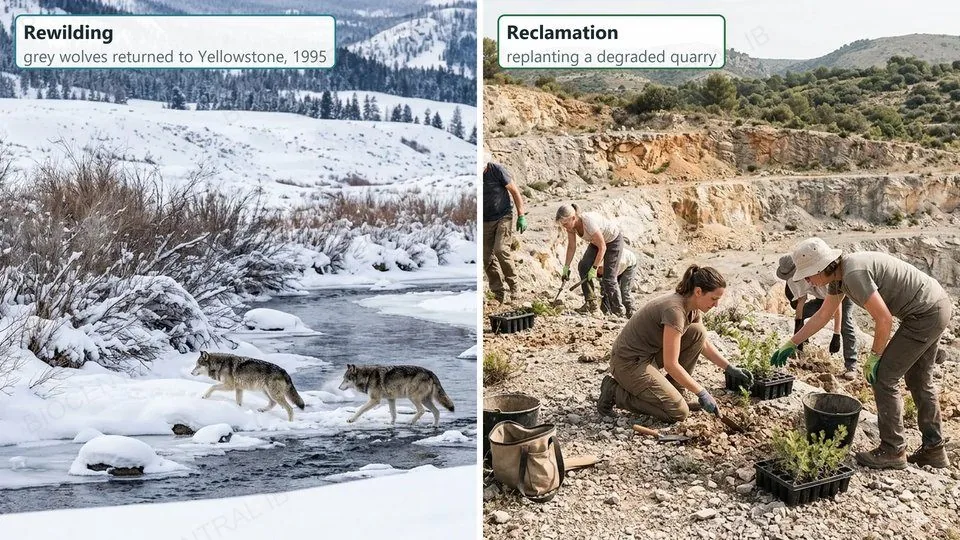
Two grey wolves crossing a snowy Yellowstone river valley (rewilding), and volunteers replanting an old quarry (reclamation)
A4.2.7

Rewilding and reclamation

Rewilding and the reclamation of degraded ecosystems restore what has been lost, rather than only protecting what remains.
  • Rewilding reintroduces missing species, often top predators or large herbivores, and lets natural processes resume.
  • Grey wolves were returned to Yellowstone National Park in 1995; studies suggest that changes in elk grazing then let some riverside willows and aspens recover.
  • Reclamation rebuilds degraded land: replanting old quarries and mines, restoring drained wetlands, or rebuilding soil on worn-out farmland.
Why it mattersStopping the damage is not always enough: a degraded ecosystem may need active help to recover.
A4.2.7

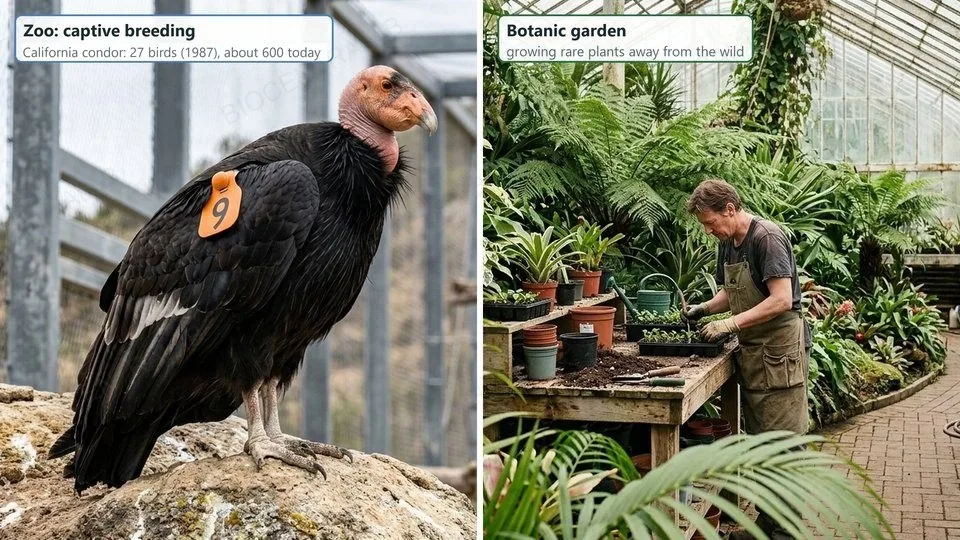
Ex situ: zoos and botanic gardens

Ex situ conservation protects species outside their natural habitat.
  • Zoos run captive-breeding programmes: the California condor fell to 27 birds in 1987, and captive breeding has rebuilt it to about 600, most now living in the wild.
  • Botanic gardens grow rare plants and keep seed collections, sometimes of species that are extinct in the wild.
  • Captive populations are small, so their genetic diversity must be managed, and releases work only if the original threat has been removed.
LimitationEx situ conservation saves species, not ecosystems.
A California condor with a wing tag in a captive-breeding aviary, and a gardener tending rare plants in a botanic garden glasshouse
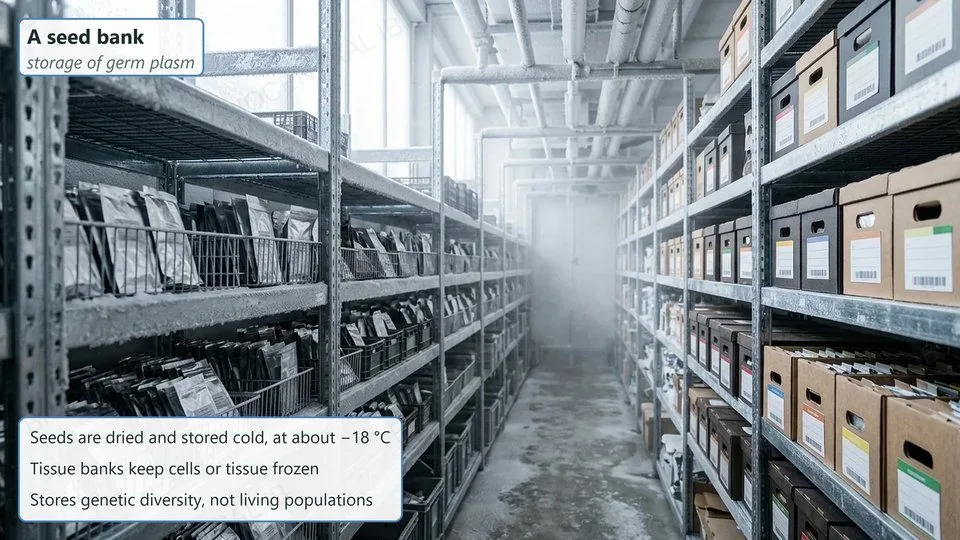
Shelves of sealed seed packets in a cold seed bank. Labels: seeds dried and stored at about −18 °C; tissue banks keep cells or tissue frozen; stores genetic diversity, not living populations
A4.2.7

Storing germ plasm

Seed and tissue banks store germ plasm: seeds, tissue or cells from which organisms can be grown again.
  • Seeds are dried and stored at about −18 °C, where many stay viable for decades or longer; tissue banks keep cells or tissue frozen.
  • The Svalbard Global Seed Vault, in the Arctic, holds duplicate seed samples of crop varieties from around the world.
  • Banks are cheap compared with keeping living populations, but they store genetic diversity, not living, evolving populations.
Why it mattersA seed bank is insurance for when a species, or a crop variety, is lost everywhere else.
A4.2.8

Choosing priorities: EDGE

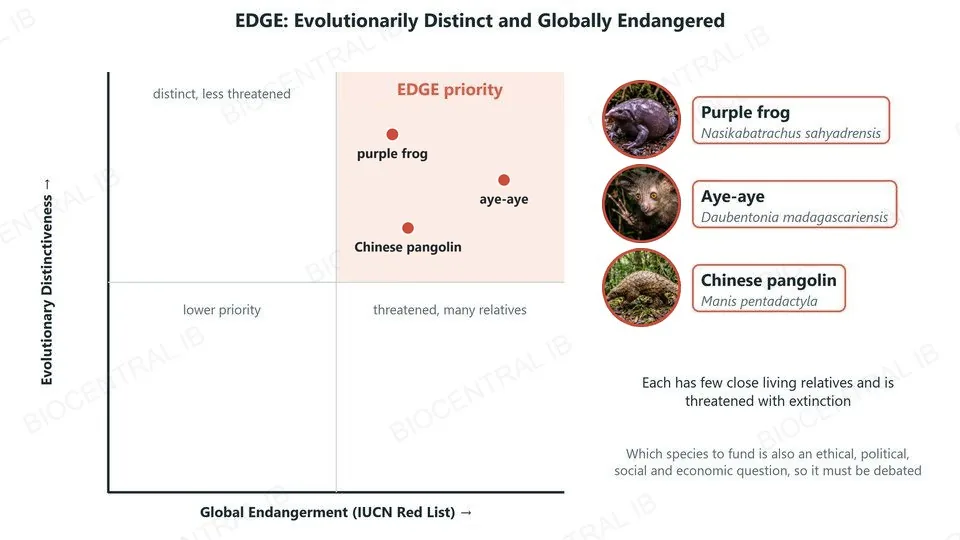
The EDGE of Existence programme (Zoological Society of London) focuses effort on species that are evolutionarily distinct and globally endangered.
  • Evolutionary distinctiveness is high for species with few close living relatives, whose lineage split off long ago.
  • Global endangerment comes from the species’ IUCN Red List category.
  • Losing a distinct species such as the purple frog, the aye-aye or the Chinese pangolin would remove a whole branch of the tree of life, not a twig.
Nature of scienceWhich species to prioritise has ethical, environmental, political, social, cultural and economic implications, so it needs to be debated.
A grid of evolutionary distinctiveness against global endangerment. The high-high corner is EDGE priority and holds the purple frog, the aye-aye and the Chinese pangolin, each with few close living relatives and threatened with extinction
Quick check

Two equally endangered species compete for limited funding. Species X has many close relatives; species Y is the last survivor of an ancient lineage. Which would EDGE favour?

X, because it has more relatives to protect
Y, because losing it removes more evolutionary history
X, because common lineages are easier to save
Neither: EDGE counts only how endangered a species is
Correct answer: Y. EDGE combines evolutionary distinctiveness with endangerment. With equal threat, the more distinct species scores higher, because its loss would erase more unique evolutionary history.

Key vocabulary

Worth being able to define in a single sentence each

Biodiversity
the variety of life in all its forms, levels and combinations.
Species richness
the number of species in a community.
Species evenness
how evenly individuals are shared between the species.
Genetic diversity
the range of alleles in a species’ gene pool.
Anthropogenic
caused by human activity.
Mass extinction
the loss of a large share of species in a geologically short time.
In situ conservation
protecting species in their natural habitat.
Ex situ conservation
protecting species outside it: zoos, gardens, banks.
Germ plasm
seeds, tissue or cells from which organisms can be regrown.
EDGE species
evolutionarily distinct and globally endangered.

Where this shows up again

C4.1 / D4.2 · Populations / Stability
How do the interactions and stability of an ecosystem depend on its biodiversity?
D4.3 · Climate change
How could climate change alter species distributions and add to the current biodiversity crisis?
D4.1 / A4.1 · Natural selection / Evolution
How does natural selection depend on the genetic diversity within a species?
A3.1 / A3.2 · Diversity / Classification
How does the classification of species help conservationists identify and prioritise biodiversity?

A4.2 Conservation of biodiversity — one-page recap

Screenshot this slide to revise from

Biodiversity
  • Ecosystem, species (richness, evenness) and genetic levels.
  • More species alive today than ever; ~2.2 million described.
Extinctions
  • Moa (megafauna), Caribbean monk seal (marine), dodo.
  • Sixth mass extinction: tens to about 1000× background rate.
Ecosystem loss
  • Dipterocarp forest → oil palm; tallgrass prairie → cropland.
  • Causes are directly or indirectly anthropogenic.
Evidence
  • IPBES, IUCN Red List, Living Planet Index (−73% since 1970).
  • Repeated, peer-reviewed surveys; citizen science helps but has concerns.
Causes
  • Overarching: human population growth.
  • Over-exploitation, urbanization, land clearance, pollution, pests and invasive species.
Conservation
  • In situ (reserves, rewilding) + ex situ (zoos, gardens, seed banks).
  • EDGE prioritises distinct, endangered species; priorities are debated.
Next step

Now test yourself on A4.2

Reading the slides is half the job. The other half is answering questions the way the exam asks them.

32 quiz questions6 data questions5 exam questionsmarkschemes included

Unlock every lesson with Pro — quizzes, data questions and exam papers. Two lessons are completely free to try: A1.1 Water and B1.1 Carbohydrates and lipids.

One-page summary, key terms and sample questions for A4.2 →

The sixth extinction is not inevitable.

Every level of biodiversity protected today is a branch of the tree of life kept.
A4.2 Conservation of biodiversity · BioCentral IB
Use ↓ ↑ or click to navigate
01 / 20