BioCentral IBBioCentral IB
IB Biology · Theme A · A2.3 · HL only

Viruses

A whole topic outside the SL course — small, borrowed, and everywhere
Guiding questions

How can viruses exist with so few genes?

In what ways do viruses vary?

Part one

What every virus has — and how they vary

A2.3.1 · A2.3.2
A2.3.1

What every virus shares

Relatively few features are shared by all viruses.
  • A small, fixed size: each kind of virus has its own size, usually tens to a few hundred nanometres.
  • Nucleic acid as genetic material: DNA or RNA.
  • A capsid: a coat made of protein.
  • No cytoplasm, and few or no enzymes (HIV carries reverse transcriptase).
Why so few genes?A virus borrows almost everything from its host cell: ribosomes, energy, raw materials and most enzymes.
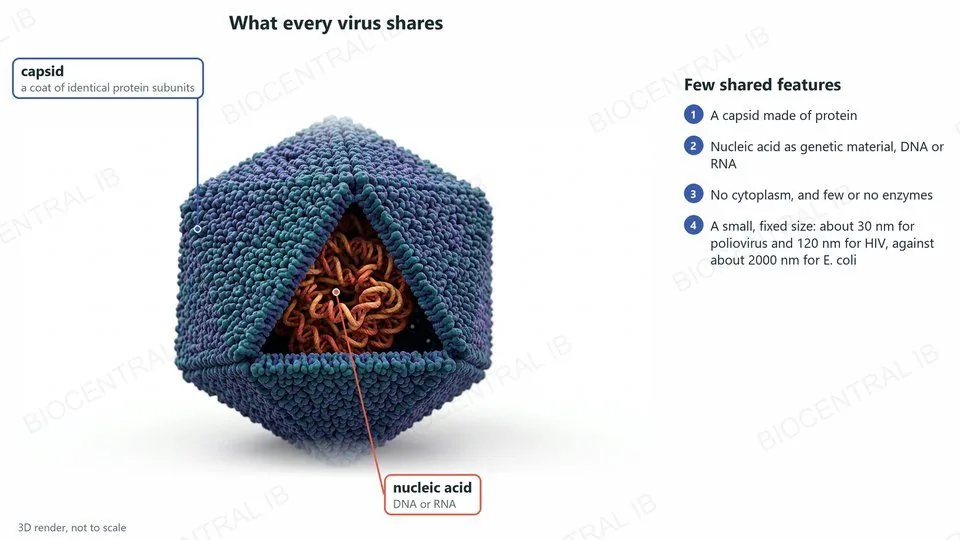
A 3D render of a virus particle with part of its angular icosahedral capsid cut away. The capsid is a coat of identical protein subunits, and inside it a coiled strand of nucleic acid, DNA or RNA, is packed tightly. Every virus has a protein capsid and nucleic acid, no cytoplasm and few or no enzymes, and a small fixed size: about 30 nm for poliovirus and 120 nm for HIV, against about 2000 nm for E. coli
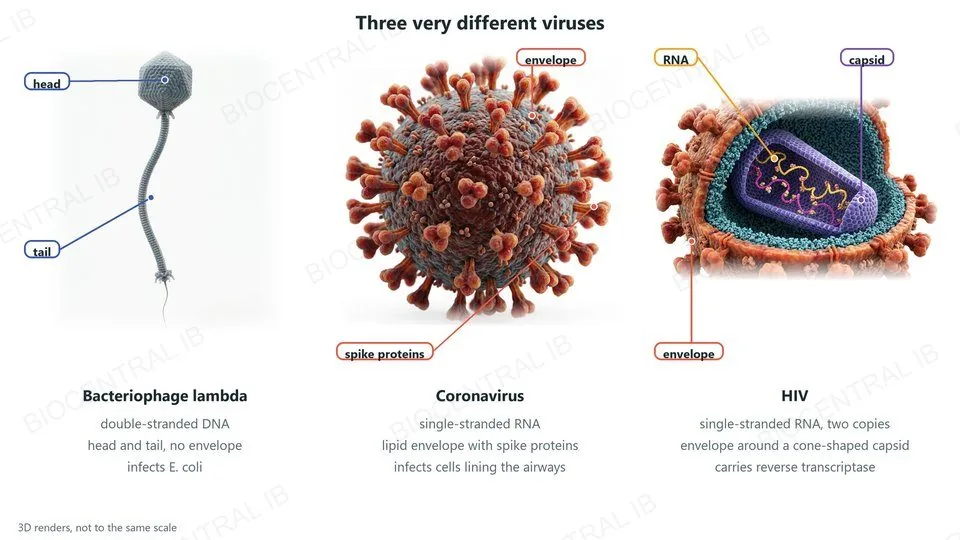
Three 3D renders of viruses, not to the same scale. Bacteriophage lambda: a head and a tail, double-stranded DNA, no envelope, infects E. coli. Coronavirus: a lipid envelope covered in spike proteins, single-stranded RNA, infects cells lining the airways. HIV, cut open: an envelope around a cone-shaped capsid holding two copies of single-stranded RNA, and it carries reverse transcriptase
A2.3.2

Viruses are highly diverse

  • Genetic material may be DNA or RNA, either single- or double-stranded.
  • Some viruses are enveloped in host cell membrane, with viral spike proteins in it; others are not enveloped.
  • Lambda: double-stranded DNA, a head and tail, no envelope. Coronaviruses: single-stranded RNA, enveloped. HIV: single-stranded RNA, enveloped, with reverse transcriptase.
Why it mattersThe envelope comes from the host’s membrane as the virus leaves a cell: one more thing a virus borrows.
A2.3.2

Shape, and a molecular lock and key

  • Capsids vary in shape: helical, icosahedral, or the head and tail of phages such as lambda.
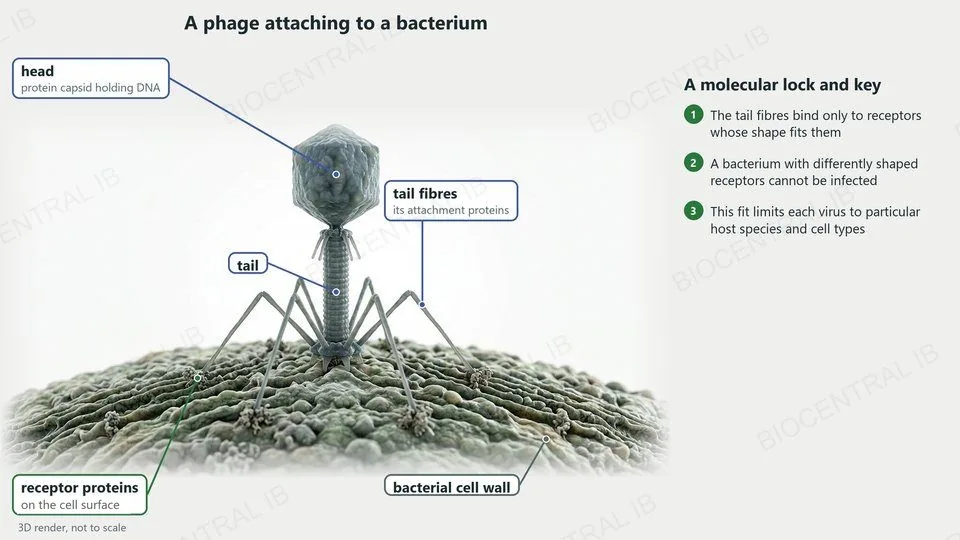
  • A virus can only attach to cells whose surface receptors fit its attachment proteins: spikes, or tail fibres in a phage.
  • This molecular fit limits each virus to particular host species and cell types.
Why it mattersA virus that infects bacteria cannot infect a human cell, and vice versa: the receptors do not match.
A 3D render of a phage standing on the surface of a bacterium. Labels: the head, a protein capsid holding DNA; the tail; the tail fibres, its attachment proteins, bound to receptor proteins on the bacterial surface. The tail fibres bind only to receptors whose shape fits them, so a bacterium with differently shaped receptors cannot be infected
Quick check

A virus's spike proteins only fit receptors on certain host cells. What does this explain?

Why viruses are smaller than cells
A virus's host specificity
Why viruses have DNA or RNA but not both
Why some viruses have an envelope
Correct answer: host specificity. Attachment proteins — spikes, or tail fibres in a phage — must match a host cell's surface receptors like a lock and key. This molecular fit, not body size, restricts a virus to particular host species and cell types.
Part two

Two ways to replicate

A2.3.3 · A2.3.4
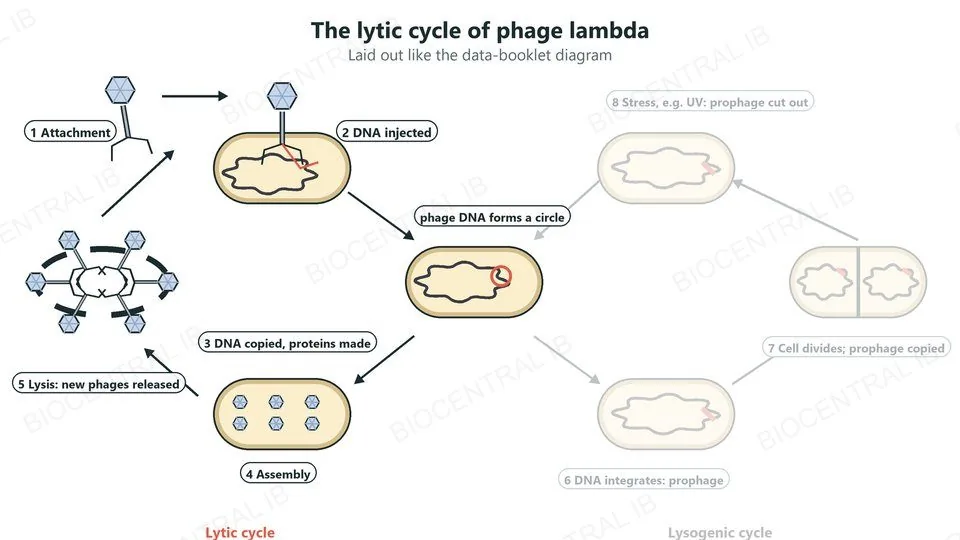
The data-booklet lytic and lysogenic cycle diagram with the lytic cycle highlighted: 1 a phage attaches to a bacterium, 2 injects its DNA, which forms a circle in the cell, 3 the DNA is copied and phage proteins are made, 4 new phages are assembled, 5 the cell bursts (lysis), releasing new phages
A2.3.3

The lytic cycle of phage lambda

Viruses rely on a host cell for energy, nutrition, protein synthesis and other life functions.
  • Lambda infects E. coli. Its tail fibres attach to receptors, and it injects its DNA, which forms a circle.
  • The host’s enzymes, nucleotides, ribosomes and ATP copy the phage DNA and make phage proteins.
  • New phages are assembled; phage enzymes then break the cell wall, so the cell bursts (lysis), releasing about 100 phages.
Data bookletThe cycle diagram is in the data booklet. This version adds stage labels.
A2.3.4

The lysogenic cycle: a quieter route

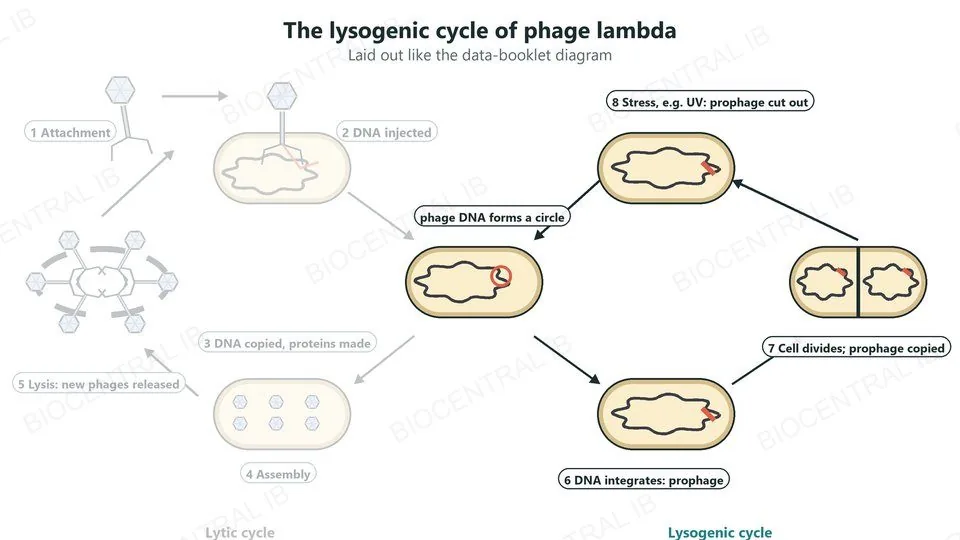
Instead of replicating at once, lambda’s DNA can integrate into the host chromosome, becoming a prophage.
  • The prophage makes no new phages. Each time the bacterium divides, the prophage is copied with the chromosome.
  • Stress that damages the host’s DNA, such as UV radiation, can cause the prophage to be cut out, and the lytic cycle begins.
Data bookletBoth cycles share the first steps: attachment and injection. Then the phage DNA either replicates (lytic) or integrates (lysogenic).
The data-booklet lytic and lysogenic cycle diagram with the lysogenic cycle highlighted: 6 the phage DNA integrates into the bacterial chromosome as a prophage, 7 the cell divides and the prophage is copied into both cells, 8 stress such as UV radiation causes the prophage to be cut out, and the cell enters the lytic cycle
Part three

Where viruses come from, and where they're going

A2.3.5 · A2.3.6
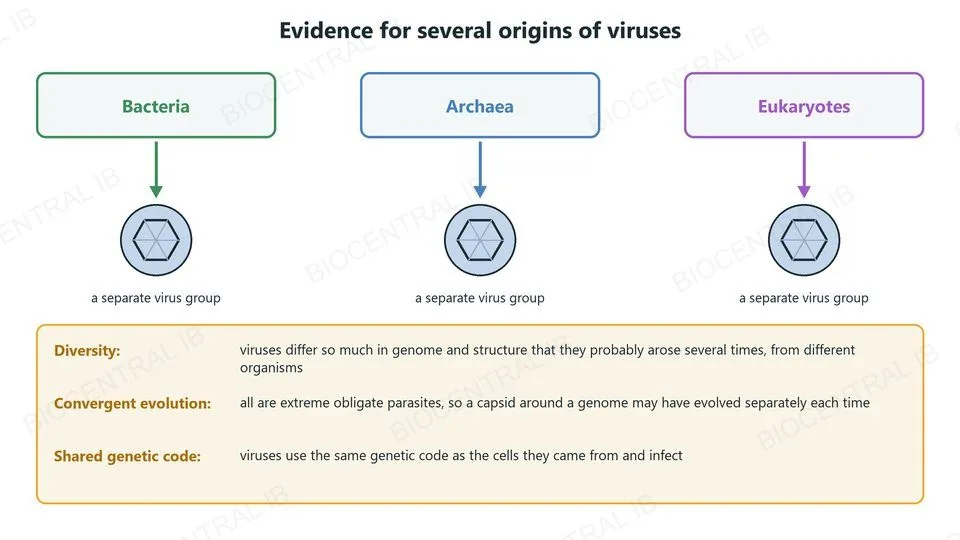
Bacteria, Archaea and Eukaryotes each give rise to a separate group of viruses. Evidence: diversity, viruses differ so much that they probably arose several times from different organisms; convergent evolution, all are extreme obligate parasites so a capsid around a genome may have evolved separately each time; a shared genetic code with the cells they came from and infect
A2.3.5

Several origins from other organisms

Viruses can only replicate inside cells, so most biologists think they evolved from cellular organisms.
  • Diversity: viruses differ so much that they probably arose several times, from different organisms.
  • Convergent evolution: all are extreme obligate parasites, so the features they share, such as a capsid, may have evolved separately in each lineage.
  • Shared genetic code: viruses use the same genetic code as living organisms.
Why it mattersSimilar features do not have to mean a common ancestor: the same way of life can produce the same solution more than once.
A2.3.5 continued

Two competing hypotheses

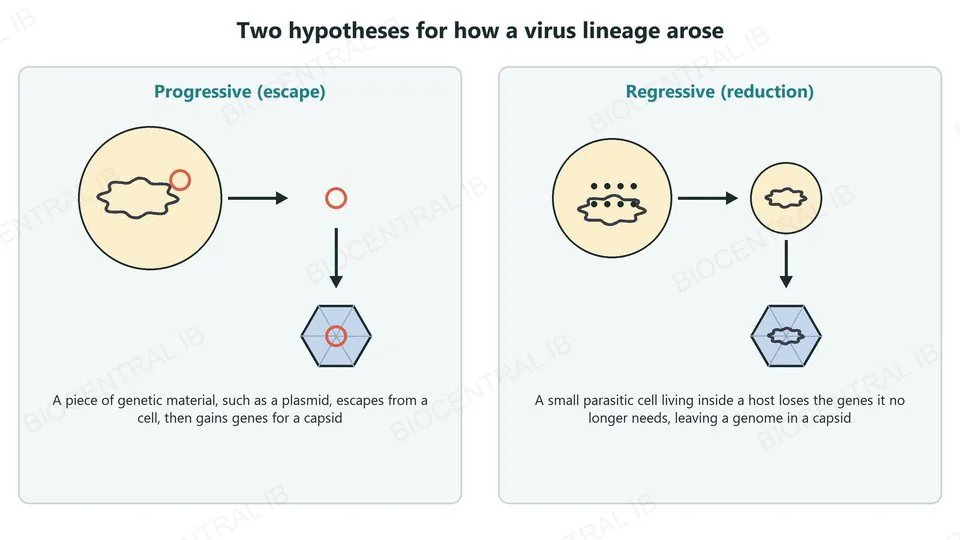
Two hypotheses attempt to explain how any individual viral lineage arose from cellular life, and both remain under active discussion.
  • The progressive (escape) hypothesis proposes viruses arose from small mobile genetic elements — plasmids or transposons — that escaped from cells and gradually acquired a protective capsid; some viral genes closely resemble host genes.
  • The regressive (reduction) hypothesis proposes viruses arose from small, free-living parasitic cells that progressively lost genes once fully dependent on a host, ending as a stripped-down genome plus capsid.
Why it mattersNeither hypothesis is settled — and different viral lineages may even have arisen by different routes.
Two hypotheses. Progressive (escape): a piece of genetic material such as a plasmid escapes from a cell, then gains genes for a capsid. Regressive (reduction): a small parasitic cell inside a host loses the genes it no longer needs, leaving a genome in a capsid
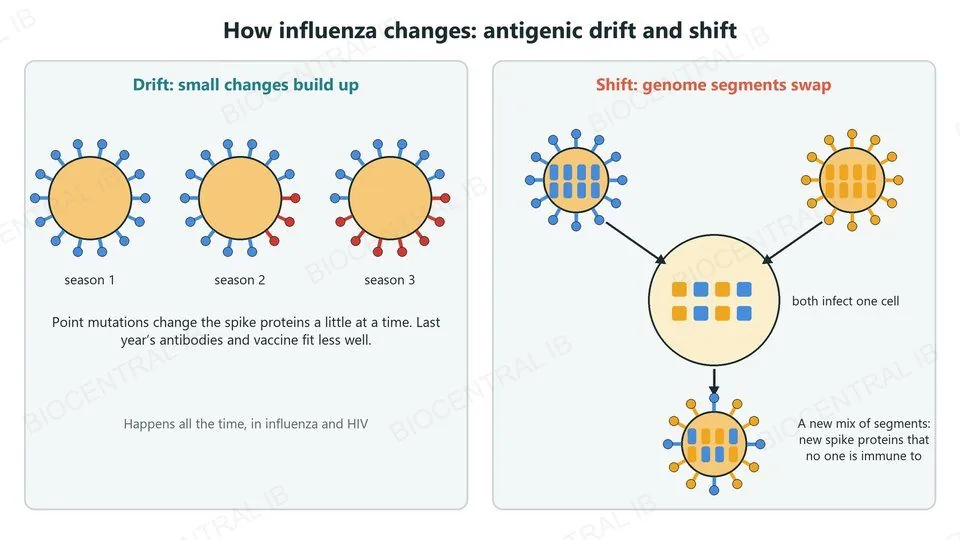
Left, antigenic drift: across three seasons, more and more of an influenza virus’s spike proteins change colour as point mutations build up, so last year’s antibodies and vaccine fit less well. Right, antigenic shift: two different influenza strains infect one cell, and their eight genome segments mix, producing a new virus with new spike proteins that no one is immune to
A2.3.6

Why some viruses evolve fast

  • High mutation rates: RNA polymerases and HIV’s reverse transcriptase make many errors and mostly lack proofreading.
  • Short generation times and huge numbers of virus particles give many chances for new variants.
  • Influenza: antigenic drift (gradual point mutations) and antigenic shift (two strains swap genome segments in one cell).
  • HIV changes so fast that many variants arise within one patient.
ConsequenceFlu vaccines must be updated every year, and there is still no vaccine against HIV.
A2.3.6

Why HIV needs several drugs at once

  • A mutant that resists a drug, or escapes immunity, is favoured by natural selection and spreads.
  • Resistant variants arise by chance before any drug is given; the drug selects them, it does not cause them.
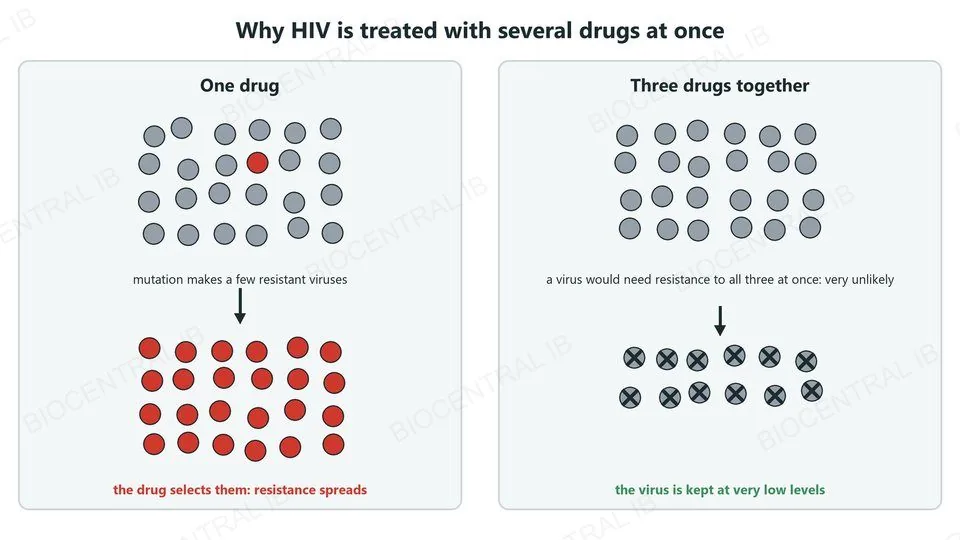
  • So HIV is treated with a combination of drugs: a virus resistant to all of them at once is very unlikely to arise.
Why it mattersRapidly evolving viruses force treatments to change: new vaccines, new drugs and combinations.
Left, one drug: a population of viruses contains a rare resistant mutant; the drug kills the rest and the resistant ones multiply. Right, three drugs together: a virus would need resistance to all three at once, which is very unlikely, so the virus is kept at very low levels
Quick check

Why does combination drug therapy work better than a single drug against HIV?

It kills the virus faster
A mutant resistant to every drug at once is far less likely to arise by chance
It boosts the immune system directly
It slows down RNA replication errors
Correct answer: a mutant resistant to every drug at once is far rarer. It would need multiple independent resistance mutations simultaneously, which is far less likely than a single mutation resisting one drug. This is why combination therapy suppresses resistance far more effectively than any single drug.

Key vocabulary — viruses

HL only — worth being able to define in a single sentence each

Capsid
The protein coat, built from repeating subunits, that encloses a virus's genome.
Envelope
An extra lipid layer, derived from host membrane, surrounding the capsid in some viruses.
Bacteriophage
A virus that infects bacteria, often with a head-and-tail structure.
Lytic cycle
The pathway in which a virus immediately replicates inside the host and lyses it.
Lysogenic cycle
The pathway in which a viral genome integrates as a prophage, replicated passively.
Prophage
A viral genome integrated into, and replicated as part of, the host chromosome.
Antigenic drift
The gradual accumulation of point mutations in viral surface proteins over time.
Antigenic shift
An abrupt change in viral surface proteins from segment reassortment between two strains.

Where this shows up again

A1.2 · Nucleic acids
How does a virus that uses RNA as its genetic material differ from the DNA found in cellular organisms?
A2.2 · Cell structure
In what ways do viruses challenge the idea that all living organisms are made of cells?
C3.2 · Defence against disease
How does the body's immune system respond to and defend against viral infection?
A4.1 · Evolution and speciation / D4.1 · Natural selection
How does natural selection acting on mutations account for the rapid evolution of viruses such as influenza and HIV?

A2.3 Viruses — one-page recap

Screenshot this slide to revise from

What every virus has
  • Small fixed size; DNA or RNA; a protein capsid.
  • No cytoplasm; few or no enzymes.
Diversity
  • DNA or RNA, never both; enveloped or not; helical, icosahedral, or head-tail.
  • Host specificity: attachment proteins must fit host receptors.
Lytic cycle
  • Attachment → injection → replication → assembly → lysis.
  • Ends with the host cell bursting, releasing new phages.
Lysogenic cycle
  • Genome integrates as a prophage, copied passively with the host.
  • Stress can trigger excision and a switch to lytic.
Origins
  • Several origins: diversity, convergent evolution and a shared genetic code are the evidence.
  • Progressive (escape) vs regressive (reduction) hypotheses.
Rapid evolution
  • Drift = gradual point mutations; shift = abrupt segment reassortment.
  • Combination therapy resists chance mutation better than a single drug.
Next step

Now test yourself on A2.3

Reading the slides is half the job. The other half is answering questions the way the exam asks them.

22 quiz questions6 data questions5 exam questionsmarkschemes included

Unlock every lesson with Pro — quizzes, data questions and exam papers. Two lessons are completely free to try: A1.1 Water and B1.1 Carbohydrates and lipids.

One-page summary, key terms and sample questions for A2.3 →

Small enough to borrow everything else.

Next: how the immune system fights back.
A2.3 Viruses · BioCentral IB
Use ↓ ↑ or click to navigate
01 / 20